The financial veil surrounding a controversial aircraft acquisition by Sri Lanka’s national carrier has been decisively lifted, revealing a costly leasing arrangement that has ignited debate over transparency, governance, and the use of public funds. After months of resistance and a prolonged legal battle, the Right to Information Commission ordered the disclosure of key details relating to an Airbus A330-200 aircraft, exposing an agreement that will cost the airline more than $26 million over eight years.
The aircraft in question, identified as 4R-ALT, was not purchased outright as some had speculated but secured under an operating lease agreement spanning from June 2025 to June 2033. According to the newly disclosed figures, SriLankan Airlines is obligated to pay a monthly installment of $275,000, amounting to an annual cost of $3.3 million. By the end of the lease period, the total financial commitment reaches $26,675,000 for a single aircraft that was manufactured in 2011, raising immediate concerns about value for money.
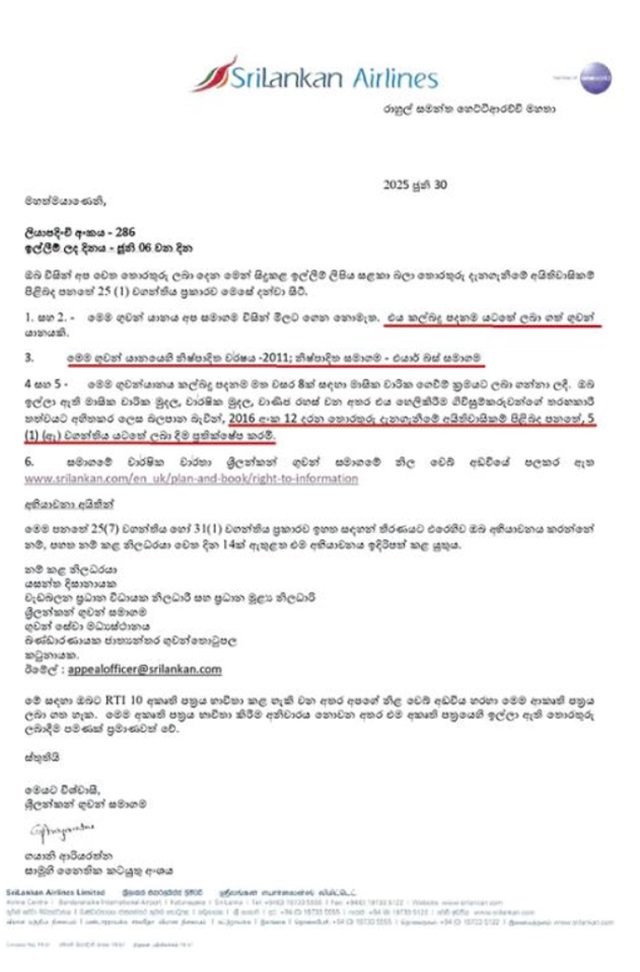
The disclosure follows an intense nine-month struggle initiated by an information request submitted on June 6, 2025. The request sought clarity on several aspects of the transaction, including the total cost, acquisition details, and lease structure. While partial information was initially released, critical financial details—specifically the lease installments—were withheld by the airline under the justification of protecting “commercial interests.”
SriLankan Airlines cited provisions under Section 5(1)(d) of the Right to Information Act, arguing that revealing such data could harm its competitiveness and relationships with suppliers. This stance, however, drew criticism given the airline’s status as a state-owned enterprise that has relied heavily on public funds amid ongoing financial struggles. Observers questioned whether such financial secrecy was justifiable in an institution effectively sustained by taxpayers.
Following the airline’s refusal, the matter escalated through formal appeals, culminating in a hearing before the Right to Information Commission under Appeal No. RTIC APP/No: 1061/2025. During proceedings, the airline maintained that disclosing lease terms would undermine its position in the global aviation market. However, the central issue before the Commission shifted toward the principle of public interest.
Under Section 5(4) of the Act, information must be disclosed if the public interest outweighs any potential harm caused by its release. The appellant argued that transparency was essential, particularly given the airline’s history of financial losses and dependence on state support. The case emphasized that citizens have a right to scrutinize whether such transactions are economically viable and conducted fairly.
In January 2026, the Commission took a critical step by ordering SriLankan Airlines to submit a sealed copy of the lease agreement for review. This move aimed to determine whether any contractual clauses explicitly prohibited disclosure. The examination ultimately found no sufficient grounds to justify continued secrecy over the financial terms.
On March 5, 2026, the Commission issued a decisive ruling in favor of disclosure, rejecting the airline’s arguments. It clarified that only information protected under intellectual property law could be legitimately classified as trade secrets. Lease agreements, particularly those involving public funds, did not meet this threshold. The Commission further concluded that transparency in this case served a greater public interest than any potential commercial disadvantage.
The ruling marked a significant moment in Sri Lanka’s governance landscape, reinforcing the authority of the Right to Information framework and setting a precedent for future cases involving state institutions. Within 30 days of the decision, SriLankan Airlines complied, releasing the previously concealed details on March 30, 2026.
The revelations have since sparked widespread debate about the financial prudence of the deal. Critics point to the aircraft’s age—14 years at the start of the lease—as a key concern, questioning whether the annual cost of $3.3 million represents a sound investment. In an industry where newer, more fuel-efficient aircraft are often preferred, the decision to commit such substantial funds to an older model has raised eyebrows among aviation analysts and the public alike.
Beyond the specifics of the aircraft, the case has highlighted broader systemic issues related to transparency within government institutions. The attempt to classify financial data as confidential under the label of “trade secrets” has been widely interpreted as an effort to shield decision-making processes from public scrutiny. The Commission’s ruling challenges this practice, asserting that accountability must prevail when public resources are at stake.
The implications extend beyond SriLankan Airlines. As a state-owned enterprise operating in a challenging economic environment, the airline’s financial decisions carry national significance. The exposure of this lease agreement has intensified calls for greater oversight, improved governance, and more responsible financial management across all public institutions.
For many observers, the case represents a civic victory, demonstrating the power of legal mechanisms to enforce transparency and hold authorities accountable. It underscores the importance of the Right to Information Act as a tool for citizens to question and evaluate decisions made on their behalf.