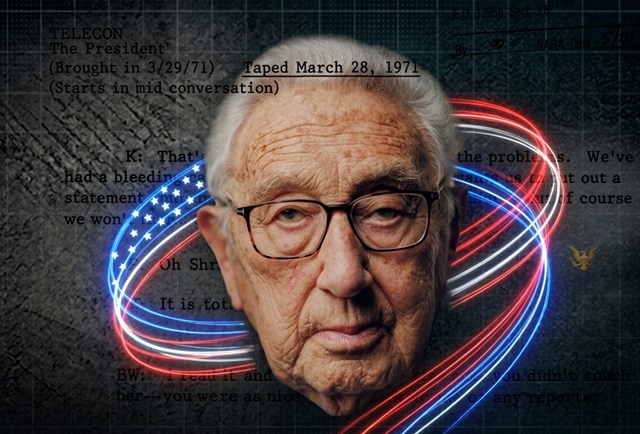
A newly released book, The Kissinger Tapes: Inside His Secretly Recorded Phone Conversations, is sending shockwaves through the corridors of history and diplomacy, offering unprecedented insight into the inner workings of one of the most powerful and controversial figures of the twentieth century. Historian Tom Wells’ meticulously edited volume draws from hundreds of transcripts—known as “telcons”—of phone conversations between Henry Kissinger, who served as National Security Advisor and Secretary of State during the Nixon administration, and colleagues, journalists, and world leaders. These records, obtained and ultimately released thanks to decades-long efforts by the National Security Archive, shed revealing light on Kissinger’s foreign policies, strategies, and personality, while also exposing widespread abuses of power within the Nixon White House.
The transcripts cover a critical period in U.S. history, spanning from 1969 to mid-1974, including covert operations, wiretapping scandals, and the unfolding Watergate crisis. Among the most startling revelations are candid discussions that display Kissinger’s willingness to manipulate both colleagues and the press, his strategic machinations in foreign policy, and his casual dismissal of human suffering. In one August 10, 1973, call to Secretary of Defense Melvin Laird, Kissinger expressed outrage at officials participating in congressional hearings investigating the secret bombing of Cambodia, insisting they defend the White House’s controversial decisions. “I mean, we saved American life. There were North Vietnamese troops there. The government of the country we were bombing were asking us to do it. What the hell—one sometimes thinks we are in a madhouse,” he said, unaware that his conversation was being recorded.
The book also exposes Kissinger’s remarkable skill at deception. Wells highlights his calculated manipulation of journalists, including New York Times reporter Seymour Hersh, CBS correspondent Marvin Kalb, and ABC News’ Barbara Walters. In one July 1973 call, Kissinger repeatedly denied knowledge of falsified reports designed to obscure the Cambodian bombings, only to brief his deputy, Alexander Haig, hours later on how he had misled Hersh. Wells notes, quoting Kissinger aides, that lying was “not because it was in his interest, but because it was in his nature.” These interactions illuminate how the U.S. media, particularly its elite ranks, intersected with the corridors of power in ways that shaped public perception and historical narrative.
Human rights abuses, too, emerge as a central theme in the transcripts. In March 1971, Kissinger discussed with President Nixon a cable from U.S. consul Archer Blood in East Pakistan (now Bangladesh) documenting a massive civilian slaughter by the Pakistani military regime. Kissinger dismissed the consul’s appeals to condemn the killings, referring to him disparagingly as “one of those pansies.” Nixon instructed Kissinger to remove Blood from his post. The transcripts underscore a recurring pattern of prioritizing political expediency over moral responsibility, reflecting a calculated indifference to civilian suffering.
Kissinger’s reach extended into the realm of covert operations and wiretaps, further revealed by these documents. In a June 1973 conversation during the FBI wiretap scandal, Nixon and Kissinger discussed exposing individuals allegedly tapped under previous administrations, demonstrating their casual acceptance of intrusive surveillance. Likewise, the transcripts reveal Kissinger’s involvement in efforts to obscure secret military operations, including Cambodia bombings, often manipulating official records to maintain a controlled narrative.
The history of these documents themselves is remarkable. Kissinger attempted to claim the telcons as his private papers when he left office in 1976, using them extensively for his memoirs. The National Security Archive, led by Bill Burr, challenged this designation through legal complaints and Freedom of Information Act (FOIA) petitions, eventually securing the return of the records from the State Department and their subsequent declassification in 2004. Over 15,000 pages of transcripts were released, forming a comprehensive digital record of U.S. diplomacy and the inner workings of Kissinger’s tenure. Archive director Tom Blanton has called Burr’s efforts a “permanent accountability tribute,” preserving the telcons for both scholarship and public transparency.
In addition to political strategy and deception, the transcripts reveal a strikingly personal side of Kissinger. Calls with journalists like Barbara Walters illustrate his concern with public image and media portrayal, sometimes veering into the peculiar and revealingly candid. Yet even in these exchanges, his strategic instincts were never far from the surface, blending personal charm with a relentless drive to control information.
Wells’ book also contextualizes Kissinger’s dealings on the global stage. Telcons with Nixon and foreign officials, such as Soviet Ambassador Anatoli Dobrynin, reveal both strategic brilliance and moments of moral indifference, often juxtaposing military action with personal commentary. In one April 1972 conversation, Kissinger derides Dobrynin while the U.S. conducted bombing campaigns in North Vietnam, illustrating the dissonance between diplomacy and destruction. Similarly, discussions surrounding the Chilean coup of 1973 show Kissinger and Nixon acknowledging U.S. involvement in the overthrow of Salvador Allende, reflecting a calculated prioritization of geopolitical objectives over democratic norms.
The release of The Kissinger Tapes has already provoked a wave of analysis and debate among historians, journalists, and policymakers. As Peter Kornbluh of the National Security Archive observes, the book is “an invaluable gift to history” and a “verdict of history on his controversial foreign policies.” By providing Kissinger’s own words as evidence, the volume forces a reevaluation of his legacy, blending recognition of his diplomatic skill with scrutiny of his moral and ethical compromises.
For decades, the public and scholars alike had only fragmentary glimpses of Kissinger’s decision-making processes. The National Security Archive’s intervention not only restored these crucial historical records to public view but also enabled a comprehensive understanding of an era defined by secrecy, scandal, and the shaping of global geopolitics from behind closed doors. Through Wells’ careful editing, readers now have direct access to the voice of a man who influenced the fate of nations, confronted moral dilemmas with strategic calculation, and often blurred the lines between brilliance and manipulation.