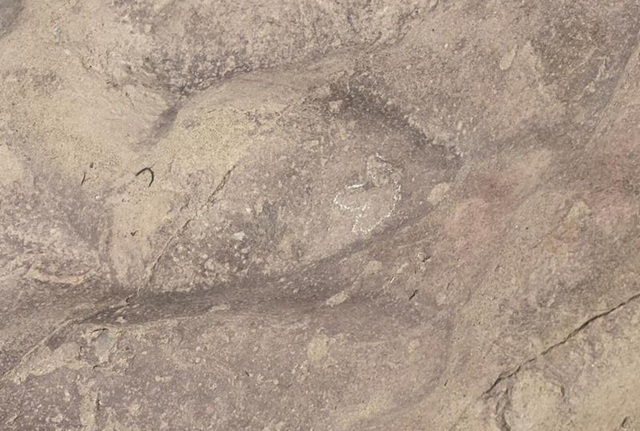
A set of five fossilized small dinosaur footprints from the Cretaceous period has been discovered in northwest China’s Gansu Province, believed to be among the smallest known dinosaur tracks in the world.
Workers from a dinosaur museum in the Linxia Global Geopark in the Hui Autonomous Prefecture of Linxia found them inside the geopark in early August after continuous rainfall exposed the footprints on a weathered rock surface.
Each footprint measures approximately one to three cm in length.
Xing Lida, an associate professor at the China University of Geosciences (Beijing), noted that such footprints were first found in the country’s Sichuan Basin and later discovered in Shandong Province and then the Republic of Korea.
The latest discovery in Linxia suggests a broader distribution of these tracks during the same period, which is significant to the study of biostratigraphy, geological ages and dinosaur diversity in these regions, said Xing.
Xing emphasized the discovery’s scientific value, stating that it provides a new perspective on dinosaur miniaturization, a key step towards the evolution of birds.
Since the late 1990s, over 2,000 dinosaur footprints have been found in Linxia’s Yongjing County, part of the geopark, known as the “Liujiaxia dinosaur footprint cluster.”
You Wenze, the curator of the museum, said that the continuous discoveries based on strengthened protection in the geopark and the neighboring area not only enlarged the dinosaur footprint cluster, but also greatly enhanced the cultural and tourism value of the local area.
Xing explained that the new footprints indicate that the trace-makers were not fast-moving.
“The rock surface shows clear ripple marks, suggesting that the small dinosaurs were active near water, with many waterbird footprints found alongside them, forming a typical combination consistent with findings in other regions,” he said.
These footprints not only reflect the habits and behaviors of dinosaurs but also shed light on their relationship with the environment, he added.