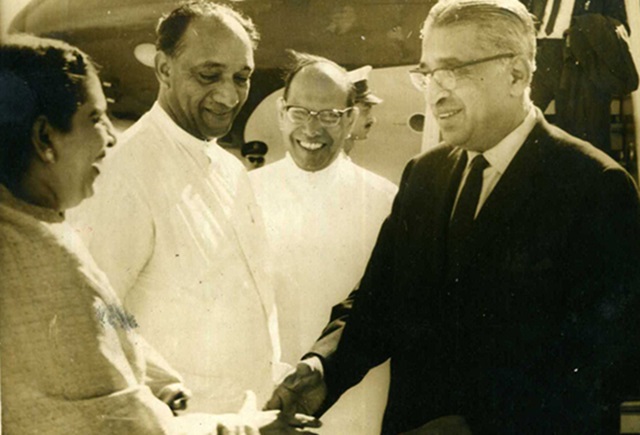
S.W.R.D. Bandaranaike was not created by D.S. Senanayake. Bandaranaike was a leader who emerged from the Sinhala Maha Sabha. D.S. enlisted Bandaranaike to secure the Sinhala Maha Sabha votes for the 1947 general election. When D.S. won and became Prime Minister, he appointed Bandaranaike as Leader of the House—but he simultaneously fostered a new set of leaders to curb Bandaranaike’s influence.
The first of these was his own son, Dudley Senanayake, whom he appointed as Minister of Agriculture, a post D.S. himself had held prior to 1947. Then he elevated Sir John Kotelawala, positioning him to clash with Bandaranaike. The main rivalry for second-in-command in D.S.’s government was between Bandaranaike and Sir John. In addition, a young and educated MP, J.R. Jayewardene, was appointed as Minister of Finance, marking his emergence as a key leader. D.S. also appointed Sir Oliver Goonetilleke as Foreign Minister, who at the time adeptly handled international politics. Later, Sir Oliver became the first Sinhalese Governor-General of Sri Lanka.
Of the leaders cultivated by D.S., Sir John became Prime Minister, Dudley became Prime Minister, J.R. became both Prime Minister and President, and Sir Oliver became Governor-General. In this way, D.S. built a succession of leaders for both the United National Party (UNP) and the South. From 1947 to 1970, the UNP endured thanks to that leadership lineage.
When Dudley died and J.R. took over the UNP, J.R. realised there were no emerging leaders within the party or in the South. Most of Dudley’s associates were ageing. So, while still in opposition, J.R. began constructing a new leadership pipeline to sustain the UNP. Although he did not appoint a deputy leader, he held a secret ballot during a working committee meeting to choose someone to lead the next election campaign under his guidance. Through this process, he aimed to identify the next generation of party leadership. Premadasa emerged as the top choice in that secret ballot, followed by Gamini, Lalith, and Ronnie.
After the 1977 victory, J.R. gave these four leaders the most powerful portfolios in government. Premadasa became Prime Minister; Gamini was put in charge of the Mahaweli Development Project; Lalith was given Trade and State Security; and Ronnie became Finance Minister. The introduction of the proportional representation (PR) system under J.R. was not only advantageous for the UNP but also intended to produce popular district-level leaders by rewarding those with the highest number of votes.
Upon adoption of PR, Lalith Athulathmudali commented that, going forward, it would lead to the emergence of new SLFP leaders from the districts—rather than continuing the dominance of the Bandaranaikes. J.R. envisioned that after Premadasa, Gamini would lead; after Gamini, Lalith; and then Ronnie—ensuring decades of UNP dominance.
However, Prabhakaran changed all that. In his autobiography, J.R. wrote that he could not bear the successive assassinations of the leaders he had nurtured. He faced the terror of 1988. Ranjan Wijeratne, brought into politics by Premadasa, and a rising leader, was assassinated.
Before becoming President, Premadasa saw Ronnie de Mel leave the party. Once in power, Premadasa sidelined Lalith and Gamini but cultivated three new leaders: Ranjan Wijeratne, Ranil Wickremesinghe, and Gamini Atukorale.
After the assassinations of Ranjan, Premadasa, Lalith, and Gamini by Prabhakaran’s bombs, only Ranil and Gamini Atukorale remained. Ranil appointed Gamini Atukorale as the party’s General Secretary. However, unlike his predecessors, Ranil did not foster new leadership within the UNP or for the political right. Instead, he contributed to creating leaders for the left and the SLFP, often to serve his short-term interests.
Without Ranil’s support, Chandrika Bandaranaike would never have become Prime Minister in 1994. Chandrika failed to secure a majority in the 1994 general election. The decisive factor in forming a government was Ashraff’s Muslim Congress. Around the same time, Gamini Dissanayake rejoined the UNP from the DUNF and contested the election, re-emerging as a UNP leader.
With Ashraff’s support, Gamini tried every political manoeuvre to form a UNP government. He even advised President Wijetunga to appoint Mrs Bandaranaike as Prime Minister to create friction between her and Chandrika. Meanwhile, a helicopter was dispatched to bring Ashraff from the East to Colombo for government formation talks.
At the time, Ranil and Gamini were politically at odds. Ranil had resisted Gamini’s return to the UNP by pressuring National List MPs not to resign. Nevertheless, Gamini, through President Wijetunga, urged Ranil not to resign as Prime Minister until a majority was secured.
Ranil suspected that Gamini would not support him to retain the premiership, even if a majority was formed. Consequently, he met Chandrika at Ravi Karunanayake’s house, struck a deal, and stepped down. (At the time, Ravi was a National List MP in Chandrika’s UPFA.) When Ranil resigned, Wijetunga had no choice but to appoint Chandrika. Ashraff told Gamini he now had to support Chandrika. Gamini was left powerless.
After Ranil assumed leadership of the UNP, Chandrika viewed him as a threat. She appointed the Batalanda Commission to politically undermine him. In response, Ranil sought an internal government figure to challenge her—he found this in Mahinda Rajapaksa. When Mahinda clashed with Chandrika and stumbled in Hambantota, Sajith Premadasa, new to politics, began to rise.
Ranil, however, suppressed Sajith and allowed Mahinda to consolidate power in Hambantota. When Ranil became Prime Minister in 2002, President Chandrika appointed Ratnasiri Wickremanayake as Leader of the Opposition. Yet Ranil backed the Mahinda-Jayaraj conspiracy to remove Ratnasiri and install Mahinda as Leader of the Opposition instead.
Ranil prohibited UNP MPs from criticising Mahinda. Ultimately, Mahinda defeated Ranil and became President.
In 2015, Ranil helped create yet another leader for the SLFP to defeat Mahinda—Maithripala Sirisena. His candidacy was made possible by the condition that no one else from the SLFP would contest. At the time, if Sajith had been the candidate, he would likely have won.
In 2022, Ranil became President with Mahinda’s backing and entered the presidential race to defeat Sajith. The outcome: Anura Kumara Dissanayake emerged victorious. After losing his seat in the 2020 general election, Ranil boosted Anura to undermine Sajith. Even as President, he continued this strategy. Ultimately, he helped create a new leader for the left—Anura—strengthening the SLFP-United Front alliance.
If Ranil had focused on building right-wing leadership as D.S. and J.R. once did, figures like Chandrika, Mahinda, Maithri, and Anura might never have emerged. Had that happened, the South—or the UNP—could have ruled the country for more than half of the three decades spanning 1994 to 2024.