Henpitagedara Gnanaseeha Thero was a monk who played a pivotal role in bringing Mrs Bandaranaike into politics after the assassination of Mr Bandaranaike. Later, he established relations with China. During Mrs Bandaranaike’s government from 1960 to 1965, the monk wrote a book in which he argued that Sri Lanka should adopt a dictatorial regime.
This book disturbed the opposition. During the same period, Chinese Premier Zhou Enlai visited Sri Lanka and promised to gift the Bandaranaike International Conference Hall to the country. Relations between Sri Lanka and China strengthened during this time.
The connection between Venerable Gnanaseeha Thero and China, combined with the monk’s book and the visit of the Chinese Premier, alarmed the opposition, including the UNP. Rumours also circulated that the Chinese Communist Party was involved in printing and sending pro-government pamphlets to Sri Lanka.
The UNP protested in front of the Chinese Embassy in Colombo. In its campaign against the Bandaranaike government, the UNP accused China of supporting her administration’s authoritarian tendencies. India, too, was uneasy when she signed a maritime agreement with China in July 1963. This led the UNP to accuse Mrs Bandaranaike of selling the Trincomalee Harbour to China.
The opposition claimed she was attempting to create a dictatorial “red” government modelled on China’s, which led the Mahanayake Theros and other monks to take to the streets against the government.
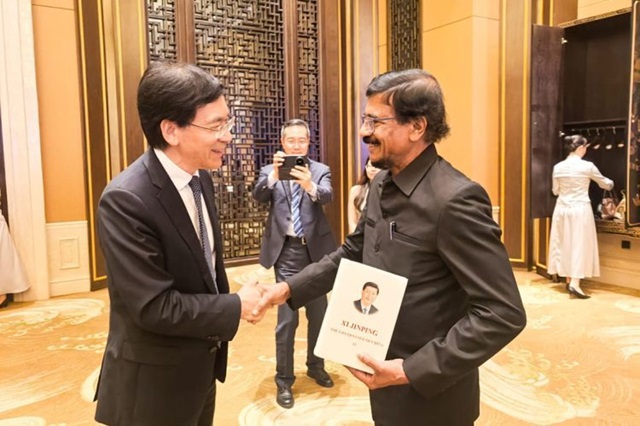
This past incident comes to mind because of a recent statement by JVP General Secretary Tilvin Silva. At a media conference, he said that during his visit to China, Chinese leaders told him the JVP government should remain in power for another 15 to 20 years in order to develop Sri Lanka.
Tilvin met with one of the seven most powerful members of the Communist Party’s Politburo. His public repetition of this statement is somewhat reminiscent of Henpitagedara Gnanaseeha Thero’s call for a dictatorial regime while maintaining close ties with China.
It is not known whether Tilvin disclosed a private discussion with China’s consent. The Sri Lankan public could form a wrong impression of China because of his statement, as it may suggest that China believes the JVP government should remain in power for 15 or 20 years. It is China’s responsibility to clarify Tilvin’s remarks.