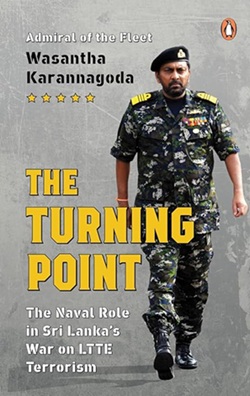
Wasantha Karannagoda, The Turning Point: The Naval Role in Sri Lanka’s War on LTTE Terrorism. India Penguin: New Delhi, p.412., ISBN: 978-0143469292
Numerous scholarly articles and monographs have examined the decisive military victory of the Sri Lankan armed forces in eliminating LTTE terrorism, commonly known as the Tamil Tigers, from the island nation in 2009. The defeat of the LTTE attracted significant international attention, as prevailing opinion prior to the Sri Lankan government’s military offensive often portrayed the LTTE as a movement that could not be defeated through military means. Following the victory, considerable enthusiasm emerged within Sri Lankan military circles, and international analysts such as Paul Moorcraft produced extensive literature analyzing the military strategies employed by the Sri Lankan army against the Tamil Tigers. However, much of this scholarship has overlooked a critical factor that contributed to the ultimate victory in 2009: the significant role played by the Sri Lankan navy.
Against this backdrop of scholarly lacuna, Admiral of the Fleet Wasantha Karannagoda’s book, The Turning Point: The Naval Role in Sri Lanka’s War on LTTE Terrorism, published by Penguin Random House, constitutes a valuable contribution that elucidates the historic role played by the Sri Lankan navy in countering the LTTE. The book is a recollection of the author’s wartime experiences, imbued with nostalgia for his life as a mariner, and frequently reflects his deep personal attachment to the navy dating back to his formative years as a cadet officer in the Ceylon Navy during its halcyon days. In the opening chapters, the author passionately highlights Sri Lanka’s (formerly Ceylon prior to 1971) enduring affinity with British naval traditions, even after the decline of British influence over the island’s political affairs. Admiral of the Fleet Karannagoda himself is an alumnus of the Royal Naval College, Greenwich, and the vivid details he presents testify to the resilience and continuity of British naval training traditions within its former colonies.
The significance of the Fleet Admiral Karannagoda’s work for modern strategic studies and international security lies in its comprehensive analysis of novel concepts implemented by the Sri Lankan navy during its campaign against the naval wing of the LTTE. The naval wing of the LTTE, known as the “Sea Tigers,” constituted a sui generis unit within the organization; its innovative approaches to naval combat and remarkable adaptability repeatedly stunned the Sri Lankan navy, which was largely accustomed to conventional naval doctrines and training. Karannagoda’s chapter on the “Sea Tigers” reveals several significant facets of the LTTE’s naval evolution from its infancy, clearly demonstrating how the organization avoided direct confrontation with the Sri Lankan navy by adopting asymmetric maritime warfare—an approach that proved to be a nemesis and severely undermined naval morale during the first decade of confrontation with the Sea Tigers.
As a veteran who witnessed the strategic debacles of the Sri Lankan navy during the first two decades of the war, Admiral Karannagoda acknowledges the effectiveness demonstrated by the Sea Tigers in employing minimal forces against overwhelming odds. By way of example, he describes how the Sea Tigers developed their own “wolf-pack”–style tactics against isolated Fast Attack Crafts (FAC) of the Sri Lankan navy, which ultimately imposed significant operational and financial costs on the Government of Sri Lanka.
As the threat posed by the Sea Tigers intensified, rendering conventional naval tactics ineffective, the Sri Lankan navy adopted the concept of small boats to address operational challenges. Admiral Karannagoda describes these newly developed vessels as “arrow boats” because of their sharp, arrow-like design and 250-horsepower engines. The chapter titled “Asymmetric Naval Warfare” provides a detailed account of the operational and conceptual challenges encountered by the Sri Lankan Navy in implementing the arrow boat strategy. Karannagoda notes the significant obstacles that weakened the Sri Lankan military apparatus following the LTTE’s declaration of its fourth Ilam war in 2006, particularly the substantial financial strain on Colombo to rapidly acquire fast attack carriers. Consequently, the navy began manufacturing its own fiberglass small boats, an example of indigenous technological innovation that yielded remarkable results against the Sea Tigers.
In addition to offering detailed insights into asymmetrical naval warfare, this book examines Sri Lanka’s transformation from a traditional maritime force to a blue water navy. The Sri Lankan navy’s successful 2007 operations against LTTE vessels in international waters are described by Karannagoda as Sri Lanka’s “sputnik moment.” The destruction of significant LTTE assets near Indonesia marked a decisive turning point, fundamentally shifting the balance in the conflict and undermining the LTTE’s operational capabilities. Therefore, Karannagoda’s characterisation of this event as a “Turning Point” effectively captures the Sri Lankan Navy’s pivotal role in countering LTTE terrorism.
Before he was appointed Commander of the Sri Lankan Navy in 2005, Admiral of the Fleet Karannagoda served as Commander of the Eastern Naval Area, which encompasses the strategically significant Trincomalee harbour. Once described by Lord Nelson as the finest harbour in the world, Trincomalee attracted British strategic interest in the eighteenth century and has continued to shape Sri Lanka’s geopolitical landscape well beyond the colonial period. In his chapter on the strategic importance of Trincomalee harbour, Karannagoda details the challenges he faced while defending the port as Chief of the Eastern Command during 2002–2003 and expresses deep dissatisfaction with the treatment he received from the government during this period. In another chapter, Admiral Karannagoda highlights how the Sri Lankan Navy maintained constructive relations with Western powers while adopting a balanced approach that avoided antagonising New Delhi, thereby enabling the acquisition of valuable intelligence on LTTE activities in the Indian Ocean.
Including personal sentiments is a common feature in autobiographical writing, as demonstrated by Admiral Karannagoda. Despite the meticulous research he presents on the naval tactics employed by the Sri Lankan navy and the dynamics of asymmetrical warfare at sea, his extensive personal narratives regarding endemic bureaucracy and the political culture of post-colonial Sri Lanka may appear tedious to readers unfamiliar with the nation’s internal affairs. Nevertheless, his wartime recollections serve as a valuable resource for military historians and strategists seeking to understand the tactical responses of a navy with limited capabilities against the asymmetrical strategies of a highly sophisticated terrorist organisation.