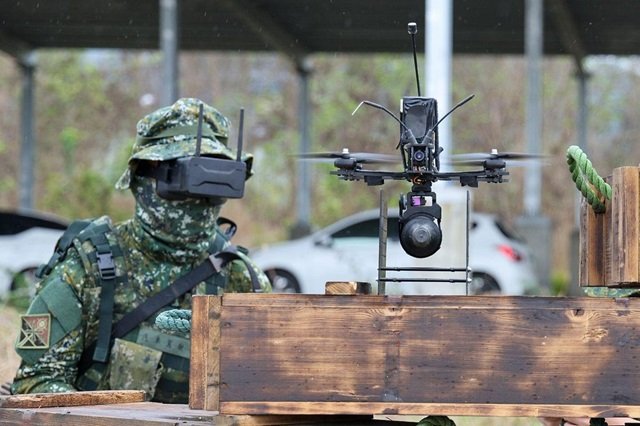
Taiwan is betting that drones can transform both its military preparedness and its industrial future, but the country’s ambitious plans are colliding with an uncomfortable question: can Taipei build thousands of effective unmanned systems quickly enough to matter in a crisis across the Taiwan Strait?
According to an analysis published by ChinaTalk, Taiwan has spent years developing indigenous unmanned systems ranging from reconnaissance aircraft and loitering munitions to unmanned surface vessels. The effort accelerated sharply after the Russia-Ukraine war demonstrated the military value of large numbers of relatively inexpensive, expendable drones. President Lai Ching-te has framed the industry as both a national-security necessity and an economic opportunity, declaring that “national defense and the economy are the two pillars supporting the country’s survival and development”.
The scale of the ambition is striking. Taiwan’s government has discussed procuring 48,750 military drones by 2027 and 50,000 civilian drones by 2030. Earlier plans envisaged still larger numbers, including a 200,000-unit military target. Yet the political machinery required to finance that expansion has become one of the principal obstacles.
Taiwan’s opposition-controlled Legislative Yuan rejected domestic drone procurement from the government’s special defence budget passed in May 2026. In August, it approved legislation authorising NT$240 billion, or roughly US$7.5 billion, for the development of unmanned vehicles, but shifted significant oversight towards the Ministry of Economic Affairs and imposed annual funding and legislative review mechanisms. The result is a system with multiple potential veto points.
The dispute is not simply about money. Opposition lawmakers have raised concerns over fiscal costs, procurement oversight and the possibility of politically connected companies benefiting from government contracts. The governing camp and parts of the defence industry argue that the new arrangements could undermine the speed and efficiency required for multi-year procurement. The political divide is particularly significant because Taiwan’s drone strategy depends on scaling production rapidly rather than merely demonstrating prototypes.
Taiwan nevertheless possesses a substantial technological base. The National Chung-Shan Institute of Science and Technology, or NCSIST, has developed reconnaissance drones and a growing family of loitering munitions. These include the Chien Hsiang “Rising Sword”, the Ching Feng series of attack drones and the Fire Cardinal. Newer systems are now being organised into an “A through E” series intended to form the backbone of the government’s planned military fleet.
The naval dimension is expanding as well. NCSIST’s Kuai Chi unmanned surface vessel has undergone testing, while Taiwan is seeking systems capable of operating in swarms. The approximately three-tonne vessel is designed to carry munitions or ram enemy ships and is small enough to fit inside a 40-foot shipping container. NCSIST has also tested its integration with Ching Feng I kamikaze drones and Albatross reconnaissance UAVs.
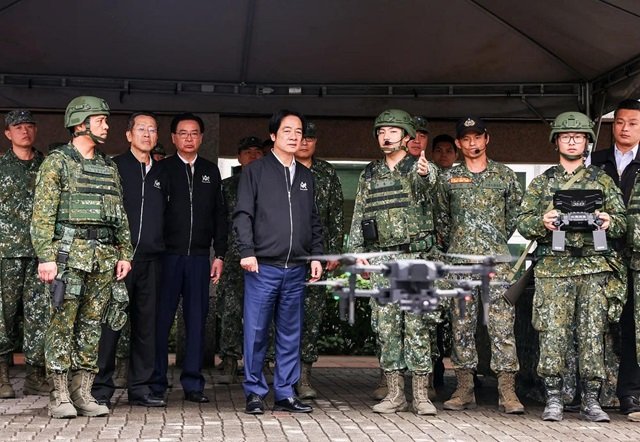
Yet Taiwan’s indigenous effort does not mean it can dispense with foreign technology. The country has ordered four US MQ-9B SkyGuardian drones and American loitering munitions from Anduril and AeroVironment. The May 2026 special defence budget includes NT$35 billion, or US$1.1 billion, for 478 Altius-600ISR and 1,554 Altius-700M drones. Anduril’s Barracuda-500 cruise missile is also to be manufactured by NCSIST in Taiwan.
That mixture reflects a central reality of Taiwan’s defence problem. Indigenous production can provide quantities, flexibility and supply-chain security, but some of the most sophisticated software, communications, sensors and autonomous capabilities remain dependent on foreign partners. Taiwan also faces geographical and regulatory constraints on flight testing, while its military requirements process is considerably less transparent than that of the United States.
ChinaTalk’s analysis suggests that Taiwan may therefore need to redefine what success means. Rather than attempting to become a globally dominant producer of complete drone systems, Taipei could concentrate on becoming a trusted supplier of components, subsystems and battle-tested technologies for democratic partners. Such a strategy would exploit Taiwan’s existing industrial strengths while avoiding some of the technological and commercial barriers to exporting complete military platforms.
The military argument for mass indigenous production is nevertheless powerful. Taiwan’s planners cannot assume that foreign suppliers will always be able to deliver weapons during a crisis. China’s political and economic influence has made major arms transfers from many non-US countries effectively impossible, while concerns over Chinese intelligence penetration have complicated access to some advanced foreign technologies.
The challenge is timing. If the greatest danger lies only a few years away, many of Taiwan’s most ambitious indigenous programmes are unlikely to reach full maturity. Over a decade, however, the prospects for a larger and more capable domestic ecosystem are considerably stronger. That leaves Taipei trying to solve two problems simultaneously: preparing for a potential war before its drone industry is fully mature, while building an industrial base that could remain valuable even without one.
The contradiction is at the heart of Taiwan’s drone gamble. The country has demonstrated that it can design and produce sophisticated unmanned systems, but prototypes are not an arsenal. Turning technological promise into tens of thousands of reliable systems requires sustained funding, private investment, software expertise, testing infrastructure, skilled personnel and political consistency.
For Taiwan, the question is no longer whether drones matter. The Ukraine war has already answered that. The harder question is whether Taipei can overcome its own political and industrial bottlenecks quickly enough to turn an ambitious drone policy into a credible military capability. As ChinaTalk’s analysis makes clear, Taiwan may have the beginnings of the technology it needs. What remains uncertain is whether it can build at the scale and speed that its security environment demands.