Japanese Prime Minister Sanae Takaichi has called for constructive and stable relations with China following two brief but cordial encounters with President Xi Jinping at the Asia-Pacific Economic Cooperation (APEC) summit in Shenzhen on Wednesday and Thursday. The exchanges marked the first direct contact between the two leaders since a diplomatic dispute erupted last November over Takaichi’s remarks suggesting that Japanese military intervention could become possible in the event of a crisis involving Taiwan.
Speaking at a news conference after the summit on Thursday, Takaichi said Japan intended to advance its strategic and mutually beneficial relationship with China through dialogue while protecting the national interests of both countries. She stressed that communication was particularly important because the two neighbours continued to face unresolved issues and disagreements.
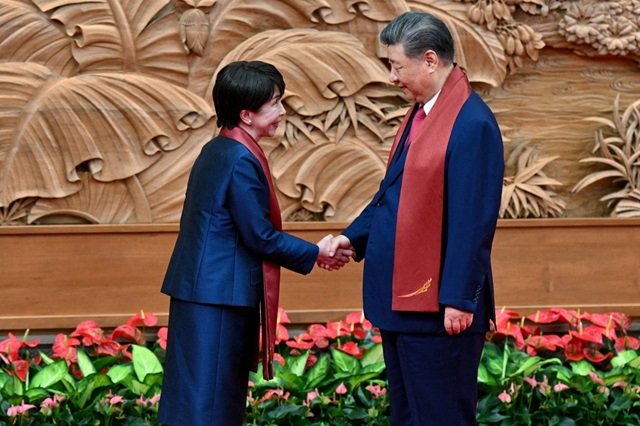
The Japanese leader said she had thanked Xi for the invitation and arrangements for the summit and congratulated him on hosting the events. Earlier on Thursday, she appeared to engage in a relatively lengthy conversation with the Chinese president during a pre-summit greeting. The interaction followed a cordial handshake at the welcome banquet on Wednesday evening.
The exchanges offered a contrast to the uncertainty surrounding the Japanese leader’s arrival in Shenzhen. Unlike South Korean President Lee Jae Myung and US President Donald Trump, who received welcomes featuring performers and festive music, Takaichi was greeted with considerably less ceremony at the airport. Japan’s Chief Cabinet Secretary, Minoru Kihara, declined to comment directly on China’s diplomatic protocol but said Tokyo understood that Japan had received the customary courtesies extended to other participating economies.
Questions over Beijing’s willingness to engage with Takaichi had also emerged earlier in the week during the China-Association of Southeast Asian Nations (ASEAN) summit in Manila. Chinese Premier Li Qiang attended Monday’s meeting before returning to Beijing that afternoon, around the time Takaichi arrived in the Philippines. Li subsequently skipped the ASEAN Plus Three meeting on Tuesday, where China was represented by Agriculture and Rural Affairs Minister Zhang Zhu. His departure fuelled speculation that Beijing was seeking to avoid an encounter with the Japanese prime minister, although the summit schedule also limited opportunities for direct contact.
The diplomatic deterioration began after Takaichi suggested last November that Chinese military action around Taiwan could potentially draw Japan’s Self-Defense Forces into a conflict. Beijing demanded that she retract the remarks and subsequently intensified economic and diplomatic pressure on Tokyo. Japan has maintained that its longstanding position on Taiwan remains unchanged.
Takaichi reiterated that position on Thursday, referring to the 1972 Japan-China Joint Communique, which established diplomatic relations between the two countries. Under the document, Japan stated that it fully understood and respected Beijing’s position that Taiwan was an inalienable part of the People’s Republic of China, without explicitly recognising Chinese sovereignty over the self-governing island.
Despite her calls for improved relations, Takaichi also maintained a firm position on China’s regional and economic policies. Addressing the main APEC gathering, she emphasised the importance of preserving a free, fair and rules-based international economic order, a position widely viewed as a criticism of Beijing’s use of economic influence as diplomatic leverage.
Earlier in the week, she joined the leaders of the United States, Australia and India at a Quad gathering in Manila, where they expressed serious concerns about economic coercion, including arbitrary export restrictions. Takaichi described the meeting as a major success.
The latest encounters also recalled the strained interaction between then-Japanese Prime Minister Shinzo Abe and Xi at the 2014 APEC summit in Beijing, when their notably frosty handshake became a symbol of deteriorating relations. That meeting was followed by formal bilateral talks and a cautious diplomatic rapprochement. No comparable meeting between Xi and Takaichi was announced this time, leaving the immediate prospects for resolving the current dispute uncertain.