by Luxman
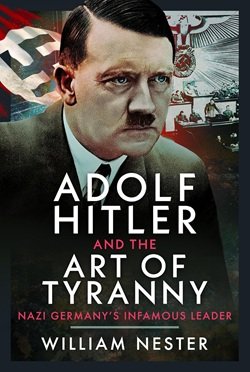
The book Adolf Hitler and the Art of Tyranny: On Power, Will, and Leadership is constructed as a curated archive of authoritarian thought, framed through thematic organisation and interpretive commentary. It does not merely present Hitler’s statements as historical artefacts; it stages them as a systematic worldview in motion, one that moves from metaphysical claims about will and leadership to explicit articulations of racial violence, propaganda, and state terror. The effect is unsettlingly double-edged: the text seeks to critique totalitarian ideology while simultaneously immersing the reader in its rhetorical coherence. This tension—between critical distance and textual proximity—runs throughout the work and becomes its defining intellectual problem.
At its foundation lies a philosophy of will that rejects contingency in favour of self-authored destiny. “The man who is born to be a dictator is not compelled. He wills it. He is not driven forward, he drives himself.” This assertion constructs leadership as ontological exception, a form of political being that transcends circumstance. Yet the anthology does not fully interrogate how such claims function as ideological self-legitimation rather than philosophical argument. When Hitler insists, “I am convinced of my brain and of my resolution,” the statement appears less as insight than as performative absolutism, where conviction substitutes for justification. The book is strongest when it exposes this rhetorical structure, but weaker when it allows the coherence of the worldview to stand without sustained analytical dismantling.
A similar ambiguity appears in its treatment of social Darwinist reasoning. “Nature … confers the master’s right on her favourite child, the strongest in courage and industry … The stronger must dominate and not blend with the weaker.” The text reproduces this logic as evidence of ideological formation, yet the repetition of such claims risks granting them an illusion of philosophical consistency. The challenge here is methodological: how does one document a worldview built on pseudo-natural necessity without inadvertently reinforcing its internal grammar? The anthology raises this question but does not always resolve it, leaving the reader to oscillate between critique and uneasy familiarity with the language of domination.
The conception of war as existential condition further intensifies this tension. “War is a constant; war is everywhere. There is no beginning, there is no conclusion of peace. War is life.” This totalisation of conflict transforms politics into ontology, dissolving distinctions between armed struggle and everyday existence. The book effectively demonstrates how such language naturalises perpetual violence, but it also risks reproducing the rhetorical grandeur through which that naturalisation occurs. In this sense, the anthology performs a paradoxical function: it deconstructs authoritarian ideology by displaying it in its own terms, yet those terms retain a residual persuasive force.
Nowhere is this more ethically charged than in the sections dealing with antisemitism and genocide. “If the Jewish financiers … should again succeed in plunging the nations into a world war the result will be … the annihilation of the Jewish race throughout Europe.” Read alongside historical outcomes, the statement becomes an index of ideological escalation into atrocity. Yet the anthology’s structure sometimes struggles to mediate between retrospective knowledge and contemporaneous ideology, producing moments where historical horror risks being absorbed into analytical abstraction. Similarly, the claim “Nature is cruel, therefore we also are entitled to be cruel” exposes the moral inversion at the heart of Nazi reasoning, where descriptive violence becomes normative permission. The book is at its most compelling when it allows these contradictions to remain visible without resolution.
The logic of terror is articulated with chilling clarity in passages such as “Cruelty impresses … People need a good scare. They want to be afraid of something.” Here, fear is not incidental but foundational to political order. Likewise, operational directives such as “I have sent … my Death’s Head units with orders to kill without pity or mercy all men, women and children of Polish race or lineage” reveal the bureaucratisation of extermination. The anthology’s strength lies in its refusal to sanitise these statements; its limitation lies in its occasional lack of interpretive depth regarding how ordinary administrative language becomes an instrument of mass violence.
The sections on propaganda reveal a sophisticated understanding of mass psychology, albeit one grounded in cynical reductionism. “The receptivity of the great masses is very limited, their intelligence is small, but their power of forgetting is enormous.” Such statements construct the public as malleable and cognitively deficient, legitimising manipulative political communication. “The first task of propaganda is to win people for subsequent organization; the first task of organization is to win men for the continuation of propaganda.” The circularity of this logic is central to authoritarian durability, yet the book occasionally presents these insights without fully unpacking their relevance to contemporary media environments.
Equally significant is the rejection of democratic legitimacy. “By rejecting the authority of the individual and replacing it with the numbers of some momentary mob, the parliamentary principle of majority rule sins against the basic aristocratic principle of Nature.” Here, democracy is not merely criticised but recoded as biological deviation. “The decision is always made by a majority of ignoramuses and incompetents.” The anthology effectively demonstrates how anti-democratic thought constructs epistemic hierarchy as natural order, yet it also raises the question of how such arguments should be presented without inadvertently granting them intellectual parity with democratic theory itself.
The book’s treatment of race and Volk ideology exposes the full scope of its ethical stakes. “If we were to divide mankind into three groups, the founders of culture, the bearers of culture, the destroyers of culture, only the Aryans could be considered as representative of the first group.” Such statements reveal the totalising logic of racial hierarchy, where culture itself becomes a tool of exclusion. “Those who are physically and mentally unhealthy and unworthy must not perpetuate their suffering in the body of the children.” Here, eugenic reasoning merges biology with moral judgement, producing a framework in which violence is reframed as care. The anthology presents these ideas with necessary clarity, but their systematic nature underscores the difficulty of analysing ideology that is both internally coherent and externally catastrophic.
In its discussion of military strategy and leadership, the text reveals a volatile combination of tactical insight and destructive rigidity. “Not a step is to be yielded.” This absolute refusal of retreat exemplifies the fatalism embedded in Hitler’s command style. Yet even within the book’s critical framing, such statements risk being read as expressions of strategic decisiveness rather than pathological inflexibility. The ambiguity between military analysis and ideological extremism is one of the anthology’s recurring structural tensions.
The sections on defeat and self-justification further expose the fragility beneath authoritarian certainty. “We can’t lose the war at all. We now have an ally which has never been conquered in 3,000 years.” Such delusions of geopolitical assurance illustrate how ideology can override empirical reality. “What would have happened if anybody other than myself had been at the head of the Reich! Anyone you care to mention would have lost his nerve.” This persistent self-mythologisation is not incidental but constitutive of Hitler’s political identity, and the anthology effectively reveals its rhetorical persistence even in the face of collapse.
The book offers a dense archive of authoritarian rationality, but its greatest intellectual challenge lies in managing proximity to its subject matter. It succeeds in exposing how totalitarian ideology constructs itself through will, myth, fear, and dehumanisation, yet it also risks allowing that construction to appear more coherent than it should. The reader is left navigating a delicate interpretive space between understanding and resistance, between analytical clarity and ethical vigilance. Its value lies not in resolving this tension but in making it unavoidable: to read it is to confront the unsettling fact that ideological systems of extraordinary violence can also exhibit a disturbing internal logic.