by Nil
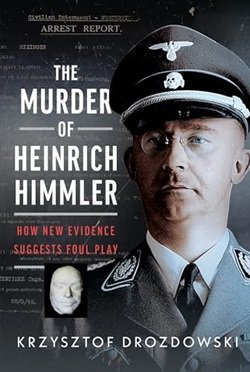
Krzysztof Drozdowski’s The Murder of Heinrich Himmler: How New Evidence Suggests Foul Play positions itself as both an intervention in one of the Second World War’s lingering enigmas and a provocation directed at the historiographical establishment. From the outset, the author frames the death of Himmler not as a settled question but as a suppressed scandal, insisting that “one of the last great mysteries of the Second World War is the story of the final moments” of the SS leader, a mystery compounded by the continued classification of the autopsy report until 2045 (p. 7). This opening gambit is rhetorically effective, immediately establishing a tone of suspicion and inviting the reader into a narrative structured less as a conventional historical account than as a forensic inquiry. Yet it also signals the book’s central methodological tension: Drozdowski’s argument depends heavily on the absence of evidence, on what is withheld, missing, or contradictory, rather than on a stable evidentiary base.
The author’s critique of established historiography is blunt, even accusatory. “Most historians have taken the official information provided by the British Army at face value,” he writes, “without considering inconsistencies… or even obvious impossibilities” (p. 7). This claim is foundational to the book’s argumentative structure, casting Drozdowski as a corrective to a complacent scholarly consensus. However, the force of this critique is uneven. While the book does assemble a considerable array of discrepancies, it often moves too quickly from identifying inconsistency to implying conspiracy. The rhetorical question—“Did Himmler really commit suicide? Or was it murder?” (p. 7)—is less an open inquiry than a guiding presumption, shaping the reader’s interpretation of subsequent evidence.
A notable strength of the book lies in its effort to contextualise Himmler within the chaotic final months of the Third Reich. Drozdowski emphasises the climate of desperation and opportunism among Nazi leaders, observing that they “fled” with the aim “to save their own skins” (p. 36). This broader framing is crucial, as it situates Himmler’s actions within a landscape where political calculations, personal survival, and ideological collapse intersected. The discussion of Allied attitudes towards Nazi leaders is particularly provocative. The claim that Churchill advocated “execution without trial” (p. 37) and that Eisenhower suggested suspects be “shot trying to escape” (p. 38) serves to destabilise the moral clarity often associated with the Allied position. By foregrounding such statements, Drozdowski constructs a context in which extrajudicial killing becomes plausible, even policy-adjacent.
Yet this contextualisation also reveals one of the book’s recurring problems: the tendency to conflate possibility with probability. The assertion that the fate of figures like Himmler was considered “a political and not a judicial” question (p. 41) does indeed open the door to speculation about unlawful actions. However, Drozdowski frequently treats such statements as indicative of actual practice rather than as expressions of wartime rhetoric or contingency planning. The leap from discourse to deed is rarely substantiated with concrete evidence, leaving the argument vulnerable to the charge of overinterpretation.
The portrait of Himmler himself is strikingly ambivalent, oscillating between condemnation and a curious form of analytical detachment. Drozdowski acknowledges Himmler as a figure of immense brutality, noting that he “murdered people in cold blood as long as it served his purposes” (p. 55), yet he also emphasises his rationality and strategic thinking. This duality is central to the book’s narrative, as it underpins the claim that Himmler was engaged in complex negotiations and manoeuvres in the war’s final phase. The suggestion that he sought a separate peace and even contemplated eliminating Hitler (p. 44) is not new, but Drozdowski integrates these ideas into a broader argument about Himmler’s potential value as an intelligence asset—an argument that, if accepted, strengthens the case for his possible assassination.
The book’s most compelling sections are those that meticulously catalogue inconsistencies in the accounts of Himmler’s capture and death. The narrative of his arrest is presented as deeply confused, with conflicting testimonies and even competing claims of responsibility. Drozdowski notes that “the Russians also take credit for it” (p. 89), while British accounts vary in significant details. This multiplicity of narratives is effectively used to undermine confidence in the official version. Similarly, the discussion of Himmler’s identification raises intriguing questions. The errors attributed to him—misstating his SS number and date of birth—are described as “hard to believe” (pp. 104–105), and the absence of the distinctive facial scar from his duel is highlighted as a critical anomaly (p. 123).
These details are undeniably suggestive, but the interpretive framework applied to them is often selective. The possibility of stress, fatigue, or deliberate obfuscation is acknowledged only briefly, while the hypothesis of a double is explored with greater enthusiasm. Drozdowski concedes that “no connections or documents have been found to indicate the existence of an ‘official’ double” (p. 97), yet continues to treat the theory as a viable explanation. This asymmetry in the treatment of evidence—where gaps favour the conspiracy hypothesis rather than undermine it—raises questions about the book’s analytical balance.
The account of Himmler’s final hours is the centrepiece of the book, and it is here that Drozdowski’s narrative achieves its greatest intensity. The contradictions between eyewitness accounts are presented in detail, creating what the author himself describes as “great chaos” (p. 100). The discrepancies in timing, the conflicting descriptions of the cyanide capsule, and the implausibility of certain physical details—such as the ability to conceal a “34-mm vial of cyanide” in a tooth (p. 160)—are marshalled to argue that the official story is untenable. Particularly striking is the suggestion that the circumstances of Himmler’s death were orchestrated, with the villa at Uelzenerstrasse potentially “prepared specifically to eliminate Himmler” (p. 112).
However, the evidentiary basis for such claims remains fragile. The book relies heavily on retrospective testimonies, diaries, and anecdotal accounts, many of which are themselves contradictory or contested. The quotation attributed to a British officer—“measures were taken to silence him permanently” (p. 135)—is presented as a smoking gun, yet its provenance and context are not sufficiently interrogated. Similarly, the speculation that Dr Wells may have physically administered the cyanide (p. 137) is acknowledged as conjectural, even as it is given narrative prominence.
One of the more troubling aspects of the book is its occasional drift towards sensationalism. The emphasis on missing photographs, alleged souvenirs, and macabre details—such as the desire to extract teeth as mementos (p. 130)—contributes to an atmosphere of intrigue but risks undermining the scholarly seriousness of the work. While these elements are not irrelevant, their cumulative effect is to blur the line between critical investigation and narrative embellishment.
At the same time, Drozdowski’s insistence on the political implications of Himmler’s death is a valuable corrective to more narrowly focused accounts. The claim that British authorities sought to prevent American or Soviet interrogation—“we cannot allow Himmler… to be interrogated” (p. 135)—raises important questions about inter-Allied tensions and the management of post-war justice. The suggestion of a “complete news blackout” to avoid reputational damage (p. 163) further situates the episode within a broader context of information control and political calculation. Even if the specific conclusions are open to dispute, the framing itself is analytically productive.

The book’s conclusion is both assertive and tentative, encapsulating its central paradox. Drozdowski declares, “Yes, murder!” (p. 169), yet immediately acknowledges that “we will not know the ultimate truth until 2045” (p. 170). This oscillation between certainty and uncertainty is characteristic of the work as a whole. On one level, it reflects an honest recognition of the limitations imposed by incomplete evidence. On another, it reveals a tension between the author’s desire to advance a definitive thesis and the equivocal nature of the material at hand.
In assessing the book as a scholarly intervention, it is necessary to distinguish between its contributions and its limitations. Drozdowski succeeds in demonstrating that the official account of Himmler’s death is riddled with inconsistencies and that these inconsistencies merit serious examination. He also highlights the extent to which historical narratives can become ossified, accepted without sufficient scrutiny. However, the leap from critique to alternative explanation is less convincing. The argument for murder, while intriguing, is ultimately built on a foundation of inference and speculation rather than decisive evidence.
The broader intellectual implication of the book lies in its challenge to historical authority. By foregrounding uncertainty and contradiction, Drozdowski invites readers to question not only the specific case of Himmler but also the processes through which historical knowledge is constructed. Yet this challenge carries its own risks. In the absence of rigorous evidentiary standards, scepticism can easily slide into conjecture, and the line between critical revisionism and conspiracy thinking becomes blurred.
The Murder of Heinrich Himmler is a deeply ambivalent work: provocative yet problematic, illuminating yet occasionally unconvincing. It succeeds in reopening a closed case, forcing a reconsideration of accepted narratives and drawing attention to neglected evidence. At the same time, its argumentative excesses and methodological inconsistencies limit its persuasiveness. As Drozdowski himself concedes, this is not a book that “puts a final full stop on the story” (p. 8). Rather, it is an invitation—to doubt, to question, and to revisit the archive with fresh eyes. Whether that invitation leads to a more accurate understanding of Himmler’s death remains, like the man himself in Drozdowski’s telling, an open question.