by Eric
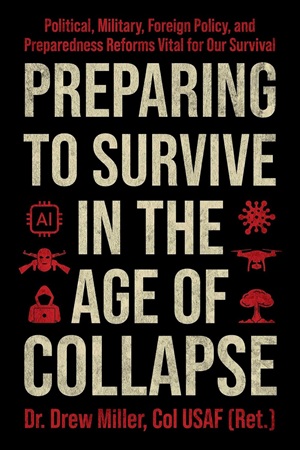
Drew Miller’s Preparing to Survive in the Age of Collapse is a book that dares to say out loud what most liberal democracies prefer to whisper, outsource to thrillers, or dismiss as paranoia: that collapse is not a speculative future event but a slow, grinding present tense. The provocation of the book lies not in its catalogue of disasters — climate breakdown, energy depletion, financial fragility, political decay — but in its insistence that the real fantasy is normalcy. Miller’s central argument is not that civilisation might fail, but that it already is, unevenly, unjustly, and in ways that reward denial among the comfortable while brutalising those without buffers.
From the outset, Miller rejects the reassuring rhetoric of resilience culture. He is scathing about the idea that collapse can be managed through optimism, innovation, or better messaging. “We are trained to believe that tomorrow will resemble today,” he writes, “even when every physical, ecological, and political signal suggests otherwise.” This is not motivational writing; it is an accusation. Miller positions false hope as a form of violence — a mechanism by which elites delay reckoning while offloading risk onto the vulnerable. In this framing, preparation is not fear-mongering but ethical clarity.
What immediately distinguishes Preparing to Survive in the Age of Collapse from the vast literature of prepper manuals and survivalist manifestos is its refusal of heroic individualism. Miller repeatedly undermines the fantasy of the armed, self-sufficient man retreating into the wilderness with stockpiles and rifles. Such figures, he argues, are not rebels but products of the very systems they claim to reject — systems built on extraction, competition, and masculinised domination. “You cannot outgun ecological collapse,” Miller observes flatly, “and you cannot individualise your way out of collective failure.” Survival, he insists, is not about strength but about interdependence.
The book’s most controversial move is its dismantling of technological salvation. Miller takes aim at renewable energy hype, electric vehicles, carbon capture schemes, and digital governance with equal scepticism. He does not deny their partial utility, but he rejects the claim that they constitute solutions. Solar panels, he notes, still require mining, global supply chains, and fossil fuel inputs. Digital systems depend on fragile electrical grids. High-tech agriculture accelerates soil depletion rather than reversing it. “Every solution offered by industrial civilisation,” Miller writes, “is constrained by the very systems causing the problem.” This is heresy in an age addicted to green capitalism.
Miller’s treatment of climate change is deliberately unsentimental. He avoids apocalyptic spectacle in favour of slow attrition: failed harvests, disrupted logistics, declining state capacity. Collapse, he argues, will not arrive as a cinematic rupture but as a series of compounding inconveniences that gradually become lethal. Food will become more expensive before it becomes scarce. Infrastructure will degrade before it fails outright. Democracy will hollow out before it formally ends. This incrementalism is precisely what allows denial to persist. As Miller notes, “People adapt to worsening conditions until adaptation becomes exhaustion.”
The political implications of the book are quietly radical. Miller is unsparing about the role of states, arguing that governments are structurally incapable of addressing collapse because their legitimacy depends on promises of growth, stability, and control. To admit limits would be to admit failure. As a result, states manage perception rather than reality, focusing on symbolic targets and performative legislation. Emergency powers expand while material security contracts. In this context, Miller frames preparation not as retreat from politics but as an alternative form of political action — one rooted in mutual aid, local knowledge, and refusal to participate in destructive systems.
Perhaps the book’s most unsettling chapters are those dealing with morality under conditions of scarcity. Miller does not romanticise community. He acknowledges that collapse will intensify cruelty as well as solidarity. He writes candidly about the likelihood of increased violence, exclusion, and authoritarianism, particularly along racial and class lines. “Collapse does not make people better,” he warns. “It reveals who was protected and who never was.” This refusal to sanitise human behaviour is one of the book’s strengths, even as it will alienate readers seeking reassurance.
Miller’s prescriptions are modest to the point of discomfort. He does not offer grand strategies or universal solutions. Instead, he advocates learning practical skills, reducing dependence on centralised systems, building trust networks, and confronting grief. Grief, he argues, is unavoidable and politically necessary. “You cannot prepare for collapse without mourning what is being lost,” he writes. This is a direct challenge to cultures that treat grief as weakness or pathology. For Miller, unprocessed grief fuels denial; acknowledged grief enables adaptation.
The book’s critics will accuse it of fatalism, and Miller anticipates this charge. He distinguishes carefully between resignation and realism. Preparing for collapse, he insists, does not mean welcoming it or abandoning responsibility. It means refusing to sacrifice the present to fantasies of restoration. “The goal is not to save civilisation,” he writes, “but to save what is humane within it.” This line is the book’s ethical core. Survival, in Miller’s account, is not merely biological persistence but moral continuity.
If Preparing to Survive in the Age of Collapse is unsettling, it is because it denies the reader both villains and saviours. There is no singular enemy to overthrow, no technology to deploy, no leader to follow. There is only a series of choices about how to live as systems unravel. Miller’s provocation is to suggest that collapse is not the end of ethics but its crucible. In refusing the comforts of denial and the theatre of false solutions, the book asks a question few are willing to confront: not how we will save the world, but who we will become as it changes beyond recognition.