For centuries, the ancient Maya have been celebrated for developing one of the world’s most sophisticated systems of mathematics, astronomy and calendrical science, producing calculations that guided royal ceremonies, monumental architecture and religious observances across Mesoamerica. Yet despite the enduring legacy of their scientific achievements, the identities of the scholars who devised these intricate calculations have remained unknown. That has now changed with the identification of the first known Classic Maya mathematician-astronomer to be directly credited for his own intellectual work.
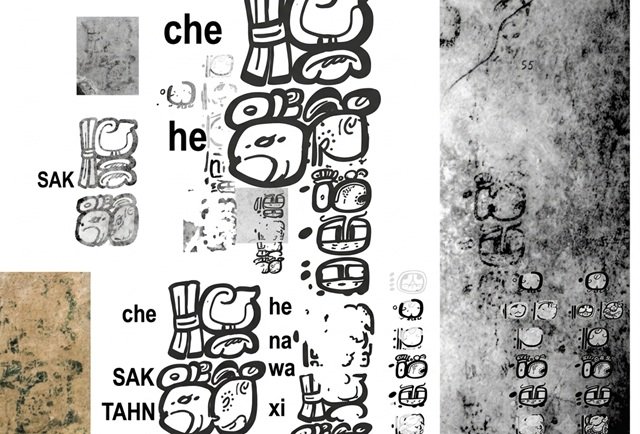
The breakthrough, published online on July 14 in Antiquity, the international peer-reviewed journal of world archaeology, identifies an eighth-century Maya scholar named Sak Tahn Waax, meaning “White-chested Fox,” as the creator of a unique astronomical and mathematical formula discovered at the ancient city of Xultun in present-day Guatemala. Founded by O.G.S. Crawford in 1927, Antiquity is edited in the Department of Archaeology at Durham University and is published in partnership with Cambridge University Press. The newly published study presents what researchers describe as the only known example of a Classic-period Maya mathematician-astronomer whose scientific work can be directly attributed to a named individual.
The discovery emerged from an extensive effort to reconstruct and decipher a faded inscription painted on the interior wall of Structure 10K-2, a small masonry building at Xultun dating to the Classic Maya period between 250 and 900 CE. Archaeologists first uncovered the chamber during excavations between 2010 and 2012, revealing an extraordinary collection of more than 50 mathematical and astronomical “microtexts” alongside painted figures of scribes and officials. Unlike the grand inscriptions typically found on monuments commemorating rulers and dynasties, these texts appear to record the working calculations, numerical tables and draft computations of specialists engaged in astronomical observations and calendrical mathematics.
To recover the damaged inscription, researchers combined traditional archaeological documentation with advanced imaging techniques, including scale drawings, high-resolution photography, multispectral imaging, infrared scanning and digital image enhancement. The painstaking reconstruction revealed eleven hieroglyphs that preserved not only a previously unknown mathematical formula but also an attribution naming its author as Sak Tahn Waax.
The inscription is exceptional for more than its signature. Researchers found that the mathematical formula employs familiar Maya calendrical and astronomical units—including the 260-day ritual calendar, the 365-day solar year, and the observed cycles of Venus and Mars—but arranges them in a way never before documented in surviving Maya texts. The formula reflects an original understanding of relationships between multiple celestial cycles, leading researchers to conclude that Sak Tahn Waax was not merely copying established knowledge but presenting his own mathematical interpretation based on astronomical observations.
For archaeologists and epigraphers, the discovery fills a longstanding gap in the historical record. While signatures of Maya artists and sculptors have previously been identified on painted ceramic vessels and carved monuments, the scholars responsible for the elaborate calculations that underpinned Maya astronomy and timekeeping had remained anonymous. The newly deciphered inscription now provides the first direct evidence that a Classic Maya mathematician-astronomer claimed, or was formally acknowledged for, an original scientific contribution, offering an unprecedented glimpse into the intellectual traditions of one of the ancient world’s most accomplished civilizations.