by Durga
Charles Ferguson’s Presidential Seclusion presents itself as a history of Camp David, but in truth it is a far more unsettling mirror held up to American power itself—its contradictions, its rituals of secrecy, and its yearning for solitude disguised as strength. What Ferguson calls “the Spirit of Camp David” is not merely the charm of wooded Maryland hills or a quaint legacy of Rooseveltian retreat; it is the distilled essence of presidential isolation. “Roosevelt kept information about the place as hush-hush as possible because he wanted privacy and relaxation above all else,” Ferguson writes, but the reader quickly realizes this “hush-hush” instinct metastasized into a governing principle of the modern presidency: that the leader of a republic must increasingly rule from behind walls, silence, and distance.
The book begins in the mythic shadows of Franklin D. Roosevelt’s creation of “Shangri-La”—a name borrowed from the utopian refuge of Lost Horizon. Roosevelt’s Shangri-La, Ferguson insists, “allowed him the space to look at the world from a fresher perspective with a clear mind and heart.” It’s a tender image, but one that also raises disturbing questions about how a leader of a democratic state could govern through a fantasy of withdrawal. FDR designed his cabin himself, a metaphor for control masquerading as retreat. In Ferguson’s account, he drove mountain roads “stealthily,” relishing a rare autonomy that “no president would enjoy again.” When a local woman, shotgun in hand, refused to believe the stranger before her was the president of the United States, FDR retreated—humbled, perhaps, but still insulated. Ferguson reads the incident as comic. A more critical eye would see it as emblematic: even in seclusion, the presidency is defined by trespass.
Ferguson’s chronicle of “presidential seclusion” reads, at its best, as an unintentional study of the pathology of power. He wants to celebrate Camp David as an oasis of diplomacy, but the anecdotes he assembles often betray a darker truth—that isolation breeds both delusion and dependency. “In the mountains,” he quotes, “Nixon was forever plotting, planning revolutions great and small.” The line, taken from one of Nixon’s aides, has the rhythm of a confession. Ferguson calls Nixon’s retreat “a refreshing island of respite,” but what emerges from his own documentation is paranoia’s perfect architecture: a mountain stronghold from which a besieged ruler could imagine himself reasonable. “For all its cosmopolitan self-confidence, Washington is a parochial city,” Nixon reflected, “and I felt a need to get out in order to keep some sense of perspective.” Yet Camp David offered not perspective but echo. Nixon’s “loss of privacy and sense of isolation” were not paradoxes—they were identical conditions, cultivated deliberately in the name of self-preservation.
Ferguson’s refusal to confront the moral paradox of this “seclusion” is where his narrative becomes most provocative. He describes Eisenhower and Khrushchev’s 1959 Camp David summit as evidence that “the Spirit of Camp David was alive and well,” a place where “world-changing things through strong relationships and few distractions” could occur. But this phrase—“few distractions”—conceals as much as it reveals. In Ferguson’s own words, Camp David’s appeal rests on its “absence of press and prying eyes.” That absence, presented as virtue, is in fact the structural problem of modern executive power: its insulation from scrutiny, its ritual of vanishing whenever accountability approaches. Camp David, Ferguson admits, “proved someone’s importance to the president.” It is therefore not a democratic space but a sacred one, where proximity to the leader becomes initiation into mystery.
The book’s most striking episodes emerge when Ferguson’s reverence falters. He recounts the infamous chandelier collapse during Roosevelt’s stay—“the chandelier slipped out of its suspended iron rim and crashed onto the table below where hours before the president had sat.” No one heard the crash. “Roosevelt was not told of this, nor have I seen the story published heretofore.” In that eerie silence—an accident concealed from a leader lest it disturb his calm—Ferguson unknowingly exposes the system he celebrates. Presidential seclusion is not merely physical; it is epistemological. Presidents do not only hide from the public; their entourages hide the world from them.
This dynamic reaches its grotesque peak in Ferguson’s treatment of Nixon and his successors. “The biggest surprise of the first year,” Nixon said, “was the paradoxical combination of loss of privacy and sense of isolation.” Ferguson repeats this quote as lamentation, but it is in fact indictment. Every president since FDR has inherited this “combination” as gospel. Carter used the retreat to stage escapades designed to fool the press: “He took Marine One to Camp David so the press would see him land,” Ferguson writes. “Once they confirmed arrival…he and his guests changed clothes and flew to another location.” The anecdote is recounted with admiration for Carter’s cleverness, but the deception is chilling—a literalization of democratic distance. Even transparency becomes theatre, and the press, those supposed sentinels of democracy, reduced to dupes at the mountain gate.
When Ferguson turns to the twenty-first century, his tone slides from reverence to outright myth-making. He invokes “the Spirit of Camp David” as if it were a living force, “an ideal location to talk with adversaries and to conduct discussions with those who disagree.” But the language of “spirit” is theological, not analytical. The president is not a prophet, and Camp David is not a shrine. To call it such is to enshrine secrecy as sanctity. The book’s discussion of Trump’s proposed Taliban talks—“Some pretty bad actors have travelled through that place throughout recorded history,” Secretary Pompeo quipped—is presented as proof of the site’s diplomatic neutrality. But the scene is Orwellian: a government justifying clandestine negotiations with terrorists by appealing to tradition, as if secrecy itself were patriotic. Ferguson calls the uproar “chatter,” reducing public outrage to noise.
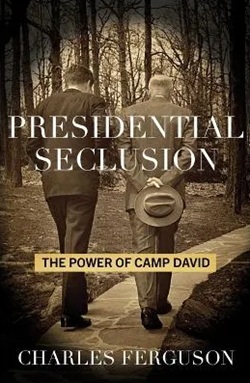
Where Ferguson does achieve something unexpectedly profound is in his portrayal of decay. The later chapters, especially those tracing Biden’s presidency, read like a quiet eulogy for the institution of retreat. “The privacy and seclusion of the retreat provided an ideal location to prepare for the high-stakes debate,” he writes of Biden’s 2024 debate prep. “Ultimately, the preparation did not provide the results his team hoped for.” The juxtaposition is brutal. Camp David, once the stage of summit diplomacy, becomes a bunker for a faltering incumbent, “roundly criticized for his performance.” Ferguson, perhaps unwittingly, documents the collapse of the myth he built: seclusion no longer preserves authority; it magnifies decline. The same mountain that hosted the Camp David Accords now hosts political withdrawal. Biden’s retreat after the debate—“Reminiscent of Nixon’s final visit to Camp David, President Biden huddled with his family to discuss his political future”—completes a grim symmetry. The mountain that once symbolized renewal now marks resignation.
Ferguson’s prose, while competent, often lapses into the tone of a National Park Service pamphlet. He writes of Obama’s G8 summit that “the surroundings gave us an opportunity to hold some intimate discussions and make some genuine progress.” This could serve as state propaganda, not critical history. When he repeats the line that “The Spirit of Camp David was alive and well,” the reader might wish he would interrogate whose spirit that really is—the ghosts of dead presidents, or the specter of power without witness. The author’s moral neutrality is itself a political act: to describe the machinery of seclusion without naming its consequences is to endorse it.
And yet, in its very blindness, Presidential Seclusion becomes a revealing document. Ferguson’s uncritical reverence exposes the cultural pathology that birthed the presidency-as-priesthood. The fact that “Roosevelt could relax and recover from the demands of running a country” is presented as triumph rather than warning. The fact that “the president could drive himself” at Shangri-La is treated as quaint liberty rather than a commentary on the infantilization of the office. Again and again, Ferguson mistakes retreat for reflection, and silence for wisdom.
What the book unintentionally demonstrates is that Camp David is the perfect metaphor for American executive power: a cloister built on the illusion of openness, a democratic monarchy sustained by distance from the people it claims to represent. “Because of the seclusion and relaxed atmosphere,” Ferguson writes, “it is the ideal location to talk with adversaries.” The sentence could serve as epitaph for the modern presidency itself—a realm where one can speak with enemies abroad but not citizens at home.
In the end, Presidential Seclusion reads like an archive of contradictions. Its anecdotes—FDR’s reckless joyrides, Nixon’s ghostwriting marathons, Carter’s deceitful escapes, Biden’s melancholy withdrawal—are less about the human need for rest than about the structural alienation of American leadership. Ferguson means to sanctify a landscape; what he reveals is a pathology. The “Spirit of Camp David,” that elastic phrase of comfort, is not the spirit of diplomacy but of detachment. Presidents climb the mountain to find peace, but what they find instead is themselves—unwatched, unchallenged, and, ultimately, alone.