by Nil
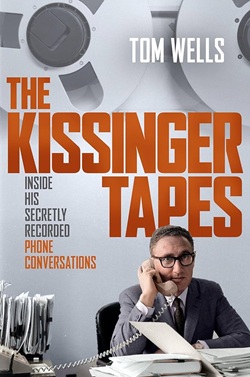
Tom Wells’s The Kissinger Tapes arrives with the aura of a historical revelation, yet its deeper significance lies less in the novelty of the documents than in the unsettling portrait they collectively construct. The book assembles transcripts of thousands of secretly recorded telephone conversations made by Henry Kissinger during his tenure as national security adviser and later secretary of state. These conversations, as Wells observes, “convey the mood in which major decisions were made” (p. 6), compressing high politics into the intimate immediacy of phone calls, gossip, and bureaucratic manoeuvring. The result is not merely a documentary collection but a destabilising counter-archive of American diplomacy. Where the official record often presents foreign policy as strategic deliberation, the tapes reveal something far messier: a world of improvisation, deception, calculation, and personal rivalry in which the moral vocabulary of statecraft frequently dissolves into profanity and tactical cynicism.
Wells’s central claim is that these conversations offer an unusually granular perspective on power, one that exposes both the everyday functioning of American foreign policy and the personality of the man orchestrating it. The tapes show Kissinger operating “on a daily, even hourly or minute-by-minute basis” (p. 4), conducting diplomacy through a constant stream of phone calls that blur the boundaries between strategic planning, public relations, and internal intrigue. In one early conversation about bombing Cambodia, Kissinger insists that the real question is not immediate political reaction but whether the war will end sooner: “the really key question is how can one bring it to a conclusion more quickly” (p. 19). The remark is chilling not because it is overtly brutal but because it reveals a technocratic logic in which violence is instrumentalised as a variable within a strategic equation. Wells repeatedly emphasises this pattern: policy emerges not from formal deliberation but from improvised exchanges among a small circle of men who treat global conflict as a tactical problem.
Yet Wells is careful not to reduce Kissinger to a caricature of cynical realpolitik. The book’s most provocative argument is that the tapes simultaneously confirm and complicate the polarised reputations that have long surrounded him. Kissinger, Wells notes, appears “at turns, brilliant, with an exceptionally quick, powerful, and wide-ranging mind,” yet also “arrogant, caustic,” and relentlessly controlling (p. 11). The transcripts reveal a figure capable of intellectual agility and bureaucratic ruthlessness in equal measure. His humour, sometimes mordant and sometimes merely petty, surfaces frequently; so too does his habit of belittling colleagues. In one aside he dismisses American corporate leaders with characteristic contempt: “American businessmen are certified morons” (p. 5). Such remarks are not incidental colour. Wells treats them as evidence of a governing temperament shaped by elitism and suspicion, a style of leadership that simultaneously seduced allies and alienated rivals.
The ethical implications of this governing style form the book’s most contentious terrain. Wells does not explicitly accuse Kissinger of criminality in every instance, yet he places the tapes within a broader historiographical debate about war crimes and moral responsibility. The conversations surrounding the Vietnam War are particularly unsettling. At one point Kissinger and Richard Nixon discuss bombing targets and the possibility of expanding attacks, treating escalation as a manageable tool of pressure rather than a humanitarian catastrophe. In another exchange Nixon casually declares that the United States will strike missile sites without public explanation: “We don’t have to explain it. It’s the Thais defending their own country” (p. 66). The banality of the language—its bureaucratic calm—renders the underlying violence more disturbing. Wells’s editorial framing underscores this point, reminding readers that such conversations occurred alongside massive bombing campaigns in Vietnam, Cambodia, and Laos.
Perhaps the book’s most damaging contribution to the historical record lies in its documentation of deception. The transcripts repeatedly show Kissinger navigating leaks, congressional investigations, and press scrutiny with a mixture of evasion and calculated dishonesty. Wells emphasises that he “lies frequently to his colleagues and journalists” and sometimes even denies conversations that clearly took place (p. 11). In a discussion of the controversial wiretapping programme, Kissinger insists that “by no conceivable stretch of the imagination could my office have had an interest in it” (p. 477), a claim Wells juxtaposes with documentary evidence showing his earlier involvement. These moments illustrate not simply individual duplicity but a broader political culture in which secrecy and plausible deniability were normalised tools of governance.
Yet the book’s narrative is not entirely one-sided. Wells repeatedly acknowledges Kissinger’s formidable abilities as a strategist and bureaucratic operator. The tapes reveal a man with extraordinary stamina, juggling crises across continents while simultaneously managing the internal politics of the Nixon administration. They also capture the peculiar intimacy of the Nixon–Kissinger partnership. Nixon appears in the transcripts as both patron and antagonist, relying heavily on Kissinger’s expertise while distrusting his loyalty. Kissinger, for his part, consistently addresses him as “Mr. President,” an almost ritualistic formality that underscores the asymmetry of their relationship (p. 11). The effect is to portray American foreign policy not as the product of institutional consensus but as the outcome of a volatile personal alliance between two ambitious and suspicious men.
Wells’s editorial method deserves scrutiny as well. By presenting extended transcripts with minimal narrative intrusion, he allows readers to witness the conversations almost in real time. This approach has clear advantages: the raw dialogue conveys the texture of decision-making in a way conventional narrative history rarely achieves. Yet it also raises interpretive questions. The conversations are fragments, stripped of some contextual documents and sometimes sanitised by Kissinger himself before release. Wells acknowledges that portions of the transcripts were edited or deleted before entering the archive (p. 13). The historian therefore confronts a paradox: these records appear candid yet are themselves products of selective preservation. Wells is refreshingly transparent about this limitation, though the book’s polemical edge occasionally pushes beyond what the surviving evidence alone can sustain.
What ultimately makes The Kissinger Tapes so provocative is not merely the revelations it contains but the broader intellectual challenge it poses. The book destabilises the conventional mythology of Cold War diplomacy by exposing the improvisational and often morally ambiguous processes behind policy decisions. Kissinger emerges neither as the master strategist celebrated by admirers nor solely as the villain depicted by his harshest critics. Instead he appears as a complicated operator—brilliant, manipulative, ambitious, and frequently ruthless—whose actions were embedded in a wider culture of secrecy and geopolitical calculation.
In that sense, Wells’s work functions less as a final verdict on Kissinger than as an invitation to reconsider the architecture of power in late twentieth-century American foreign policy. The tapes reveal how easily the language of strategic necessity can obscure human consequences, how quickly bureaucratic rivalries can shape global events, and how thin the boundary can be between statecraft and manipulation. The book’s most unsettling implication is that the behaviour documented in these transcripts may not be exceptional. Rather, it suggests that the logic of Cold War realpolitik produced a political environment in which such conduct was not only tolerated but rewarded.
If Wells’s tone occasionally veers toward prosecutorial zeal, the underlying archival achievement remains formidable. By assembling and contextualising these conversations, he provides historians with an unusually intimate record of power in action. The result is a book that reads at times like a political thriller and at others like a forensic investigation of statecraft itself. For readers willing to confront its uncomfortable implications, The Kissinger Tapes offers something rarer than scandal or vindication: a raw, unsettling glimpse into the moral psychology of modern diplomacy.