Editor’s Note: The excerpt that follows is adapted from Family of Spies: A World War II Story of Nazi Espionage, Betrayal, and the Secret History Behind Pearl Harbor, by the author, published by Celadon Books.
In December 1944, Friedel finally received the news she had been waiting for. Along with her children, Hans and Ruth, she was to be sent back to Germany as part of a prisoner exchange involving captured and wounded Americans held in Germany, Japan, and Italy. Perhaps pressure from the German government had worked—the Reich wanted its spies returned. Escorted from the Crystal City internment camp, Friedel and her children endured a thirty-hour train journey to Jersey City. On January 7, 1945, they walked up the gangplank of the MS Gripsholm alongside other German and Japanese civilians and prisoners of war who had been interned in the United States.
As the ship slowly made its way down the Hudson River and out into the Atlantic, Friedel caught one last glimpse of the city that had been her entry point nearly a decade earlier. As the mainland faded from view, no one stood to wave goodbye. She would never see Eberhard again.
The ship arrived in Marseille, placing Friedel, Hans, and Ruth just hours from home. But their journey stalled there. Germany had agreed to exchange 875 prisoners, yet the list of Allied prisoners slated for release numbered only 713. Until an agreement could be reached, no one was allowed to leave Marseille. After intense diplomatic negotiations, Germany agreed to immediately hand over forty-six additional captives held in the notorious Bergen-Belsen concentration camp and to release another three hundred in the “near future.” Among the sixty thousand prisoners held there was Anne Frank, who would die under the horrific conditions before any further inmates were freed.
Once the stalemate was resolved, Friedel and her children were loaded onto one of two trains bound for Montreux, Switzerland. From there, they were transferred to another train and taken to Kreuzlingen, just outside Germany’s southern border. They arrived on January 24, 1945. This was the exchange point—the final prisoner swap of the war.
They watched as a train from Germany pulled into the station, carrying roughly the same number of detainees and prisoners of war who had been held by Italy and Germany. As Friedel, Hans, and Ruth boarded the train, they passed wide-eyed men, women, and children who had been interned by Germany and were now traveling in the opposite direction. Neither side knew what awaited them.
An hour later, the train crossed the Rhine River. The Kuehns were home. Their destination was Berlin, where the German army was fighting a losing battle against Soviet forces while the Allies advanced steadily from the west. The city they reached bore little resemblance to the capital they had once known. Weeks of artillery fire and relentless Allied bombing had reduced Berlin to rubble. Steel pillboxes dotted the landscape, streets were cratered and impassable, and mountains of shattered glass and brick lay everywhere. The skyline was grotesque—buildings mangled by bombardment loomed through dust and smoky haze.
Their travel documents listed Leopold’s house at 10 Laubenheimer Strasse as their final destination. Leopold and his wife, Ursel, now had two sons, born in 1938 and 1940. Friedel looked forward to reuniting with Leopold and meeting his family for the first time. But she quickly realized Berlin was far too dangerous. The reunion would have to wait.
The grim truth was that nowhere was safe. Allied bombs fell on cities large and small across Germany. Hamburg, Friedel’s hometown, had been devastated by a weeklong firestorm that turned the city into an inferno. Frankfurt was under siege. Munich offered no refuge. After weighing her options, Friedel chose Bregenz, Austria—an ancient city with roots stretching back to the Roman Empire. Evading constant Allied air attacks, Friedel, Hans, and Ruth arrived to find the city remarkably untouched. Friedel hoped they would be safe there.
Meanwhile, Leopold had sent Ursel and their sons out of Berlin to Spremberg, a small city ninety miles south. Though far from secure, it was spared the worst of Berlin’s devastation. Soviet troops were gathering just thirty-five miles from the capital, amassing more than a million soldiers and over six thousand tanks. Despite this looming threat, daily life continued in a grotesque imitation of normalcy. Nazi flags still hung defiantly from battered buildings, while propaganda slogans scrawled on walls urged citizens to fight to the death.
Leopold was forbidden to leave Berlin. Joseph Goebbels had assigned him to defend the crumbling heart of the Nazi empire. On February 18, 1945, shortly before the final siege, Leopold wrote to Ursel. He told her that Friedel, Hans, and Ruth were in Bregenz but could not remain there long. He urged Ursel to leave Spremberg immediately and proposed that the family consolidate into a single household in southern Germany. Though he acknowledged the difficulties—financial strain, personal tensions—his overriding concern was her safety.
Leopold instructed Ursel to pack at once, securing anything she could not carry. He feared the advancing Russians but had no power to help, as he was trapped in Berlin. His letter ended with tenderness and resolve, urging her to be strong and promising they would soon be reunited.
At the same time, Leopold’s brother Eberhard was undergoing basic training at Fort Bliss, Texas. His hatred of the Nazis had grown steadily over the past decade. Soon, he and his fellow teenage soldiers would be sent into combat. For Eberhard, this carried a horrifying possibility—he might face his own brother on the battlefield. In March, his unit received its orders. They were heading to the front.
The final Allied assault on Berlin began on April 16, 1945, as more than a million Soviet soldiers and a vast armored force surged toward the city. Four days later, Hitler was informed that Soviet troops had reached Berlin’s outskirts. That evening, Nazi leaders gathered deep underground in the Führerbunker to celebrate Hitler’s birthday. It would be their last celebration.
The next day, Leopold listened as radios broadcast Goebbels’s final speech, delivered from beneath the city amid the thunder of artillery. Goebbels declared that Berlin would stand and that he and his family would remain there. Within hours, Soviet forces unleashed a relentless bombardment that continued for days. By April 30, only ten thousand German defenders remained—many of them policemen, schoolboys, and elderly men.
Leopold was among this desperate final resistance. Deep in the bunker, Hitler tested cyanide on his dog, Blondi, then retreated with Eva Braun, whom he had married the night before. Braun took poison; Hitler shot himself. Their bodies were carried outside, drenched in gasoline, and burned as bombs continued to fall on Berlin.
The following day, Goebbels and his wife murdered their six children with morphine and cyanide before killing themselves. On May 2, 1945, Berlin surrendered. The war in Europe was over.
Across Germany, women, children, and the elderly vastly outnumbered able-bodied men. Families dragged carts piled with possessions, searching for safety amid the ruins. Friedel, Hans, and Ruth faced the same desperate conditions as they made their way south. Eventually, they reached a small town where they reunited with Ursel and her children. For the first time in years, Friedel could breathe.
Ursel, however, was anxious. She had not heard from Leopold in weeks. Soon, the truth emerged. Leopold had been mortally wounded in an explosion during the final battle and died the day after Germany surrendered.
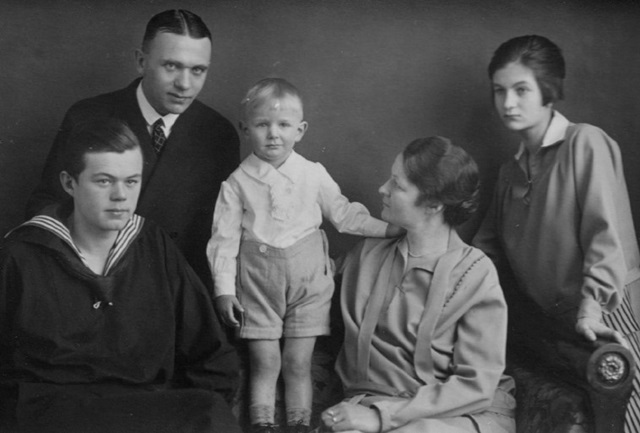
Photographs taken months later show a postwar family reunion in the countryside. Friedel stands at the center, matriarchal and resolute. Around her are Ruth, Hans, Ursel, and the children—each marked by loss in different ways. Friedel had shaped their destinies, often with tragic consequences.
As Friedel mourned Leopold, another son was fighting for his life in the Pacific. On April 1, 1945, American forces landed on Okinawa. For eighty-two days, nineteen-year-old Eberhard Kuehn endured brutal combat against a Japanese army that refused to surrender. The war in Europe had ended—but the struggle was far from over.