by Durga
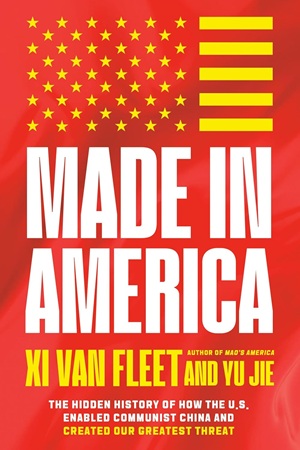
Xi Van Fleet and Yu Jie’s Made in America is a book that positions itself not merely as memoir or polemic but as warning siren — and it does so with an urgency that borders on obsession. Framed as a personal reckoning with two political systems, Maoist China and contemporary liberal America, the book advances a deeply controversial thesis: that the United States is not drifting towards authoritarianism by accident, but actively importing the ideological machinery of the Chinese Communist Party under the benign language of progress, safety, and justice. The provocation lies not only in what the authors claim, but in how unapologetically they refuse the reader’s comfort.
At its core, Made in America is animated by comparison. Xi Van Fleet recounts her childhood during the Cultural Revolution with a level of detail that resists abstraction. She describes being taught that loyalty to the Party superseded loyalty to family, that teachers could be denounced, parents humiliated, neighbours erased. “We were taught to destroy the Four Olds,” she recalls — old ideas, old culture, old customs, old habits — and to understand destruction as virtue. The power of these passages lies in their banality. Indoctrination, she insists, was not theatrical; it was routine. Ideology worked because it became normal.
The book’s most incendiary move is its insistence that this same normalisation is occurring in the United States. The authors repeatedly draw parallels between Maoist struggle sessions and contemporary practices of public shaming, cancellation, and ideological policing. Xi writes that she recognises the emotional architecture immediately: “the language, the fear, the pressure to conform, the demand for confession.” What makes this claim explosive is not the comparison itself — which critics will dismiss as hyperbolic — but the authors’ insistence that lived experience grants epistemic authority. This is not theoretical anti-communism; it is memory speaking.
Yu Jie’s contributions sharpen the political edge. Where Xi’s narrative is experiential, Yu’s is diagnostic. He argues that Western democracies are uniquely vulnerable to ideological subversion precisely because of their moral confidence. “A free society,” he writes, “assumes good faith even when it is being dismantled by bad ideas.” The book repeatedly accuses American institutions — universities, media organisations, corporations — of adopting the methods of authoritarian governance while insisting on their moral superiority. The charge is stark: America is mimicking the tools of repression while congratulating itself for doing so in the name of justice.
Education emerges as a central battleground. Xi’s descriptions of Maoist classrooms are chilling in their familiarity. Children were encouraged to correct teachers, to report parents, to memorise slogans rather than ask questions. Knowledge was less important than obedience. When the authors turn to contemporary American schools, they argue that ideological conformity has again replaced intellectual curiosity. Students are taught what to think before they are taught how to think. The language has changed; the structure has not. “Indoctrination,” Xi writes, “does not announce itself as tyranny. It arrives as care.”
The book is particularly unsparing in its treatment of identity politics. Xi and Yu argue that the reduction of individuals to group identities mirrors the collectivist logic of communist regimes. The insistence that moral worth derives from group membership, they contend, erodes personal responsibility and encourages perpetual grievance. This is one of the book’s most controversial claims, not least because it positions anti-racism and social justice movements as structurally authoritarian. The authors are careful to distinguish between moral equality and ideological enforcement, but the distinction will not satisfy all readers. Indeed, it is designed not to.
Where Made in America risks overreach is in its sweeping generalisations. The authors sometimes collapse disparate movements, policies, and cultural trends into a single ideological enemy. Nuance is sacrificed for urgency. Yet this too appears intentional. The book is less interested in persuading sceptics than in mobilising those who already sense something is wrong but lack a language to articulate it. In this sense, Made in America functions as counter-indoctrination: a narrative designed to interrupt consensus.
The emotional centre of the book is fear — not the fear of oppression returning in identical form, but the fear of repetition through adaptation. Xi writes that what terrifies her is not slogans or statues, but silence. “People knew what was happening,” she recalls of China, “but they were afraid to speak.” When she observes similar silences in America — colleagues self-censoring, institutions issuing apologies under pressure, dissent reframed as harm — the parallel feels less rhetorical and more psychological. The book argues that authoritarianism succeeds not through brute force but through the internalisation of limits.
The authors reserve particular scorn for elites who believe themselves immune. Intellectuals, they argue, are often the first to collaborate, convinced that their sophistication exempts them from consequence. This, too, echoes Xi’s childhood memories, where educated families were among the earliest targets. “Education did not protect us,” she writes. “It marked us.” The implication is deliberately unsettling: that those who believe themselves progressive, enlightened, and historically literate may be repeating patterns they claim to oppose.
Made in America is not a balanced book, nor does it pretend to be. It is a polemic shaped by trauma, conviction, and moral urgency. Its critics will accuse it of fear-mongering, false equivalence, and political opportunism. Its defenders will argue that it names truths others are too polite or too compromised to acknowledge. What cannot be denied is that it forces an uncomfortable question: how does a society distinguish between moral progress and ideological coercion before it is too late?
In the end, the book’s most provocative claim is not that America is becoming China, but that it no longer believes it could. Xi and Yu argue that the refusal to imagine collapse is itself a vulnerability. Made in America does not ask the reader to agree with every comparison it draws. It demands something more basic and more unsettling: vigilance. Whether one finds its warnings prophetic or paranoid, the book insists that freedom, once lost, is rarely lost all at once — and almost never announced in advance.