


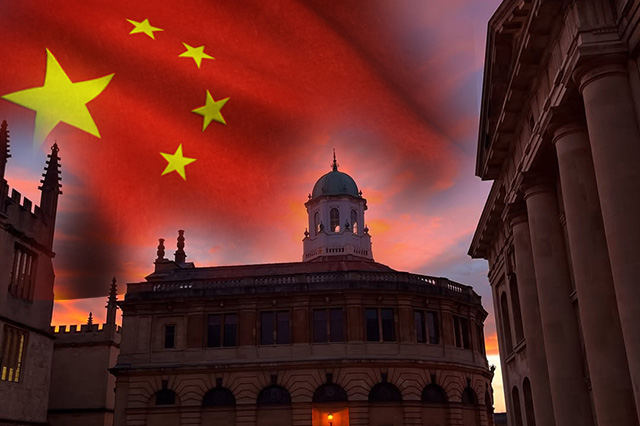
British universities have continued to sign agreements with Chinese defense universities, despite a stark warning from MI5 about espionage risks and the potential for inadvertently aiding Chinese military research.
In the wake of a security alarm last April, at least 23 British universities have entered into partnerships with Chinese institutions deemed to have significant ties to China’s military. MI5’s director-general, Ken McCallum, had briefed university leaders that hostile states, including China, were targeting sensitive UK research to advance their military capabilities and undermine British national security.
Yet, according to The Times, at least seven British universities have signed or renewed deals with Chinese universities flagged as posing a high risk for military-related research. The collaboration with these institutions has raised alarms among security experts, who believe these partnerships could facilitate surveillance, human rights abuses, and military technology development, posing a significant threat to UK national security.
In response to MI5’s warning, the Australian Strategic Policy Institute (ASPI) identified several Chinese universities linked to the defense sector, such as Northwestern Polytechnical University (NWPU) and Harbin Engineering University, as key players in China’s military research. Despite these concerns, universities such as Queen Mary University of London, Robert Gordon University in Aberdeen, and Aberdeen University have maintained or pursued new agreements with these Chinese universities.
Queen Mary University, for example, renewed a collaboration with NWPU, a member of the “Seven Sons of National Defence” — a group of Chinese universities deeply integrated with the military. Similarly, Robert Gordon University partnered with NWPU’s National Subsea Centre, which specializes in naval technology, unmanned aerial vehicles, and space technology.
Aberdeen University also extended its relationship with Harbin Engineering University, known for its research in shipbuilding, naval armaments, and maritime technology, all critical to China’s defense capabilities. These ongoing collaborations have raised concerns about the role British academic institutions might play in supporting Chinese military objectives.
These partnerships come despite previous warnings from MI5 and Parliament’s Intelligence and Security Committee, which expressed fears over China’s influence in UK academia. Lord Beamish, chair of the Intelligence and Security Committee, underscored the importance of transparency and the implementation of measures to monitor foreign interference in research. His committee’s 2023 report advocated for a public register of universities receiving donations from China, a move that has yet to be fully actioned.
The Times’ investigation, based on Freedom of Information requests, uncovered that several British universities continued to collaborate with high-risk Chinese companies, such as Huawei and Shougang, both linked to China’s military. Imperial College London, for instance, continued its research partnership with Huawei on video generation technology, despite the company being under US sanctions.
This raises concerns over intellectual property theft, with experts pointing out that many of the UK’s research projects with Chinese entities could be exploited for military or surveillance purposes. Former Conservative leader Iain Duncan Smith warned that the reliance of the British defense sector on academic research makes these links particularly dangerous. He emphasized that the practice of using civilian universities for military research is less common in countries like the US, where such collaborations are more tightly regulated.
However, British universities defending these agreements argue that they are conducted with caution. A spokesperson from Robert Gordon University insisted that the institution uses “stringent processes” to assess partnerships, including risk evaluations and collaboration reviews. Universities like Aberdeen and Strathclyde also emphasized their adherence to UK regulations and security guidelines when engaging with international partners.
Despite these reassurances, concerns about the long-term consequences of these partnerships persist. Luke de Pulford, executive director of the Inter-Parliamentary Alliance on China, criticized the academic sector for becoming “vulnerable to malign foreign interference” due to financial pressures and competition for Chinese investment.
The growing number of agreements between British universities and Chinese military-linked institutions highlights the increasing tension between academic collaboration and national security, especially as the geopolitical rivalry between China and the US intensifies. As the UK grapples with the risks posed by these partnerships, there are calls for more robust measures to ensure that academic institutions are better equipped to identify and manage potential security threats.
A government spokesperson reassured the public that the UK has implemented a “robust approach to risk” in the research sector, with universities being supported in making informed decisions when collaborating internationally. However, as MI5’s warnings continue to echo, the question remains whether these academic ties will endanger national security in the long run.











