President Donald Trump has said he wants Iran to accept “unconditional surrender.” It isn’t clear if this is actually his policy, or just a threat. But whatever it is, the policy of Unconditional Surrender has significant historical roots, and may point to the future of the Iranian regime, and in particular to the “Supreme” Iranian leader, Ayatollah Khamenei.
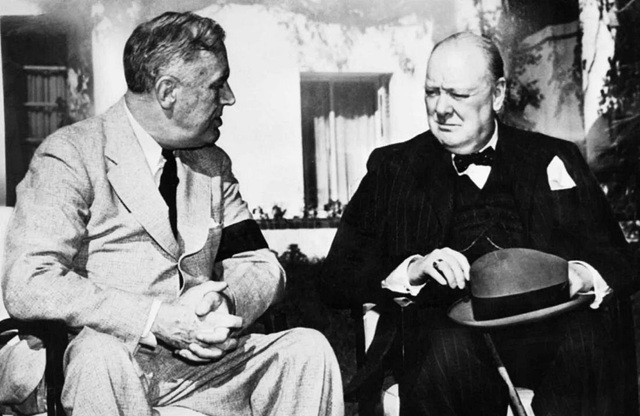
In January 1943, at a high-level meeting in Casablanca, President Franklin Roosevelt announced the Allied policy with respect to Germany, Italy, and Japan would be their Unconditional Surrender. It was not one that British Prime Minister Winston Churchill favored, but it certainly had the support of Joseph Stalin and the Soviet Union – although Stalin was not at the meeting.
The declaration cemented the Allied decision to invade Sicily, followed by the Italian peninsula, and to delay any cross-Channel operation to send troops into German-occupied France. This fell well short of Stalin’s demand for a real second war front to split German forces and take some of the pressure off the USSR. This was a month before the Russians defeated the Nazis at Stalingrad, and before the war fighting started to turn in Russia’s favor. And so, Unconditional Surrender, to a degree, was to assure Stalin that the Allies intended to go all the way and defeat the Germans.
Roosevelt died April 12, 1945. President Harry Truman would reaffirm the policy of Unconditional Surrender of Japan on May 8th – the day after Germany had surrendered to the Allies.
A significant consequence of the Unconditional Surrender policy was the suicide of Adolph Hitler (allegedly April 30, 1945). Even today, theories about Hitler’s suicide remain controversial, with the Russians carrying out their own investigations, suspecting that Hitler might have escaped. Hitler signed two documents on April 29, 1945: a Political Testament and a Will. Some historians think the Political Testament was written, at least in part, by Joseph Goebbels. In it, Hitler sets up a successor Nazi government to be headed by Goebbels as Reich Chancellor. His singular act as Chancellor, after Hitler’s death, was to authorize German General Hans Krebs to deliver a letter under a white flag to Soviet General Vasily Chuikov, informing the Soviet general of Hitler’s death and requesting a ceasefire. Chuikov rejected Goebbels’ request. With the Soviet rejection, Goebbels and his wife took the lives of their six children and then each other.
If in fact Hitler actually authored the Political Testament and Will, it is strange that he would go to the trouble of setting up a new government and appointing all the ministers as announced in the Testament. It is also strange that the Will does not talk about suicide and does not mention his alleged wife Eva Braun by name.
An alternative theory might go like this. Hitler intended to stay in his bunker until the end, and if he did not survive, a replacement government would take over. In this theory, which is mine, Hitler was “helped” to commit suicide or was simply shot. Once he was out of the way, Goebbels could try and secure a ceasefire. In Hitler’s last few days, he was livid and ordered some of his top aides shot for insubordination. Was that the trigger that forced Goebbels’ hand?
There is relevance here when you apply the alternative theory to events in Iran.
If Trump is serious about Unconditional Surrender, and the Iranian leadership believes him, they may see themselves cornered. Khamenei has already signaled he will not accept demands from Washington which, at minimum, require the complete dismantlement of Iran’s nuclear facilities, and at maximum unconditional surrender to the United States. Khamenei certainly knows his regime will not survive if the US actually enters the war (as Trump says, he knows where Khamenei is). Of interest is whether we will see events unfold that perhaps parallel Hitler’s end in 1945, namely that his backers in the regime prefer a deal with the US than going to their deaths with him.
Unconditional Surrender means, for Iran, regime change.