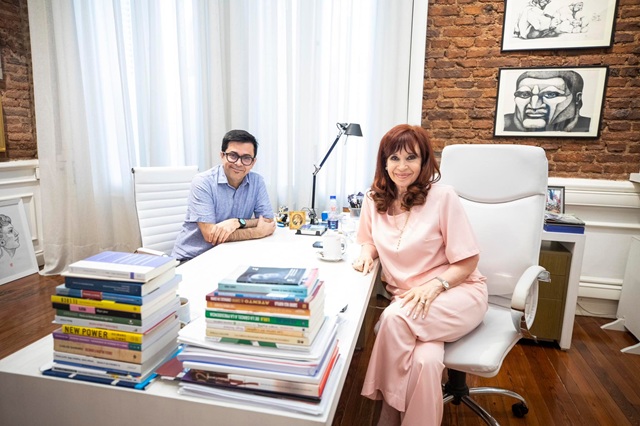
The United States has banned former Argentine President Cristina Fernández de Kirchner from entering the country due to her involvement in what US Secretary of State Marco Rubio called “significant corruption.” This move marks a significant escalation in the Trump administration’s broader crackdown on immigration and its efforts to target left-wing political figures, both domestically and internationally.
In a statement on Friday, Rubio also announced that Kirchner’s longtime planning minister, Julio de Vido, along with members of their immediate families, were also prohibited from entering the US. Rubio, a former Florida senator known for his staunch criticism of left-wing leaders in Latin America, accused Kirchner and de Vido of orchestrating and financially benefiting from a series of bribery schemes involving public works contracts. These schemes allegedly resulted in millions of dollars being stolen from the Argentine government.
“[Kirchner] and De Vido abused their positions by orchestrating and financially benefiting from multiple bribery schemes, resulting in millions of dollars stolen from the Argentine government,” Rubio said in his statement, noting that several courts had convicted the Argentine leaders for corruption.
The move against Kirchner comes after she was sentenced in 2022 to a six-year prison term and banned from holding public office for life on charges of fraud. Although an Argentine appeals court upheld the conviction last year, Kirchner is expected to take her appeal to the Argentine Supreme Court. Despite her legal troubles, she remains a powerful figure in Argentina’s left-leaning Peronist political movement, which is the primary opposition to President Javier Milei’s libertarian government. Kirchner is widely seen as a polarizing figure in Argentina’s political landscape.
Kirchner served as Argentina’s president from 2007 to 2015, during which she significantly shifted the Peronist movement to the left and expanded the size of the state. Afterward, she served as vice-president in the 2019-2023 government. However, the country’s economic troubles, particularly an inflation crisis linked to the Peronist government’s money-printing policies, contributed to Milei’s rise to power in late 2023.
In response to the US sanction, Kirchner took to social media, accusing the Trump administration of siding with Argentina’s right-wing politicians, including Milei and former president Mauricio Macri. She suggested that the US government’s actions were influenced by its alliance with Macri, who secured a $57 billion loan from the International Monetary Fund (IMF) in 2018 with the support of President Donald Trump.
“He still can’t get over the fact that we beat [Macri] at the elections in 2019,” Kirchner said in a post on X (formerly Twitter). She also called on her supporters to participate in a march on Monday, coinciding with the anniversary of Argentina’s 1976 military coup, highlighting her belief that the US had never imposed similar sanctions on Argentina’s military junta leaders.
This rare move by the State Department to bar a former or current international political figure from entering the US comes amid a period of heightened geopolitical tensions. The Trump administration has made similar moves in the past, notably barring Russian officials following the invasion of Ukraine. Rubio’s action serves as a warning to other left-wing political leaders globally that they could face similar measures if they fall out of favor with the US.
The move also comes as Washington is reportedly considering a broad new travel ban targeting citizens from up to 40 countries, including Venezuela and Iran. This policy could be more expansive than the travel restrictions implemented during Trump’s first term, which primarily targeted citizens from several Muslim-majority nations.