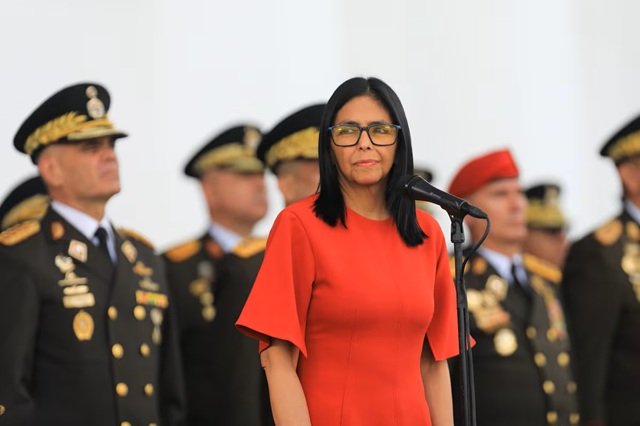
Delcy Rodríguez will travel to New York next week to participate in the United Nations General Assembly, in what will be the first visit by a Venezuelan head of state to the organisation since Nicolás Maduro addressed the assembly in September 2018. But the significance of the visit extends beyond the formal proceedings. On Tuesday, President Donald Trump is due to meet Venezuela’s acting president briefly in what diplomats call an “aside” — an encounter that would have been difficult to imagine when the two governments were defined by open hostility.
The meeting, previously reported by Bloomberg and Axios, has now received official confirmation from Mike Walsh, the United States ambassador to the United Nations. Rodríguez’s journey to the United States represents one of the clearest signs yet of the extraordinary transformation in relations between Washington and Caracas following the operation ordered by Trump at the beginning of the year that resulted in the detention of Maduro. Venezuela has since been described in the supplied account as having become a kind of American protectorate.
The political reversal is unfolding rapidly. Until the overthrow of Maduro, the Venezuelan government had defined itself in opposition to Washington. Now the governments of the two countries are displaying increasing alignment, with economic and security interests at the centre of the relationship.
On 28 August, Trump announced an agreement under which the United States would receive privileged access to more than 65,000 million barrels of Venezuela’s oil reserves, representing almost a quarter of the country’s total reserves. The announcement triggered criticism, but Trump defended the arrangement several days later, declaring: “Es un regalo de Venezuela al pueblo de Estados Unidos” — “It is a gift from Venezuela to the people of the United States”.
Trump maintained that the agreement would not cost the United States a dollar and would instead bring benefits to the country. He also said the 65,000 million barrels covered by the agreement would, among other purposes, help replenish America’s strategic reserves, which were then at their lowest level in four decades.
The economic agreement has been accompanied by a marked shift in security cooperation. On Wednesday, Trump announced that Venezuela would be removed from the list of countries deemed to have failed to meet their commitments in the fight against drug trafficking. He attributed the decision to what he described as “positive progress” under Rodríguez’s interim administration.
“Dados los avances positivos logrados bajo la gestión de la presidenta interina Delcy Rodríguez, he decidido que Venezuela ya no debe ser señalada por haber incumplido de manera demostrable sus compromisos de control de drogas”, Trump said in a decree circulated by the State Department. The decision, according to the supplied account, also reflected what Trump described as “growing cooperation” between the two countries in combating drug cartels.
That cooperation has included the joint military operation that neutralised the leader of Tren de Aragua, Niño Guerrero, following the change of government after the detention and removal of what Washington described as the “exdictador ilegítimo y narcotraficante Nicolás Maduro”.
Against that backdrop, Rodríguez’s return to the United Nations carries an unusual historical resonance. The last Venezuelan head of government to address the General Assembly was Maduro, in September 2018, during Trump’s first administration. Before and after that appearance, Chavista diplomacy used the UN platform to denounce the encirclement created by American sanctions, which remain in place, and to assert Venezuelan sovereignty, generally in openly confrontational terms towards Washington.
Rodríguez herself knows the chamber well. She appeared there in 2016 as foreign minister and returned in 2019 as vice-president. During that 2019 appearance, she described American sanctions as a form of “state terrorism” that no longer required bombs but operated through banks and insurance companies. Six years later, with the Chavista government now cooperating with Trump, those earlier words carry an unmistakably different context.
At the time, Rodríguez accused Trump of having “stretched his imperial claws” against Cuba. She argued that peoples such as Venezuelans lacked access to a media apparatus serving the world’s “hegemon” and its satellites, and called on Washington to show less arrogance and greater tolerance towards free nations.
Her intervention was also notable because several delegations left the chamber in protest. It was her last formal appearance at the organisation until her forthcoming intervention as Venezuela’s head of state.
The contrast between those two appearances captures the scale of the diplomatic transformation. The same political movement that once used the United Nations to condemn American pressure is now sending its leader to New York for a meeting with the American president, while the two governments deepen cooperation over energy and counter-narcotics operations.
Rodríguez’s visit will therefore place an unusually visible symbol of Venezuela’s political reversal inside the institution where the country once presented itself as a leading opponent of Washington’s regional influence. Her meeting with Trump, alongside the expanding economic and security relationship, marks a moment in which a relationship defined for years by confrontation is being recast through direct engagement.
According to the representative of the Trump administration, the American president will address the United Nations on the same day and hold other bilateral meetings, including with United Kingdom Prime Minister Andy Burnham and the Japanese prime minister. He will also preside over a meeting with the leaders of the Persian Gulf countries.
For Rodríguez, however, the journey will carry a significance beyond the diplomatic schedule. Her return to the United Nations will place her once again before the international community, but this time from a dramatically altered position: not as the representative of a government denouncing Washington, but as the leader of a Venezuela whose government is increasingly working alongside it.