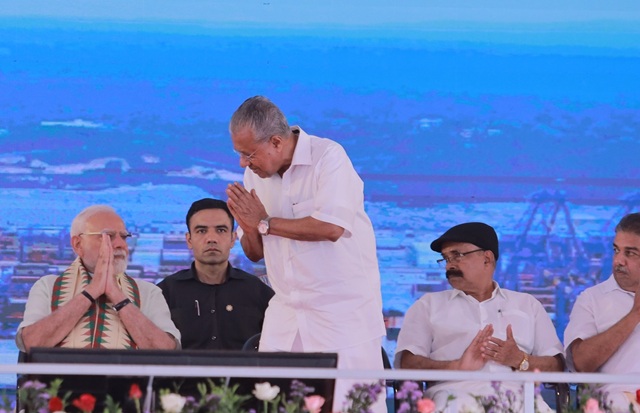
The Vizhinjam Port Project in Kerala, constructed by the Adani Group—a private sector enterprise—in partnership with the Marxist-led Kerala government, is a refreshing development of far-reaching and significant importance, both economically and socially, particularly for the state of Kerala. While this project will undoubtedly transform Kerala into a major economic hub, equally noteworthy is the transformation in the approach and philosophy of the Marxist Communist Party currently governing Kerala, particularly regarding its stance on the private sector and investment.
Principle of Communist Philosophy
The cardinal principle of communist philosophy, as I understand it, is that opportunities should be equally distributed in both economic and social terms for every segment of society. Certainly, communist philosophy is not based on blind hatred or animosity towards what are referred to as private investors (or the so-called corporate sector).
What communist philosophy expects from the private sector is that it should not operate with undue profit as its sole motive, which would amount to exploitation. Nowhere in communist philosophy is it stated that the profit motive is inherently wrong, especially since government-owned and public sector enterprises also need to operate in an economically viable manner—i.e., generating profit, though not excessive or exploitative profit.
Unfortunately, over the years in India, an impression has taken root that communist parties are associated with a sort of hostile and violent stance towards private sector employers. Past leaders of the communist movement in India bear some responsibility for fostering this perception, where violent trade union activities were often regarded as genuine expressions of the working-class movement.
A Violent Approach
I worked for several years at a state government-owned public sector undertaking in Kerala (a chemical industry) at a senior level, during which I was gheraoed and spat upon at midnight by members of a so-called trade union affiliated with CITU during an agitation. I was subjected to more than an hour of harassment, all the while wondering what wrong I had committed and why I was being targeted.
Later, I worked at a senior level in a private sector industry in West Bengal when Mr Jyoti Basu was Chief Minister. At that time, I developed the impression that Mr Basu did not endorse violence as part of the communist movement and recognised the necessity of cooperation from both private and public sectors for the state’s rapid progress.
When Mr Buddhadeb Bhattacharya succeeded Mr Basu as Chief Minister, he appeared to share similar views and actively supported an automobile project proposed by the Tata Group. Unfortunately, that project was sabotaged, and those responsible are well known. Ironically, those very individuals are now in power in West Bengal and are appealing for increased private sector participation in the state’s economic development. However, the private sector remains hesitant due to bitter past experiences.
A Pragmatic Kerala Chief Minister
In this context, the current Chief Minister of Kerala deserves admiration and praise for his courage and conviction in collaborating with the Adani Group to implement the massive Vizhinjam Port Project. This initiative will significantly improve the quality of life, both economically and socially, for people across various layers of society. In other words, the Kerala Chief Minister has effectively and convincingly reshaped the future direction of the communist movement in India.
Earlier, when a massive LNG terminal project with an annual capacity of five million tonnes was established in Kochi, Kerala by the private-sector Petronet Group, there was resistance to laying the gas distribution pipeline within the state. Some trade unions opposed it. The current Chief Minister of Kerala resolved the issue through proactive engagement, and the LNG terminal is now operational, supplying gas to both Kerala and Karnataka.
This stands in sharp contrast to the situation in Tamil Nadu, where the pipeline from the Kochi LNG terminal was not permitted due to protests. The Tamil Nadu government failed to intervene effectively, resulting in the loss of substantial investment opportunities that could have materialised had the gas supply extended into the state.
Given the pragmatic approach of the Kerala Chief Minister, I believe that the massive Sterlite Copper project in Tamil Nadu might not have been closed—based on questionable allegations—if it had been located in Kerala under the present leadership.
A Turning Point
All things considered, the commissioning of the Vizhinjam Port Project as a public-private partnership marks a progressive step forward for the communist movement in India. It represents a significant shift while maintaining the fundamental principles of communist philosophy.
Can we now say that the Vizhinjam Port Project is a sign of a turning point for the communist movement in India?