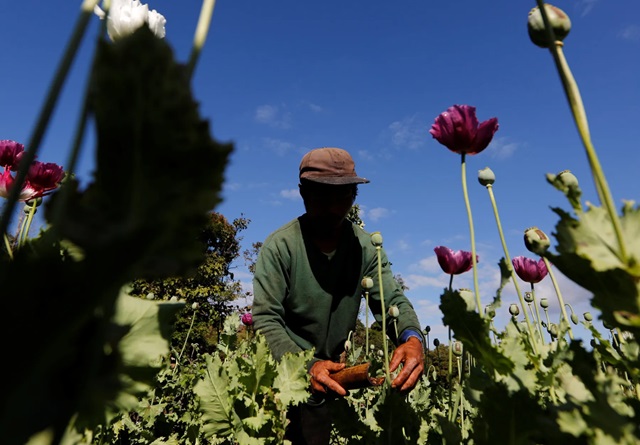
As reported on September 17, 2025, the Anti-Narcotics Force (ANF), Levies Force, Frontier Corps Balochistan, and Police destroyed poppy cultivation in 33,000 acres of land in the Killa Abdullah, Chaman, Pishin, Duki, Harnai, Loralai, Killa Saifullah, Nushki, Kalat, Mustang and Kharan districts.
As reported on July 30, 2025, the Levies Forces and intelligence field formations conducted a poppy eradication operation in the Toba Kakari area of Barshore Tehsil (revenue unit) in Pishin District, destroying approximately 60 acres of illegally cultivated poppy.
As reported on April 12, 2025, in an anti-poppy operation led by the Assistant Commissioner of Karezat, along with Levies Forces and intelligence field formations, four acres of illegal poppy fields were cleared in the Khanozai area of Karezat District.
On March 7, 2025, the district administration, in collaboration with the Levies Force and ANF, carried out a joint operation destroying poppy crops planted on more than 100 acres of land at Dalbandin in Chagai District.
As reported on December 16, 2024, in an operation in ??Chagai District, the Levies Force destroyed the poppy crop cultivated on 10 acres, about 80 kilometres from Dalbandin.
Significantly, as reported on April 8, 2025, ANF and Excise and Taxation and Anti-Narcotics Department of Balochistan signed a Memorandum of Understanding (MoU) to enhance cooperation to curb drugs smuggling. Director General ANF Major General Abdul Moeed and senior officers of ANF were also present on this occasion. The MoU aimed at mutual data transfer, operational cooperation and timely analysis of drug trends.
Further, on September 10, 2025, Balochistan Chief Minister Mir Sarfraz Bugti reaffirmed his government’s commitment to eradicate poppy cultivation from the province, warning that strict measures would be taken against anyone found involved in the practice. Addressing the Balochistan Assembly, Bugti disclosed that, with the support of the federal government, poppy crops had already been eliminated from more than 36,000 hectares of land. “Poppy cultivation will not be tolerated, whether by local landowners or individuals crossing the border,” Bugti declared, “We will arrest offenders, confiscate their land, and destroy the crop before it matures.”
Earlier, on July 31, 2025, raising the issue on the floor of the Balochistan State Assembly, Member of the Provincial Assembly (MPA) Zabid Reki from Dalbandin said the shift of poppy cultivation from Afghanistan into Pakistani territory was an alarming development. “After Afghanistan’s ban on opium, poppy growers are now moving into Baloch and Pashtun regions of Pakistan. This is disastrous,” Reki said. “The unchecked expansion of this crop is poisoning our youth and must be addressed urgently”, he added. Former Chief Minister and National Party leader Dr. Abdul Malik Baloch supported this concern, asserting that the issue extended far beyond agriculture: “Poppy cultivation is not just an agricultural issue, it’s a threat to our society… Strict legal action must be taken against those promoting and facilitating this trade.”
The districts of Balochistan where poppy cultivation takes place include Killa Abdullah, in its Gulistan area, where it is mostly done by Afghan migrants; Duki, where cultivation is done by relocated Afghan farmers; Chagai, in its Barab Chah border area; Pishin; Killa Saifullah, where new cultivation is noted by migrants from Afghanistan; and Zhob.
The primary reason behind expansion of poppy cultivation in Balochistan is the Taliban’s official ban on its cultivation in Afghanistan, issued on April 2, 2022. All official border crossings between Afghanistan and Pakistan in the south (of Afghanistan) were closed to travelers without documents almost immediately after the Taliban takeover in 2021. Nevertheless, Afghans continue to cross the border illegally, using smuggling routes. Many use illegal crossings between the Bahramcha District in the Helmand Province of Afghanistan and the Nushki District of Balochistan for which smugglers, charge PKR 30,000-35,000 (USD 110-125) per person. From Nushki onwards, Afghans pay bribes at various Police posts, till they reach their desired destination.
Satellite imagery shows poppy cultivation in agricultural land in the former desert areas of several districts of Balochistan since the Taliban takeover and the subsequent imposition of the poppy ban in Afghanistan in April 2022. As reported on June 17, 2025, high-resolution imagery analysis identified 8,100 hectares of poppy in just two small areas of Balochistan, in Duki and Killa Abdullah districts. Displaced Afghan farmers, brought with them cultivation know-how from Helmand and Kandahar Provinces, including precise seed selection and timing of planting to match local seasonal dew and moisture. They also brought advanced techniques of the use of solar-powered wells for the extraction of groundwater, to water massive agricultural fields. They rent land from local Baloch farmers or engage in share-cropping with them. The flower of the poppy plant is not just the source of opium, but also other noxious drugs such as heroin, as well as an ingredient in pharmaceuticals such as morphine, codeine, and oxycodone.
Several seizures of narcotics have also taken place in Balochistan, including, recently:
- On September 5, 2025, ANF arrested seven suspects and recovered 25 kilograms of Methamphetamine (Ice), in a raid at Airport Chowk on the Western Bypass of Quetta, the provincial capital of Balochistan. ANF was targeting a drug-trafficking network, led by brothers Haji Rashid and Abdul Bari.
- As reported on August 26, 2025, the Frontier Corps’ (FCs’) Kalat Scouts conducted an operation on the outskirts of Khuzdar, seizing a large quantity of narcotics.
- On August 7, 2025, the Pakistan Navy and ANF seized about 1,250 kg of illicit drugs worth USD 38 million, from smugglers near Balochistan’s Pasni coast in Gwadar District. The seized items included 1,100 kilograms of hashish, 50 kilograms of crystal meth, and 100 kilograms of heroin.
The story of poppy cultivation in Balochistan goes back to 2003, when it was first grown in the country. By 2005, Loralai, Chagai, Khuzdar, and Killa Abdullah districts had appeared in official lists of suspected poppy-growing areas. During the 2000s and 2010s, Pakistan’s enforcement agencies, including ANF, Levies, and Frontier Corps, regularly carried out eradication operations and seizures against poppy cultivation in Balochistan. In April, 2009, for instance, in a campaign launched against poppy cultivation, Pakistan Narcotics Control Board and Frontier Corps destroyed standing crops on 274 acres in Chamalang, Gambaz and surrounding areas of Duki District. From 2010–2020 poppy cultivation in Balochistan moved from a relatively marginal problem to a recurring enforcement and policy challenge, local reports and government documents show. Field reporting and provincial enforcement activity intensified around 2013–2015 when security gaps, cross-border trafficking and high farm-gate value of opium made poppy attractive in some districts, prompting large-scale destruction operations as done in Loralai and Duki in early April 2015. Moreover, provincial press and local coverage from 2014–2016 documented cultivation in northern Balochistan Districts (Loralai, Duki, Killa Abdullah, Pishin and surrounding areas) and explained how powerful landowners, sharecropping arrangements and migrant labour contributed to periodic surges. During 2016–2020 Pakistani enforcement continued a pattern of seizures, eradication and arrests reported in ANF releases and provincial dispatches, but public records show that eradication outcomes varied year-to-year depending on access, intelligence and local cooperation. However, Taliban’s April 2, 2022, ban on poppy cultivation in Afghanistan triggered a new wave of displacement of poppy farmers from Afghan provinces of Helmand and Kandahar, to Balochistan.
Balochistan’s role in the Golden Crescent, one of the world’s major drug production and trafficking regions comprising Afghanistan, Iran, and Pakistan, has evolved from primarily being a transit route for drugs to a major producer. The province’s long and porous border with Afghanistan and Iran makes it a strategic location for drug traffickers. The ‘Southern Route’ which primarily originates in Afghanistan and moves through Pakistan and Iran, runs through Balochistan, facilitating the smuggling of opium and heroin to global markets, including Europe and Africa. Moreover, as reported on September 11, 2025, profits from the poppy trade, carried out under the watch of the Inter-Services Intelligence (ISI) and Pakistani Army, are believed to be enriching armed groups that control smuggling routes, while farmers pay off forces like the Frontier Corps, long dogged by corruption allegations. Explicit evidence of Baloch militants’ involvement in the drug trade is limited, though a few reports suggest that the Baloch Yakjehti Committee (BYC), considered as a proxy of the Balochistan Liberation Army (BLA), receives funding from drug trafficking mafias involved in the transport of opium, heroin, and other banned substances.
As long as the economic incentives for cultivation remain high and the enforcement mechanisms are weak, Balochistan is likely to remain a key player in the Golden Crescent’s illicit drug economy. For Pakistan, opium eradication comes at a high cost. The state balances global pressure with local poverty, militancy, and weak governance. Burning fields is expensive and temporary. Without long-term livelihood alternatives, cultivation simply shifts to harder-to-reach areas. Eradication is thus not just about borders, but about Pakistan’s ability to secure its people and protect its global reputation.