



All quotes are from the new, enriched edition of the author’s book Einstein on Israel and Zionism (September 2024) published by Robin Philpot, the publisher of Baraka Books
A few weeks before the creation of the State of Israel, Shepard Rifkin, a New York-based representative of the Stern Group, a Zionist paramilitary organisation founded in Mandatory Palestine, requested that representatives of the group meet with Albert Einstein in the United States, described by journalist I.F. Stone as “the greatest Jewish figure of the time.” Einstein’s response was unequivocal: “When a real and final catastrophe should befall us in Palestine, the primary responsibility for it will lie with the British, and the secondary responsibility with the terrorist organisations built from our own ranks. I am not willing to see anyone associated with those misled and criminal people.” To grasp Einstein’s prescience, one need only replace “the British” with “the Americans” and “terrorist organisations” such as the Stern Group and the Irgun with the Netanyahu government, the political descendants of the leaders of these groups, Menachem Begin and Yitzhak Shamir.
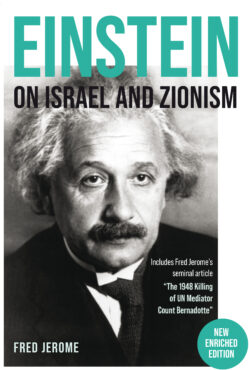
Einstein once remarked that his “life was divided between equations and politics.” Yet, among his hundreds of biographers and in the mainstream media, his extensive political writings on Israel and Zionism have, at best, been swept under the rug, or at worst, been completely distorted, portraying him as a supporter of the State of Israel. That is, until the late Fred Jerome sought out Einstein’s writings, found them, had them translated (mostly from German), and published them in the book Einstein on Israel and Zionism. Unfortunately, the first edition of this text, published by a New York publishing house, had a very small print run, was never promoted or made into an e-book, and sold out quickly. This is why Baraka Books has published a new edition with the agreement of Jocelyn Jerome, the author’s widow.
It was in Germany in the 1920s—a time of rampant antisemitism, when the theory of relativity was attacked as “Jewish science”—that Einstein was drawn to the Zionist movement. Only in 1914, when he arrived in Germany, did he “discover for the first time that he was a Jew,” a discovery he attributed more to “Gentiles than Jews.” Before that, he had seen himself as a member of the human species. He called himself a “cultural Zionist,” but as early as 1921, Kurt Blumenfeld, a Zionist activist sent to recruit Einstein, warned Chaim Weizmann, the future president of Israel, about the great scientist: “Einstein, as you know, is no Zionist, and I ask you not to try to make him a Zionist or to try to attach him to our organisation… Einstein, who leans to socialism, feels very involved with the cause of Jewish labour and Jewish workers… I heard… that you expect Einstein to give speeches. Please be quite careful with that. Einstein… often says things out of naïveté which are unwelcome by us.” Apart from Einstein’s supposed “naivety,” Blumenfeld could not have said it better. Einstein would be a constant obstacle to the Zionist project of colonisation of Palestine and the creation of the State of Israel until his death in 1955.
His exchanges with Chaim Weizmann, the future president of Israel, illustrate both how important Einstein was to the Zionists and how his views differed from theirs. In a letter to Weizmann on 25 November 1929, he wrote: “If we are not able to find a way to honest cooperation and honest pacts with the Arabs, then we have learned nothing during our two thousand years of suffering, and deserve the fate which will befall us.” The idea of “the fate which will befall us” recurs often. In 1929, he already seemed to foresee that the nation-state the Zionists dreamed of creating without “honest cooperation and honest pacts” with their Palestinian neighbours would become what it is today: the most dangerous place in the world for Jews to live. A few weeks later, on 14 December 1929, he wrote to Selig Brodetsky of the Zionist Organisation in London: “I’m happy that we have no power. If national pigheadedness proves strong enough, then we will knock our brains out as we deserve.”
Furthermore, Leon Simon, one of his early editors and translators, wrote: “There is in Professor Einstein’s nationalism no room for any kind of aggressiveness or chauvinism. For him, the domination of Jew over Arab in Palestine, or the perpetuation of a state of mutual hostility between the two peoples, would mean the failure of Zionism.” Unlike the vast majority of Zionists, Einstein’s support for a possible “Jewish homeland”—not a state—was not limited to Palestine. There was nothing religious in his commitment. Some Zionists advocated the establishment of such a homeland in China, Peru, or Birobidzhan in the Soviet Union, but always in agreement with state authorities and local populations.
Einstein supported these alternative ideas. For example, regarding the Jewish homeland of Birobidzhan in the Soviet Union after the Second World War, he wrote: “We must not forget that in those years of atrocious persecution of the Jewish people, Soviet Russia has been the only great nation that saved hundreds of thousands of Jewish lives. The enterprise to settle 30,000 Jewish war orphans in Birobidjan and secure for them in this way a satisfying and happy future is new proof of the humane attitude of Russia towards our Jewish people. In helping this cause we will contribute in a very effective way to the salvation of the remnants of European Jewry.”
In the pivotal years between the end of the war and his death in 1955, Einstein was outspoken about the Jewish state project. Invited to testify before the Anglo-American Committee of Inquiry on Palestine in Washington, DC, in January 1946, he answered unequivocally when asked about the possible State of Israel versus a cultural homeland: “I have never been in favour of a state.” In March 1947, I.Z. David, a member of the Irgun terrorist group led by Menachem Begin, sent him a questionnaire to which he responded sharply and clearly. When asked for his opinion on the establishment of a free National Jewish Palestine, Einstein replied: “Jewish National Home? Yes. Jewish National Palestine? No. I favour a free, bi-national Palestine at a later date after agreement with the Arabs.” When asked about the partition of Palestine and Weizmann’s proposals regarding it, he simply responded: “I am against partition.”
Regarding the alliance between British and American imperialism, Einstein harboured no illusions. He remarked: “It seems to me that our beloved Americans are now patterning their foreign policy on the model of the Germans, since they appear to have inherited the latter’s inflatedness and arrogance. Apparently, they also want to take on the role England has played up to now. They refuse to learn from each other; and learn little even from their own harsh experience. What has been implanted into their heads from early youth is rooted more firmly than experience and reasoning. The English are yet another good example of this. Their old-fashioned methods of suppressing the masses by using unscrupulous indigenous elements from the economic upper class will soon cost them their whole empire, but they are incapable of changing their methods, regardless of whether it’s the Tories or the Socialists. With the Germans, it was exactly the same. All of this would be good and well, except for the fact that it’s so sad for the better elements and the oppressed.”
Einstein also criticised the political ancestors of the current Netanyahu government, particularly in the New York Times. When Menachem Begin came to New York in late 1948, Einstein, Hannah Arendt, and other Jewish intellectuals in the United States published a letter denouncing his visit and the organisation he led, calling it “a political party very close in its organisation, methods, political philosophy and social appeal to the Nazi and fascist parties.” They cited, among other things, the massacre of 240 men, women, and children in the Palestinian village of Deir Yassin. Einstein would repeat this accusation until his death in 1955, saying: “These people are Nazis in their thoughts and actions.” Today, anyone who says this in the mainstream media is immediately labelled an antisemite and blacklisted.
It is common knowledge that when Chaim Weizmann died in 1952, the Prime Minister of Israel offered the presidency of Israel to Albert Einstein. Less well known, however, is the reason Einstein gave for his refusal: “I would have to say to the Israeli people things they would not like to hear.” Even less well known is Ben Gurion’s response: “Tell me what to do if he says yes! I’ve had to offer him the post because it was impossible not to, but if he accepts, we are in for trouble.”
Hundreds, if not thousands, of people are being accused of antisemitism or losing their jobs because they dare to criticise the State of Israel, call it an apartheid state, and denounce the genocide of the Palestinians. They may rest assured: they are in good company, because if Einstein were alive today, he would be on the front lines, demonstrating with them.











Who is the author of this article? It is most certainly not Mr. Jerome as he passed away in 2020.
Unless of course you are recycling a previously published article written years ago, then, I believe, the dateline should not read, “by Fred Jerome. November 13, 2024.