The following excerpts are adapted from the author’s book Humans in Shackles: An Atlantic History of Slavery, published by the University of Chicago Press.
We are living in a moment in which slavery and its legacies are discussed more fiercely and publicly than ever before. How did we get here?
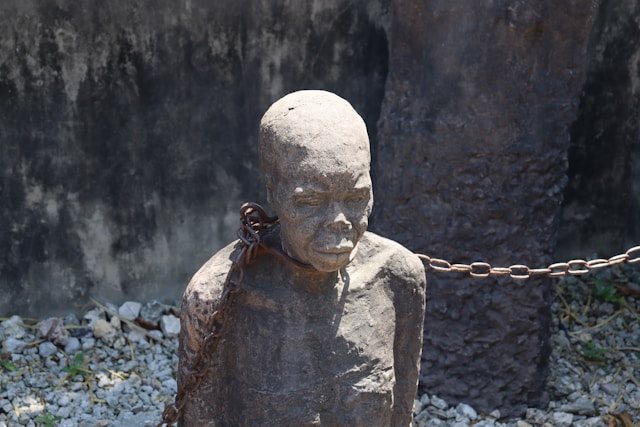
Since the late twentieth century, there has been growing attention to the history of slavery and the Atlantic slave trade. A series of commemorations since the 1990s led to the construction of monuments and memorials remembering the victims of the Atlantic slave trade in various countries across the Americas, Africa, and Europe. In 2007, the bicentennial of the British abolition of the slave trade propelled a huge wave of conferences, new books, and documentary films focusing on British participation in the trade of enslaved Africans, and motion pictures such as Amazing Grace (2006), which praised the role of William Wilberforce in fighting against the British Atlantic slave trade. In 2012, a few years before the commemoration of the sesquicentennial of the abolition of slavery in the United States, Steven Spielberg—who had already directed the 1997 film Amistad about the titular slave rebellion—released Lincoln, which, like Amazing Grace, featured a great emancipator in the figure of President Abraham Lincoln. Despite focusing on the history of slavery, however, these films emphasized the role of white saviors, thereby neglecting the many ways enslaved people fought for their own freedom.
During an era of ongoing violence against Black men and women, and following the emergence of Black Lives Matter as a global movement in 2013, new movies and television series began to focus on the lives of specific historical figures who were enslaved in the Americas. The film 12 Years a Slave (2013), which told the story of Solomon Northup, a Black man born free in the state of New York but kidnapped in Washington, DC, and sold into slavery, won several Academy Awards in 2014, including for Best Picture. In 2016, The Birth of a Nation (which despite the title is not to be confused with the 1915 white supremacist movie by D. W. Griffith) brought to the big screen the bloody slave revolt led by Nat Turner in Southampton, Virginia, in 1831. Released in 2019, Harriet presented the story of Harriet Tubman, the enslaved woman who escaped slavery by the middle of the nineteenth century and helped emancipate many other bondspeople. The production of these movies responded to the demands of popular audiences tired of seeing the history of slavery presented through the lens of European and American men represented as heroes who abolished the Atlantic slave trade and slavery.
In Brazil, the painful memory of slavery since its abolition in 1888 has remained present through religious and public festivals such as Carnaval. But despite this visibility, it is only in recent years that federal, state, and municipal governments have begun to invest in permanent markers commemorating the country’s history of slavery. Nonetheless, like the United States, Brazil also witnessed a growing number of cultural productions focusing on the country’s history of slavery. Movies such as Quilombo (1984), directed by Cacá Diegues, tells the story of the Palmares quilombo, the largest and longest-lasting Brazilian runaway slave community. In recent years, several comic books have also told the story of the states created by enslaved, freed, and free Black individuals, born in Brazil and in Africa, to resist slavery in the seventeenth century. Recently, African American novelist Gayl Jones published her epic novel Palmares, which also drew on the history of Brazil’s most important quilombo.
Cultural products addressing the history of slavery are also related to the growing number of academic studies exploring new dimensions of the lives of enslaved people in the Americas. Some of these works have focused on specific biographies and how bondspeople resisted against slavery. Nonetheless, the impact of most work by historians of slavery has remained confined to the academy. But as slavery has become a topic of growing concern in public discussion, this landscape has dramatically altered.
The Enduring Significance of Atlantic Slavery
In the United States, 2019 became emblematic for Black history. That year marked the four hundredth anniversary of 1619, the arrival of the first documented enslaved Africans in the colony of Virginia. The year 1619 has been associated with the birth of slavery in the United States, yet this date is also a construction. Indeed, as we will see in this book, since the sixteenth century, thousands of enslaved Africans had been brought to the Americas, not only to the West Indies, Brazil, and other regions of Latin America but also to the region encompassing today’s United States. Nonetheless, the year 1619 became a landmark, a commemorative date that gained new visibility through a journalistic project of the same name led by Nikole Hannah-Jones and the New York Times, featuring essays by scholars, writers, and artists focusing on the present-day legacies of slavery in the United States.
The emphasis on this specific year and the politicized reactions against the journalistic project triggered fierce public discussions in the media. Some academics questioned the project’s accuracy, whereas politicians criticized it for making slavery central to the history of the United States. But regardless of how political parties and individuals reacted, and despite the fact that 1619 did not mark the start of Africans being taken to the Americas, the year that for decades had already been a site of memory for many African Americans gained new meaning and began to be conceived as a reminder of how chattel slavery gave birth to anti-Black racism in a country that had failed to implement any national date of recognition to commemorate its tragic involvement in this human atrocity.
As the COVID-19 pandemic hit the world and following the murder of George Floyd in the summer of 2020, antiracist protests against police violence spread in the United States and in several countries in Europe and Latin America. Eventually, in June 2021, after many years of discussion, Juneteenth National Independence Day was officially instated as a federal holiday commemorating the emancipation from slavery in the United States.
The holiday is certainly an important achievement and a major step toward honoring formerly enslaved people and their descendants. But battles over the past have continued to evolve. Starting in 2020, several states in the United States introduced legislation banning books on the history of slavery and racism. These prohibitions are not related to the history of slavery itself; they are attempts to control how the history of slavery is taught, and they are expressions of how the past is politicized in the present, as I have discussed in previous works.
© 2024 by The University of Chicago