by Our Special Correspondent in New Delhi
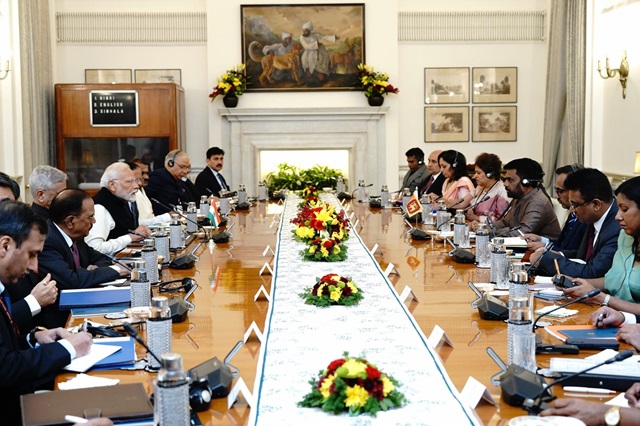
A senior diplomat in New Delhi, who wished to remain anonymous, has revealed that the Indian central government is no longer confident in the 13th Amendment of Sri Lankan constitution to address Tamil minority concerns in Sri Lanka. The 13th Amendment to the Constitution of Sri Lanka, introduced in 1987 as part of the Indo-Sri Lanka Accord, was intended to address ethnic tensions and provide a framework for devolving power to the provinces. However, today’s joint statement between India and Sri Lanka signals a significant departure from this position.
The India–Sri Lanka Joint Statement: Fostering Partnerships for a Shared Future, issued on 16 December 2024, notably lacks any strong reference to Tamil rights or the 13th Amendment. Instead, it focuses on projects for the Indian-origin Tamil community and broader development initiatives. The statement reads: “Extend full support towards timely implementation of projects for the Indian Origin Tamil community, Eastern Province, and solar electrification of religious places in Sri Lanka; Identify new projects and areas of cooperation for development partnership, in accordance with the needs and priorities of the Government of Sri Lanka.”
“This was carefully selected, and I don’t think we can rely on the 13th Amendment any longer,” the source said, reflecting a stark shift in India’s stance.
Another reliable source suggested that Sri Lankan President Anura Kumara Dissanayake strongly opposed including a call for the full implementation of the 13th Amendment in the joint statement. Dissanayake’s party has a long history of opposing the amendment, and a sympathiser from the same political background infamously attacked late Indian Prime Minister Rajiv Gandhi during a guard of honour in Colombo.
Until earlier this year, India had consistently urged Sri Lanka to fully implement the 13th Amendment. Past joint statements and official documents reaffirmed this position. For instance, during Sri Lankan President Ranil Wickremesinghe’s visit to India on 21 July 2023, Prime Minister Modi declared: “We hope that the Government of Sri Lanka will fulfil the aspirations of the Tamils. Will drive the process of rebuilding for equality, justice and peace. Will fulfil its commitment to implement the Thirteenth Amendment and conduct the Provincial Council Elections. And will ensure a life of respect and dignity for the Tamil community of Sri Lanka.”
Similarly, during his meeting with Sri Lankan President Gotabaya Rajapaksa on 29 November 2019, Modi remarked: “We also openly exchanged views on reconciliation in Sri Lanka. President Rajapaksa told me about his inclusive political outlook on ethnic harmony. I am confident that the Government of Sri Lanka will carry forward the process of reconciliation, to fulfil the aspirations of the Tamils for equality, justice, peace and respect. It also includes the implementation of the 13th Amendment. India will become a trusted partner for development throughout Sri Lanka including North and East.”
In earlier years, Modi’s remarks during his visit to Sri Lanka on 13 March 2015 further reflected India’s commitment to the amendment: “We stand with you in your efforts to build a future that accommodates the aspirations of all sections of society, including the Sri Lankan Tamil community, for a life of equality, justice, peace and dignity in a united Sri Lanka. We believe that early and full implementation of the 13th Amendment and going beyond it would contribute to this process.”
Additionally, Modi’s meeting with a Tamil National Alliance delegation on 23 August 2014 underscored his government’s consistent stance: “The Prime Minister stressed the need for a political solution that addresses the aspirations of the Tamil community for equality, dignity, justice and self-respect within the framework of a united Sri Lanka. In this context, the Prime Minister urged all stakeholders in Sri Lanka to engage constructively, in a spirit of partnership and mutual accommodation, towards finding a political solution that builds upon the 13th Amendment of the Sri Lankan Constitution.”
The omission of the 13th Amendment from today’s joint statement marks a dramatic policy shift. While development projects for the Tamil community remain a focus, the lack of emphasis on political solutions raises questions about India’s evolving approach to reconciliation and autonomy in Sri Lanka.