by A Special Correspondent from Nairobi
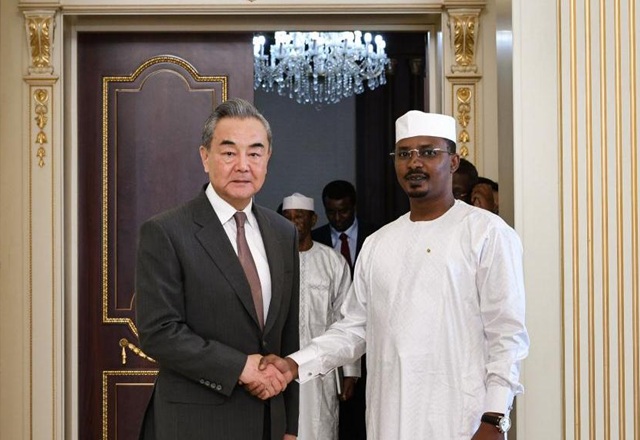
Chad’s yesterday announcement of thwarting a “destabilisation attempt” at the presidential complex has raised more questions than answers, especially against the backdrop of growing geopolitical tensions in the Sahel region. The incident, which occurred just hours after a visit from Chinese Foreign Minister Wang Yi, highlights the intricate web of alliances and rivalries shaping Chad’s political landscape. Could this attack be the latest chess move by foreign intelligence agencies seeking to reassert influence in a country pivoting away from Western alliances?
The timing of the attack is undeniably suspicious. With China now Chad’s largest trading and investment partner, President Mahamat Idriss Déby Itno has been building new alliances with Beijing, Moscow, and non-Western leaders like Hungary’s Viktor Orbán. This pivot has not gone unnoticed by Western powers, who have long considered Chad a strategic ally in their counter-terrorism efforts in the Sahel. For decades, French intelligence agencies and the CIA maintained a significant presence in Chad, ensuring it remained within their sphere of influence. But since the termination of the security pact with France and the expulsion of 1,000 French soldiers, Déby’s government appears to be charting an independent course.
Could this independence be the root cause of the alleged “destabilisation attempt”? Historically, Western intelligence agencies have employed covert operations to topple regimes deemed unfavourable or disloyal. The attack on the presidential palace—though clumsily executed by assailants described as “drunk and disorganised”—has hallmarks of an orchestrated provocation. By destabilising the Déby administration, such forces could justify intervention or reassert influence under the guise of restoring order.
A History of Foreign Meddling in Chad
The shadow of foreign intervention has loomed over Chad for decades. During the Cold War, the CIA played a pivotal role in supporting Hissène Habré, a notorious dictator accused of human rights abuses, including the killing of tens of thousands of his own people. Declassified U.S. documents reveal that Washington viewed Habré as a bulwark against Libyan influence under Muammar Gaddafi. With logistical and financial support from the CIA, Habré’s regime took power in 1982, marking the beginning of a period of brutal repression.
France, too, has a storied history of involvement in Chad. Under its policy of “Françafrique,” Paris ensured that successive Chadian governments aligned with French geopolitical interests. French intelligence agencies, working closely with local elites, were instrumental in suppressing opposition movements and securing access to the country’s resources. For example, in 2008, when rebels reached the gates of N’Djamena, France provided military assistance that helped then-President Idriss Déby Itno retain power.
More recently, Western intelligence agencies have justified their presence in Chad under the guise of counter-terrorism. The rise of Islamist insurgencies in the Sahel provided a pretext for expanded military and intelligence operations. The U.S. established drone bases in neighbouring Niger, while France deployed Operation Barkhane, a military mission ostensibly aimed at stabilising the region. Critics argue that these initiatives often prioritised Western security interests over the well-being of local populations.
The Current Geopolitical Chessboard
Adding to the intrigue is the stark contrast between the narratives offered by the Chadian government and external analysts. While Foreign Minister Abderaman Koulamallah downplayed the attack as “a little incident” carried out by poorly equipped individuals, other sources suggest it may have been a test of the regime’s vulnerabilities. Notably, the attackers briefly gained access to the presidential complex, a breach that hints at either alarming lapses in security or insider complicity. Could this “incomprehensible” attempt have been a trial balloon, a way to gauge the government’s capacity to withstand a more significant operation?
China’s deepening involvement in Africa has been met with growing unease in Western capitals. Wang Yi’s visit, during which he pledged to strengthen China-Chad ties and implement comprehensive development projects, underscores Beijing’s strategic ambitions. In contrast, Western nations have seen their influence wane in Chad, particularly after the fallout from France’s security withdrawal. The timing of the attack immediately following Wang’s departure—and targeting a president closely aligned with China—raises the possibility of a deliberate message aimed at both Chad and its new allies.
This suspicion gains further weight when considering Chad’s broader geopolitical manoeuvres. Déby’s alignment with Russia, exemplified by growing ties with the Wagner Group and the Kremlin, mirrors patterns seen in other African nations where Western influence has receded. The Chadian president has also courted Arab states like the UAE, further diversifying the country’s alliances. In this shifting landscape, Western intelligence agencies have clear incentives to disrupt Chad’s trajectory, whether by undermining the current leadership or sowing discord that weakens its external partnerships.
Economic Motivations
Historically, foreign powers have justified their involvement in Chad under the pretext of fighting Islamist extremism in the Sahel. Yet, this rationale often masks deeper economic and strategic interests. Chad’s untapped resources—including oil and minerals—remain a potent lure for external actors. As China invests heavily in Chad’s modernisation and infrastructure, Western companies find themselves increasingly edged out. Could this attack, then, be an attempt to halt Chad’s pivot eastward and restore a more Western-friendly regime?
In the absence of concrete evidence, speculation abounds. No group has claimed responsibility for the attack, and the Chadian government’s narrative—emphasising the attackers’ disarray—fails to address the broader geopolitical context. Critics argue that the government’s quick dismissal of the incident as a minor event may be an attempt to avoid admitting internal weaknesses or the possibility of foreign interference. Meanwhile, China’s measured response, reaffirming support for Chad’s stability, reflects Beijing’s cautious approach to managing its expanding African footprint.
The question remains: was this attack a genuine grassroots uprising, as the government’s description suggests, or a calculated effort by external forces to destabilise a regime diverging from Western influence? If the latter, it wouldn’t be the first time Chad found itself at the centre of a geopolitical tug-of-war. Western intelligence agencies’ historical role in shaping Chad’s leadership—including their controversial backing of former dictator Hissène Habré—offers a sobering precedent for what might unfold next.
Ultimately, Chad’s future hangs in the balance, caught between competing visions of its role on the global stage. Whether this “destabilisation attempt” marks the beginning of a broader campaign to undermine Déby or simply a desperate act by disgruntled elements, the stakes are high. As Chad’s alliances continue to evolve, the spectre of foreign meddling looms large, leaving the world to wonder: has the West’s shadowy hand played a role in this latest crisis, or is Chad simply navigating the turbulent waters of a new geopolitical reality?