Sixty years ago today (Feb. 21), the world lost one of its most enigmatic and misunderstood figures: Malcolm X. His assassination on February 21, 1965, wasn’t just the silencing of a man—it was the calculated erasure of a revolutionary who dared to challenge America’s comfortable narratives about race, power, and freedom. And yet, six decades later, the Malcolm X you think you know might be little more than a sanitised shadow of the man who truly was.
Mainstream history often reduces Malcolm X to a militant, a symbol of anger and division—a sharp contrast to the more “palatable” civil rights icon, Martin Luther King Jr. But this comparison does more than simplify; it sanitises. It strips Malcolm X of the depth, complexity, and sheer radical brilliance that made him a threat not only to white supremacy but to systemic injustice in every form.
Before Malcolm X became the defiant voice of Black empowerment, he was Malcolm Little, a young boy brutalised by systemic racism before he could even understand its weight. His father, Earl Little, a preacher and outspoken follower of Marcus Garvey’s Back-to-Africa movement, was likely murdered by white supremacists—though officials labelled it an accident. His mother, Louise Little, was institutionalised after being crushed by the relentless grind of poverty and discrimination. The state, in its cold efficiency, scattered Malcolm and his siblings into foster care.
This was not just a tragedy; it was a calculated stripping of identity. The boy who would become Malcolm X learned early that the system was designed to break Black families, steal futures, and leave ambition to rot.
The ‘X’ in Malcolm X was more than a letter. It was a symbol of rejection—the rejection of a slave name, the rejection of colonial history, and the rejection of the narrative forced upon Black Americans. What many don’t realise is that before he became the articulate revolutionary, Malcolm was known on the streets as “Detroit Red”, a hustler, gambler, and petty criminal with a razor-sharp wit and charm that commanded every room he entered.
It was prison that forced Malcolm to confront his potential. While others crumbled, he devoured knowledge—so much so that he copied an entire dictionary by hand, page by page, just to learn how to express the ideas burning in his mind. The state tried to break him, but instead, it forged a man who would challenge the very foundations of American hypocrisy.
Here’s the uncomfortable truth many refuse to confront: Malcolm X wasn’t radical. He was right. He didn’t preach hatred—he preached self-defence. He didn’t advocate violence—he warned of the inevitable consequence of oppression.
When Malcolm X famously said, “By any means necessary,” it wasn’t a declaration of war—it was a desperate cry for justice in a nation deaf to peaceful pleas.
But this message terrified not only white America but also sections of the Black community invested in a more conciliatory, integrationist approach. His growing influence threatened not just racists but also political systems built on the illusion of progress.
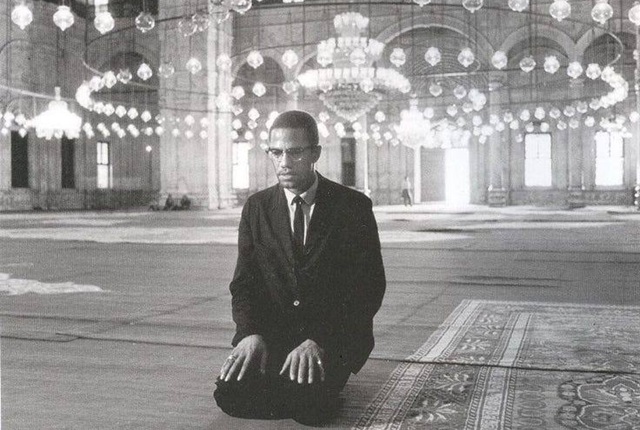
In 1964, after splitting from the Nation of Islam, Malcolm X embarked on a pilgrimage to Mecca. What he found there reshaped his vision entirely. He witnessed true racial unity among Muslims of all backgrounds—a revelation that shifted his fight from Black nationalism to a global human rights struggle.
Malcolm began to speak not just of Black empowerment but of global solidarity. His evolving ideology threatened to unite oppressed people worldwide, bridging the gap between African-American struggles and anti-colonial movements across Africa, Asia, and Latin America.
Imagine if Malcolm X had lived long enough to realise this vision. Would America—and indeed, the world—have been ready for him?
Malcolm X was assassinated on February 21, 1965, in front of his family at the Audubon Ballroom in Harlem. The official story claims that members of the Nation of Islam—angered by his departure and criticism of their leader, Elijah Muhammad—were solely responsible for his murder.
But here’s where the mystery deepens. In recent years, questions have intensified around potential state involvement. The FBI and NYPD had infiltrated both Malcolm’s inner circle and the Nation of Islam. Was his death simply a case of religious betrayal, or was it facilitated—if not orchestrated—by those who feared his growing power?
In 2021, two men wrongfully convicted of his assassination were finally exonerated, casting an even darker shadow over the official narrative. If justice failed him in life, it certainly continues to elude him in death.
Sixty years on, it’s clear: Malcolm X was not just a product of his time—he was ahead of it. His message of self-reliance, global solidarity, and unapologetic truth-telling is perhaps more relevant today than ever.
In an age where racial inequality remains entrenched and the very institutions Malcolm warned us about continue to oppress, one has to wonder: Did America kill not just a man, but the possibility of real change?
Malcolm X’s life remains a challenge to the status quo—a reminder that the truth is rarely comfortable, and the leaders who speak it most clearly are often the ones we lose too soon.
The real question, on this grim anniversary, is not how Malcolm X died—but why his message remains so terrifying to those in power.