by Our Diplomatic Affairs Editor
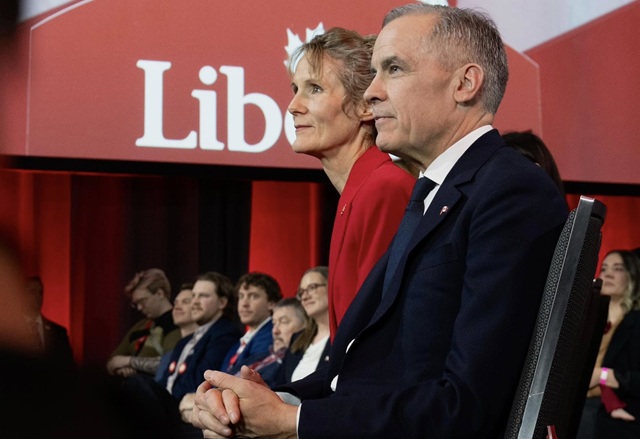
Ex-banker Mark Carney has been overwhelmingly elected as the new leader of the Liberal Party of Canada. His resounding victory, securing 85.9% of the vote, not only marks the dawn of a new era but also delivers a stinging repudiation of Justin Trudeau’s lamentable tenure. The coronation of Carney—a man of profound intellect, unassailable expertise, and unparalleled global stature—signals the electorate’s yearning for sagacity over showmanship, for substance over spectacle.
For nearly a decade, Trudeau basked in the effulgence of his curated charisma, his governance an unrelenting pageant of rhetorical grandeur and performative idealism. Yet, beneath the veneer of progressive platitudes lay an administration bereft of strategic foresight, mired in ethical transgressions, and paralysed by indecisiveness in moments of national exigency. The Canadian polity, fatigued by the vacuous sloganeering and economic misadventures that defined Trudeau’s twilight years, has turned to a leader whose credentials are etched not in the fleeting currency of public relations but in the immutable calculus of economic stewardship.
The Apotheosis of Competence
Mark Carney’s ascendancy is a testament to the electorate’s latent hunger for cerebral leadership. Here stands a man whose dominion over global finance is uncontested—a former Governor of both the Bank of Canada and the Bank of England, a custodian of monetary stability during the cataclysmic 2008 financial crisis, and a venerated architect of resilient fiscal policy. Unlike his predecessor, Carney does not pander to ephemeral ideological fads; his modus operandi is one of pragmatism, empirical rigor, and meticulous strategy.
A scion of both Bay Street and Threadneedle Street, Carney has spent his career steering institutions through tempests of economic upheaval. His tenure at the Bank of England saw him fortify the UK’s financial defences post-Brexit, while his stewardship of the Bank of Canada insulated the nation from the worst ravages of the global economic downturn. This is a leader who comprehends the precarious tightrope between economic sovereignty and global interdependence—a comprehension woefully absent in the Trudeau administration’s reckless fiscal largesse and regulatory incoherence.
As Carney himself asserts in Value(s): Building a Better World for All, “Markets are powerful instruments of innovation and prosperity, but left to their own devices, they can devour social capital and turn values into prices.” His philosophy of economic governance is rooted in the belief that financial systems must serve broader societal goals rather than exist as autonomous entities beholden only to profit. This ethos will undoubtedly shape his premiership, ushering in an era where fiscal discipline is wielded not as an ideological cudgel but as an instrument of national revitalisation.
The Indictment of Trudeau’s Decade of Dysfunction
It is impossible to extol Carney’s ascension without juxtaposing it against the debris of Justin Trudeau’s premiership. His tenure, which commenced with such promise, descended into a morass of scandal, administrative incompetence, and ideological hubris. From the SNC-Lavalin debacle that exposed the moral malleability of his governance to the unconscionable mishandling of Indigenous reconciliation efforts, Trudeau’s government became an exemplar of performative progressivism unmoored from tangible achievement.
Economically, Trudeau presided over a landscape marred by unsustainable deficits, inflationary excesses, and a housing crisis metastasising into an existential national affliction. His government’s cavalier approach to fiscal policy—ostensibly justified by the exigencies of the COVID-19 pandemic—has left Canada teetering on the precipice of financial instability. Under his watch, a nation once lauded for its economic prudence became a playground for fiscal imprudence, its debt spiralling, its productivity stagnating, and its citizens burdened with an unremitting cost-of-living crisis.
His foreign policy, meanwhile, was a spectacle of naivety masquerading as statesmanship. Trudeau’s dalliance with China, his lack of coherence in handling Canada’s relationship with the United States, and his feeble responses to geopolitical tremors laid bare his inadequacies. His fawning globalist aspirations stood in stark contrast to the stark realities of an international order increasingly defined by realpolitik and economic nationalism.
Carney has articulated a diametrically opposed vision, declaring, “True leadership in a crisis is about making decisions with imperfect information, knowing that inaction is itself a decision.” His tenure will likely be characterised by decisiveness, a stark departure from Trudeau’s perennial dithering.
The Carney Doctrine: A New Paradigm for Canada
Carney assumes the mantle of leadership at an inflection point, where Canada’s socio-economic architecture demands urgent recalibration. His immediate challenge lies in arresting the economic inertia left in Trudeau’s wake. Unlike his predecessor, Carney’s economic philosophy is one of disciplined interventionism—tempering market excesses while ensuring the state does not become an overbearing leviathan.
His expertise in global financial systems positions him uniquely to navigate the treacherous currents of an increasingly hostile international trade environment. With Donald Trump’s belligerent economic policies placing Canada in an unenviable defensive posture, Carney’s adeptness at high-stakes negotiation will prove invaluable. His sharp rebuke of Trump’s protectionist machinations—articulated in his victory speech with the ferocity of a statesman unafraid of confrontation—augurs a recalibrated Canada, one that will no longer prostrate itself before American caprice.
Carney’s leadership is also poised to inject long-overdue gravitas into Canada’s climate policy. While Trudeau’s environmental strategy was a symphony of grandiloquent proclamations with little substantive follow-through, Carney’s stewardship in sustainable finance suggests a leader who understands the intricacies of green economic transformation. “The sustainability revolution has the scale of the industrial revolution and the speed of the digital revolution,” Carney has written—an assertion that underscores his commitment to embedding environmental imperatives within the economic framework.
A Future Defined by Meritocracy, Not Theatrics
In congratulating Mark Carney, one does not merely celebrate the victory of a man but the triumph of intellect over impulse, of competency over charisma. His leadership heralds the resurgence of a Canada that prizes empirical rigor over ideological dogmatism, a nation poised to reclaim its stature not as a passive actor in global affairs but as a formidable force of stability and economic acumen.
For too long, Canada’s governance has been dictated by the ephemeral allure of rhetoric, by the saccharine lullabies of populism and performative virtue. With Carney at the helm, there is hope—hope that Canada’s trajectory will no longer be steered by the fickle winds of political expediency but anchored in the steady hands of meritocratic leadership. “Capitalism must be part of the solution, not just part of the problem,” he has insisted.