by Durga
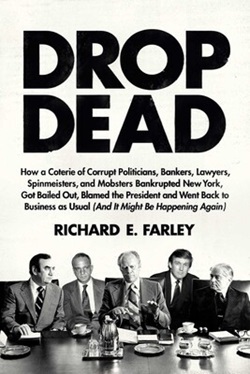
Richard E. Farley’s Drop Dead is a searing, meticulously researched chronicle of the political, fiscal, and moral collapse that led to New York City’s infamous 1975 fiscal crisis. Written with biting wit and a historian’s rigour, the book refuses to offer easy answers or scapegoats. Instead, Farley peels back the layers of myth and ideology to expose a systemic rot—a culture of political patronage, civic complacency, and bipartisan moral compromise. What emerges is less a tale of economic mismanagement than a tragicomedy of institutional decay in which “a bad debt is better than a good tax” became city policy, and “Saint Anthony of the Docks”—a mafia-linked union boss—lectured at Harvard.
Farley opens with a direct challenge to the modern tendency to treat the present as unprecedented. The idea that fake news and misinformation are recent phenomena is, he writes, “false comfort.” “The past remembers better than it lived,” he quips, quoting Jackie Gleason, and proceeds to show how media complicity, public relations sleight-of-hand, and political theatre have long been part of the American civic fabric. “Even in the heyday of so-called responsible political and media behaviour,” Farley notes, “the politicians shamelessly pulled the wool over the voters’ eyes with the willing assistance of their ink-stained lackeys.”
The central figures in Farley’s account are not economists or ideologues, but savvy operatives like John Scanlon, a former monk turned publicist, and Anthony Scotto, the dockworker-turned-mafia-linked labour leader. Scanlon, a gifted manipulator of narratives, saw in Scotto not a mobster but a media opportunity: “Tall, dark, and handsome… looked like Tony Bennett’s brother, if Tony Bennett had a brother who went to Harvard Business School.” With Scanlon’s guidance, Scotto was transformed from a suspected gangster into “a pillar of the New York establishment,” wining and dining with politicians, attending charity balls, and teaching at Ivy League universities. “I can buy any reporter in town for a cup of coffee,” Scotto once told journalist Murray Kempton—“who took no offense and loved the copy.”
This intertwining of criminality and public service, image and influence, is one of Farley’s most potent insights. He does not caricature; instead, he probes how figures like Scotto and Scanlon were embraced by the political class. Farley details how Scotto was on first-name terms with Jimmy Carter, Hubert Humphrey, and Hugh Carey, the last of whom would later appoint Scanlon to a senior post in the Municipal Assistance Corporation—an appointment that drew public scrutiny when it was revealed Scanlon also represented clients under federal investigation. The irony is biting: the man who helped sanitise Scotto’s reputation was now tasked with rescuing the city from financial ruin.
At the centre of the crisis stands Mayor Abe Beame, whose diminutive stature—“five feet, two inches”—becomes a recurring metaphor for his political limitations. A product of the Madison Democratic Club, Beame was, as Farley portrays him, a man of integrity and extraordinary work ethic, but ill-suited to navigate a city spiralling into chaos. “Beame was impeccably honest in his own personal financial dealings,” Farley writes. “But when it came to the practices of others from the clubhouse… he did not judge.” Beame’s loyalty to the old political order was, in the end, his downfall. His refusal to confront the structural problems—unrestrained union contracts, bloated city payrolls, and fictionalised budget practices—meant that he was governing a fantasy city, not a solvent one.
Farley is especially compelling in his discussion of how budgets were manipulated to conceal the city’s deteriorating finances. He quotes James Cavanagh, Beame’s first deputy mayor and budget director, who memorably said, “A bad loan is better than a good tax.” The city blurred lines between capital and expense budgets, reclassified teachers’ salaries as “teacher training,” and even borrowed against phantom taxes from tax-exempt buildings like foreign embassies. “By June 30, 1975, the New York State Comptroller… found that 80 percent of the unpaid real estate taxes recorded on the city’s books was uncollectible.” Yet these unpaid bills were used to support short-term loans—an act of fiscal self-cannibalism.
Crucially, Farley does not limit blame to Democrats or unions, as conservative narratives often do, nor does he scapegoat President Ford, as liberal revisionism tends to. Instead, he shows how both parties, elites of all kinds, and even the city’s cultural icons enabled the decline. Pete Hamill, darling of the New Left, wrote in support of Scotto during his RICO trial, decrying the use of “wired stool pigeons” and claiming it was “difficult to root for anyone but Scotto.” Meanwhile, former mayors John Lindsay and Robert Wagner, and even sitting Governor Hugh Carey, testified in Scotto’s defence. “He is trustworthy, energetic, intelligent, effective, and dedicated,” Carey said from the witness stand. The rot, Farley suggests, was not on the margins—it was at the centre.
Perhaps the most intellectually satisfying part of Drop Dead is Farley’s dismantling of the conventional narratives. On the left, the story is one of racialised federal neglect; on the right, of spendthrift liberalism. Farley dismantles both. Yes, the city’s welfare burden was real—“in 1974, 1.5 million New Yorkers were on welfare, triple the number ten years earlier”—but this was exacerbated not by generosity, but by structural anomalies: “New York City was required to bear a portion of the cost of its citizens’ welfare benefits—25 percent… the largest contribution of any city in the nation.” The city also ran its own hospitals, prisons, and universities—functions handled by states elsewhere—transforming itself into a municipal behemoth.
And while New York was indeed overtaxed—“over 10 percent of all personal income of city residents was paid in taxes”—these revenues often looped back into politically controlled spending, especially on public employee pensions and salaries. The unions, in Farley’s account, emerge as both defenders of workers and powerful political actors who knew their clout: “We have the ability, in a sense, to elect our own boss,” said Victor Gotbaum, head of District Council 37.
If there is a central moral lesson to Farley’s narrative, it is this: cities, like democracies, can function for decades under dysfunction—until they can’t. “It’s never a crisis until the money runs out,” he writes. The financial markets, long willing to overlook the city’s accounting tricks, finally balked—not out of moral principle, but because of basic portfolio limits and rising interest rates. “New York City, with $14 billion of debt, accounted for nearly 10 percent of all municipal debt in the United States by 1975.” Wall Street, not Washington, pulled the plug.
The final chapters deliver not catharsis, but bitter clarity. Beame’s idealism about New York’s safety net—“he was hell-bent not to be the mayor who shredded the safety net of programs assembled by Fiorello La Guardia, Al Smith, and Franklin Roosevelt”—was noble but delusional. Political machines that once delivered real material gains had become “a factory of legal graft.” Zoning laws were twisted, tax abatements sold, budgets gamed, and the clubhouse marched on. The Madison Democratic Club had become, in Farley’s withering phrase, “the American way.”
Drop Dead is not just a history of New York’s financial collapse—it is a profound meditation on the fragility of institutions and the moral hazards of democracy when accountability collapses. It is the story of how a great city was brought to its knees not by malice or ideology, but by collective evasions, short-term bargains, and wilful blindness across all levels of society. As Farley incisively observes, “The people do not want a mayor they can canonise; they want a mayor who keeps the city running.” But when everyone gets what they want, and no one pays the true cost, the reckoning is only delayed—not avoided.