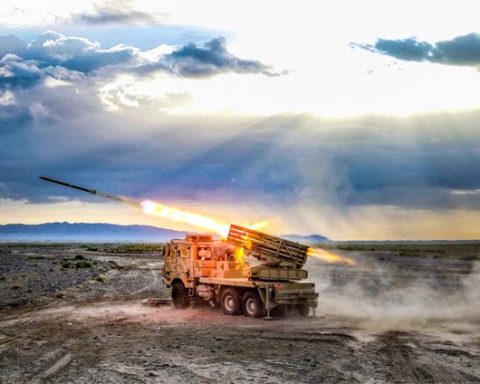
Just look at Yemen. Despite being one of the poorest nations in the world, the Houthi rebel group—under siege for more than a decade—has leveraged low-cost, low-tech drones to punch far above its weight. In the past 18 months, the group has used drones, missiles, and remote-controlled drone boats to bombard cargo ships and cripple global shipping through the Red Sea, all in an effort to pressure Israel over its war in Gaza. The attacks have been sophisticated enough to challenge US Navy vessels, exposing a new and unsettling reality: non-state actors can now project power and disrupt global commerce using inexpensive, easily assembled aerial vehicles. The era of drone warfare isn’t coming—it’s here.
This growing threat has spurred a race among defense firms to create next-generation anti-drone weapons. Among them, a standout is Epirus, a tech startup born from a fusion of Silicon Valley innovation and military engineering heritage. As reported in MIT Technology Review, Epirus has developed “Leonidas,” a high-powered microwave weapon that can disable entire swarms of drones with pulses of focused energy. Unlike conventional jamming devices that block signals or kinetic systems like missiles and lasers that target one drone at a time, Leonidas uses directed microwaves to fry a drone’s internal circuits mid-air—rendering it inoperable within seconds. It doesn’t matter whether the drones are radio-controlled, autonomous, or even tethered by fiber-optic cable; if it has electronics, Leonidas can zap it.
In rigorous field tests, Epirus engineers discovered that the microwave beam can find its way into nearly any drone—even those wrapped in protective copper tape—by exploiting exposed components like antennas or spinning propeller shafts. Sometimes just rotating the drone 90 degrees changes which motor goes down first. The effect is as eerie as it is effective. On the wall of CEO Andy Lowery’s office hangs a signed drone wing from a successful test and a photograph of dozens of destroyed drones piled in a heap—evidence of Leonidas’s deadly efficiency.
Cost efficiency also sets Leonidas apart. Each unit currently costs in the low eight figures—roughly $16.5 million based on an initial Army contract—but unlike missiles that cost hundreds of thousands of dollars each and must be constantly replenished, Leonidas runs on electricity. It never runs out of ammo and can keep firing in rapid succession. According to MIT Technology Review, this positions it as a potentially game-changing technology in modern warfare, particularly as the U.S. military anticipates future conflicts where drone swarms are common on every battlefield.
The Pentagon is already taking notice. In 2023, the Army’s Rapid Capabilities and Critical Technologies Office signed a $66 million contract with Epirus for four Leonidas units, and more branches are jumping in. The Marines received a more mobile, green-painted version in April, and the Navy has tested Leonidas emitters against drone boats, successfully frying their outboard motors. Epirus is also working on smaller, mountable versions for Stryker vehicles and even airborne platforms—drone-mounted microwave zappers that could target enemy electronics, vehicles, or even data centers.
What makes Epirus especially notable is how it exemplifies a new model of weapons development. Traditional defense contractors like Raytheon and Lockheed Martin typically wait for government contracts before developing new systems, often resulting in long delays and massive cost overruns. In contrast, Epirus began developing Leonidas before the military ever signed on, with funding from venture capital firms and roots in the tech industry. The company was cofounded by Joe Lonsdale—also a cofounder of Palantir—and John Tenet, the son of former CIA director George Tenet. The startup’s name, Epirus, is said to refer both to a mythological bow that never runs out of arrows and the Greek region from which Tenet’s family hails.
Epirus CEO Andy Lowery’s background reflects the firm’s hybrid identity. A former Navy nuclear engineer and ex-Raytheon chief engineer for the Next Generation Jammer project, Lowery now leads a team packed with former Raytheon veterans. Together, they repurposed military-grade microwave amplifier tech for close-range electronic warfare. The transition from vacuum-tube systems like the Pentagon’s existing THOR platform—bulky and dependent on dish antennas—to compact, solid-state systems like Leonidas is part of what makes Epirus’s approach revolutionary. As MIT Technology Review notes, Leonidas owes much of its success to advances in solid-state materials like gallium nitride, which can handle extreme power loads without melting. Though China dominates global gallium production, Epirus sources recycled gallium from Japan, insulating itself from geopolitical supply shocks.
Despite these advances, Epirus still faces the monumental challenge of scaling production and proving reliability in actual combat. Neither the Army nor the Navy has announced full-scale contracts beyond the initial purchases, but interest appears to be growing rapidly. In March, Epirus raised $250 million in new funding to expand manufacturing capacity, anticipating what it hopes will be a flood of large orders. The company is betting that its system could become as commonplace for soldiers as body armor or night vision, especially as drone threats become “every soldier’s problem,” as one Army CTO put it.
Indeed, some envision Leonidas systems not just on battlefields but on American soil—perhaps guarding the US-Mexico border or even protecting major cities. Lowery has floated the idea of a city-scale Leonidas network, housed in buildings akin to the Cold War–era PAVE PAWS radar installations, capable of zapping drones from 10 to 15 miles away. Whether used in Taipei, on Navy ships, or at US forward operating bases, Leonidas represents a pivotal shift in how modern militaries might defend against the next wave of airborne threats.
As warfare evolves, Epirus’s microwave defense systems could become as transformative as the first radar stations or anti-aircraft guns of the 20th century. Whether zapping down Houthi drones in the Red Sea or guarding against future attacks in Taiwan or Eastern Europe, Leonidas may be the most important weapon you’ve never heard of—until now.