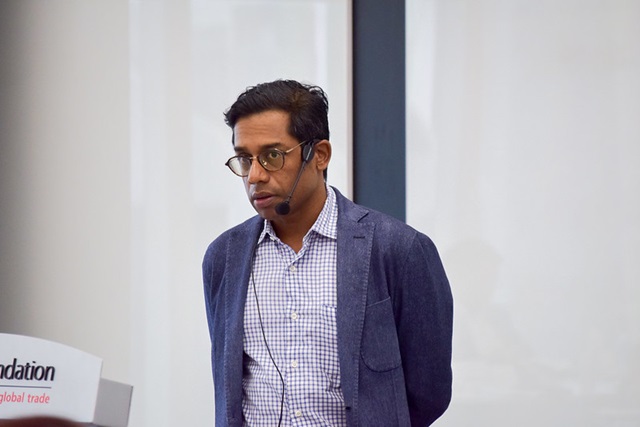
Editor’s Note: Dr Shashi Jayakumar has dedicated his career to international security. He is the founder and executive director of SJK Geostrategic Advisory, a security and political risk consultancy. Prior to this, he served for over a decade in Singapore’s civil service, predominantly within the Ministry of Defence. His expertise spans geopolitics, extremism, disinformation, and societal polarization. The Singapore government has also appointed Dr Jayakumar as non-resident ambassador to the Republic of Cuba. This article is based on his lecture, From Economic Espionage to Sabotage: Economies Facing Increasing Security Threats, delivered as part of the International Trade Fellowship, organised by the National Press Foundation and hosted at the Hinrich Foundation office in Singapore. It is the third in a series exploring key themes and insights from the Fellowship sessions in the coming days.
by Our Foreign Affairs Editor
If there is one thing that the contemporary world’s security landscape unequivocally illustrates, it is that cyber defence, disinformation, and the evolving technological environment have become central pillars in the defence and sovereignty of nations. Singapore, a small but remarkably resilient city-state, provides an instructive case study in how these modern challenges are met with a combination of policy, law, international cooperation, and social cohesion efforts. Dr. Shashi Jayakumar’s insights during the International Trade Fellowship highlight the nuanced and multifaceted approach Singapore has taken to these 21st-century security concerns.
The cyber realm represents both a frontier of opportunity and a battleground fraught with threats. In Singapore’s context, national service includes the potential for conscription into cyber defence roles, reflecting the integration of technical and military preparedness. This co-option of national servicemen into cyber defence units signals not only the importance the state places on cybersecurity but also the need for a broad-based, society-wide mobilisation in the digital age. Such a policy acknowledges that defence is no longer the exclusive preserve of traditional armed forces but extends into the technological domain where adversaries can operate anonymously and without physical borders.
Singapore’s confidence in its cyber defence capabilities is reinforced by its active participation in the development of international norms governing cyberspace. Unlike many small states that might remain on the sidelines of such global conversations, Singapore has taken a proactive role in shaping the rules of engagement in cyber conflicts and peacetime conduct. This includes crucial involvement in the United Nations Group of Governmental Experts (GGE) discussions, a platform often dominated by Western powers but one where Singapore has ensured its voice is heard. When geopolitical tensions caused the 2017-18 GGE process to falter, Singapore strategically facilitated the continuation of these critical discussions through the Singapore International Cyber Week, fostering regional consensus among ASEAN nations on abiding by internationally recognised cyber norms. This leadership in normative frameworks reflects Singapore’s desire to “punch above its weight” on the global stage, ensuring that its interests, and those of smaller nations in the region, are protected in an environment increasingly defined by cyber interdependence.
However, the cyber dimension of security is inseparable from other modern security challenges such as disinformation and foreign interference, which have become especially potent tools for malign influence campaigns. The notion of ‘assuming breach,’ emphasised by David Koh, Chief Executive of the Cyber Security Agency (CSA) of Singapore, encapsulates the pervasive threat environment where systems are presumed compromised. This principle fosters resilience and vigilance, enabling institutions to maintain continuity even while under constant threat. This mindset is particularly crucial in Singapore’s “super normal conditions” — a term used to describe the city-state’s longstanding stability and relative security, which ironically can breed complacency. The CSA’s surveys have revealed a tendency among Singaporeans to overestimate their cyber awareness, underscoring the ongoing challenge of building genuine public cyber resilience amid a seemingly secure environment.
The issue of disinformation has gained global prominence especially since the 2016 US presidential election and related scandals such as Cambridge Analytica and Russian interference. Singapore’s experience with disinformation, while often overshadowed by Western narratives, is no less critical. Recognising disinformation as a vector for undermining social cohesion and national unity, particularly in a multi-ethnic society, Singapore took early and decisive legislative action. The 2018 parliamentary Select Committee on Malicious Online Falsehoods was a watershed moment, culminating in the Protection Against Online Falsehoods and Manipulations Act (POFMA). This law was a direct response to social media platforms’ refusal to take responsibility for the content they host, with Facebook’s testimony before the committee famously asserting their role as neutral intermediaries, not arbiters of truth. POFMA thus represents a shift in governance, signalling that platforms cannot be left unchecked and that governments must intervene to safeguard the integrity of information in the public sphere.
Yet, fake news is only one facet of the broader threat posed by hostile foreign influence campaigns. The introduction of the Foreign Interference Countermeasures Act (FICA) in 2019 reflects Singapore’s acknowledgement that malign actors may employ a wider array of tactics to sow discord and erode trust. The stark geopolitical context of Russia’s illegal invasion of Ukraine further crystallised these concerns. Singapore’s principled stance as the only ASEAN member to sanction Russian interests and voice opposition in the United Nations demonstrated its commitment to upholding international law despite pressures to maintain neutrality. However, such foreign policy decisions exposed fissures within the Singaporean populace, where segments expressed scepticism or opposition, questioning why a small state should engage in great power conflicts. These divisions illustrated the very vulnerabilities that hostile influence campaigns seek to exploit—cleavages along ethnic, cultural, or ideological lines that can be manipulated to weaken national cohesion.
Singapore’s struggle with disinformation and foreign interference is further complicated by the shifting dynamics of strategic communications. Historically, foreign policy and sensitive issues were tightly controlled by the government, with limited public discourse permitted within strict “out-of-bounds” markers. However, recent years have seen a gradual opening of civic spaces, often facilitated by non-governmental organisations, enabling more candid and contentious discussions among Singapore’s youth and civil society. This evolution recognises that not all challenges can be solved through legislation alone; fostering a robust “town square” for civil discourse is essential to preempt social fragmentation and inoculate the public against manipulative narratives. The hollowing out of the middle ground, a phenomenon seen in Western democracies, is increasingly evident in Singapore along lines of race, identity, class, and ideology, creating fertile ground for malign influence.
The government’s efforts in legislation and public engagement are complemented by ongoing cooperation with social media platforms, particularly TikTok and Facebook, to moderate content and combat disinformation. However, this partnership is fragile, as recent shifts in the US social media environment suggest a retreat from content moderation under political pressure. This trend raises questions about the global implications for countries like Singapore, which serve as regional hubs for major platforms and face unique security challenges. If platforms scale back moderation, Singapore may need to enact even more stringent laws or enforcement mechanisms to maintain information integrity, a prospect that underscores the complexity and evolving nature of cyber governance.
The advent of artificial intelligence (AI) adds a new layer of complexity and urgency to these issues. AI technologies, including generative AI and deepfakes, offer both offensive and defensive capabilities in the cyber and information domains. Well-resourced adversaries already employ AI to automate phishing attacks, generate sophisticated disinformation at scale, and create convincing deepfake videos aimed at undermining public trust or manipulating political outcomes. Singapore has experienced such threats firsthand, with high-profile deepfake attempts targeting senior government figures to spread false messages or promote products illicitly. At the same time, the democratisation of AI tools means that individuals with limited technical expertise can soon wield these technologies for nefarious purposes, greatly expanding the threat landscape.
On the defensive side, Singaporean government agencies responsible for strategic communications have begun harnessing AI for monitoring and rapid response. AI assists in summarising news reports, drafting initial press releases during crises, and simulating potential scenarios to enhance preparedness. Despite these advances, defenders remain in a reactive posture, constantly playing catch-up with adversaries who innovate quickly and exploit the inherent openness of digital platforms. The accelerating pace of technological change necessitates continuous investment in AI capabilities and innovative approaches to cybersecurity and strategic communication.
Underlying these technical and legal strategies is Singapore’s enduring emphasis on social cohesion and resilience. The country’s long-standing commitment to nation-building, which has painstakingly crafted a multiracial, multicultural identity, faces unprecedented tests from both external and internal pressures. Malign cyber and information operations seek to exploit existing social tensions or fabricate new ones, threatening the fabric of trust that underpins Singaporean society. Government efforts to facilitate open dialogue, support NGOs, and engage youth reflect a recognition that resilience is as much about social capital as it is about technological defences.
Singapore’s experience offers important lessons for other nations navigating the complex interplay of cyber threats, disinformation, and geopolitical contestation. Small states can no longer afford to be passive bystanders but must actively shape international norms and develop robust internal mechanisms to counter evolving threats. The legal frameworks established in Singapore, though often criticised as heavy-handed, provide necessary tools to confront challenges posed by powerful global platforms and hostile foreign actors. Simultaneously, fostering an informed and engaged citizenry capable of critical media literacy is indispensable to sustain social harmony and national security.