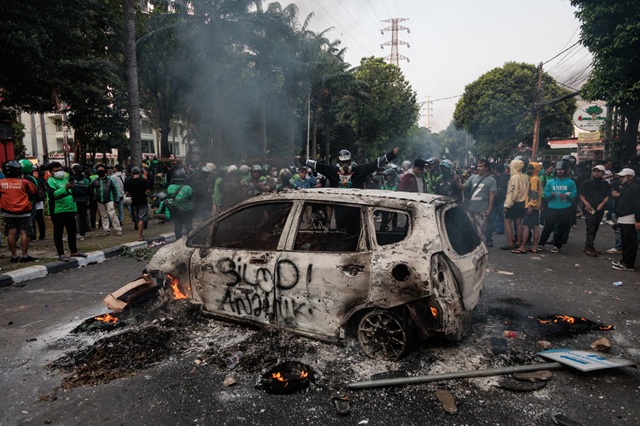
Indonesian President Prabowo Subianto condemned police conduct during violent protests in Jakarta after the death of a motorcycle taxi driver struck by an armored vehicle, as demonstrations against lawmakers’ pay hikes intensified across the capital on Friday evening.
Thousands of students, workers, and motorcycle taxi drivers defied heavy rain to rally outside Jakarta police headquarters, hurling bottles and firecrackers after officers fired tear gas. Protesters torched street barricades and chanted “The police are killers!” Organizers demanded the removal of the police chief, while some vowed to continue demonstrations into Saturday.
“I am shocked and disappointed by the excessive actions of the officers,” Prabowo said in a televised address — his first remarks since the unrest erupted earlier in the week. He urged calm but warned Indonesians to be vigilant against “elements that always want to cause unrest and chaos.”
The protests — the most serious challenge of Prabowo’s presidency since he took office in October — were sparked by parliament’s approval of new monthly allowances worth 50 million rupiah ($3,029), nearly ten times Jakarta’s minimum wage. The issue has struck a nerve as Indonesians grapple with job losses, rising living costs, and widening inequality. Official data show more than 42,000 workers were laid off in the first half of this year, a 32% increase from 2024.
The political fallout rattled financial markets. On Friday, the rupiah slid 0.9% against the dollar and Indonesian stocks dropped 1.5%, making them the region’s worst performers. Yields on five- and 10-year government bonds saw their steepest jumps in months. The central bank pledged to intervene to stabilize the currency.
The unrest also disrupted government business: several official meetings, including a Finance Ministry budget briefing and a national inflation coordination session, were canceled, while major roads were shut and companies told staff to work from home.
In an unusual twist, members of the military and navy appeared at protest sites, where they were cheered by demonstrators and even posed for selfies — highlighting a divide in public trust between the armed forces and the police. Rights groups have pressed Prabowo, a former general, to ensure accountability for the fatal incident. Police have apologized and said seven officers are under investigation.
Indonesia’s economy has maintained about 5% growth over the past decade, but frustration is mounting as manufacturing job cuts erode middle-class incomes. Prabowo, who campaigned on sweeping promises to create employment and improve livelihoods, is now facing criticism that his government is out of touch with ordinary citizens.
“This is a severe issue,” said Kevin O’Rourke, principal at Jakarta-based consultancy Reformasi Information Services. “Prabowo is on a collision course with student demonstrators and financial markets for that matter.”