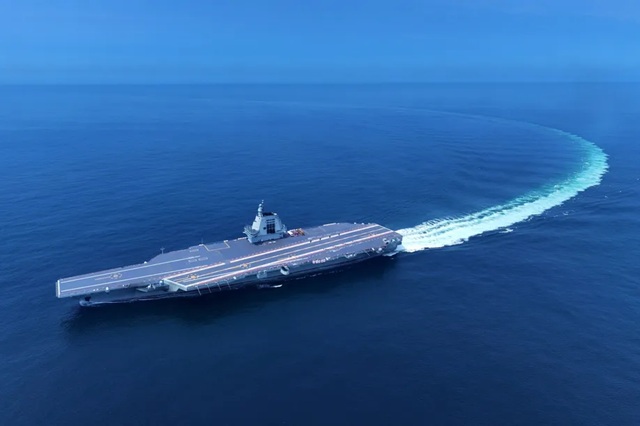
President Xi Jinping presided over the commissioning ceremony on Wednesday in Hainan, according to state media outlet Xinhua. The Fujian, named after the coastal province opposite Taiwan, has now joined the People’s Liberation Army Navy as China’s third aircraft carrier and its first equipped with electromagnetic catapult launch systems. The move significantly enhances Beijing’s capacity to project power across contested waters such as the South China Sea and the Taiwan Strait.
The Fujian’s induction comes at a time of intensifying maritime tensions between China and U.S. allies, particularly the Philippines, over overlapping territorial claims. The 316-meter (1,037-foot) vessel is fitted with three electromagnetic catapults — an advanced launch system similar to that used by the U.S. Navy’s latest Gerald R. Ford-class carriers. However, unlike America’s nuclear-powered fleet, the Fujian relies on conventional propulsion, a factor that could limit its range and operational endurance.
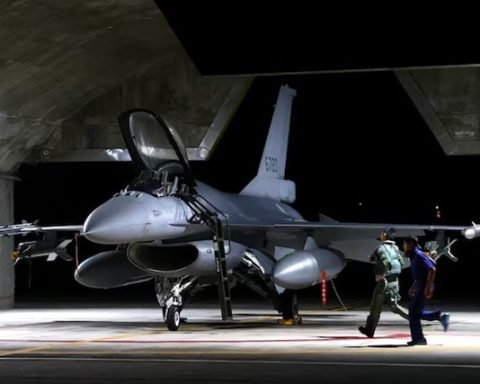
In September, China released footage for the first time showing its fifth-generation J-35 stealth fighter successfully taking off from the Fujian via an electromagnetic catapult — a launch capability personally endorsed by Xi, according to Xinhua. Analysts say the development puts China a step closer to fielding a modern blue-water navy capable of long-range operations. “As the first PLA supercarrier with catapults, the Fujian will set operational norms for future carriers, providing the PLAN experience with catapults as well as with fifth-generation carrier-based fighters,” said Tianran Xu, a senior analyst with Open Nuclear Network in Vienna.
Bloomberg reported that the ship’s commissioning underscores China’s rapid military modernization and the geopolitical implications of its expanding naval power. Washington has repeatedly expressed concern over Beijing’s assertiveness in regional waters, particularly its military activities near Taiwan and its growing use of maritime militia in disputed zones.
While electromagnetic launch systems are more compact and efficient than traditional steam-powered mechanisms, their dependability remains in question. The U.S. Congressional Research Service noted in August that reliability challenges persist aboard America’s own Ford-class carriers, despite ongoing technical upgrades. Beijing has not disclosed details on the performance or maintenance standards of its systems.
Although the Fujian will still require additional sea trials and training before achieving full operational capability, its entry into active service already carries symbolic and strategic weight. As Xu noted, even before reaching combat readiness, “its sheer presence in contested territories could deliver a message and impact.”