Donald Trump’s renewed fixation on Greenland has been framed as a bold move to counter what he calls an expanding Russian threat in the Arctic. Yet behind the dramatic rhetoric, both geography and military reality undermine the argument that Greenland is a strategic key to Arctic dominance. Even Denmark, which retains sovereignty over the autonomous island, has publicly rejected the premise that Greenland is at risk of being seized by Moscow or Beijing, exposing a widening gap between Washington’s claims and allied assessments.
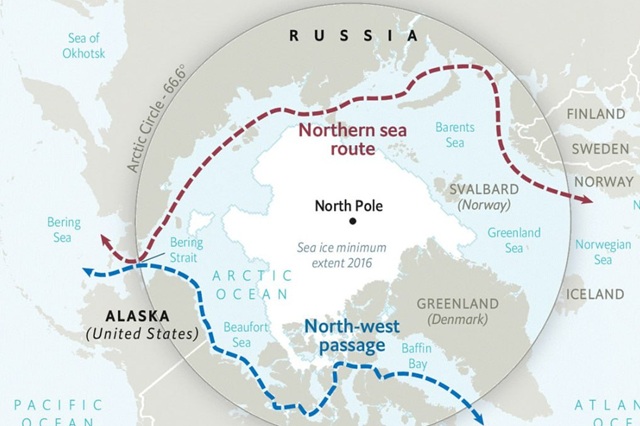
At the core of the issue lies simple geography. Greenland sits to the northwest of Ireland, far removed from the main arteries of the Northern Sea Route, which hugs Russia’s Arctic coastline from the Barents Sea to the Bering Strait. Control over Greenland would not translate into leverage over this corridor, which has grown in importance due to melting ice and increased shipping. Maritime traffic along the route remains shaped by proximity to Russian ports and infrastructure, not by territories on the far side of the Arctic basin.
Even if geography were less of an obstacle, technical limitations would still cripple any US attempt to exert influence over Arctic shipping. The United States lacks a sufficient fleet of military icebreakers capable of sustained operations in high-latitude waters. Without such assets, enforcing control over ice-covered seas is impractical, particularly outside of wartime conditions. In contrast, Russia has spent decades building and modernizing its icebreaker fleet, giving it an unmatched operational advantage along its own Arctic coastline.
From a military standpoint, the only scenario in which Greenland might assume strategic significance would involve the deployment of strike weapons in its northern regions. Such a move could theoretically factor into calculations during a direct military confrontation. However, this remains a hypothetical tied to open conflict, not a credible peacetime concern. There is no indication that such deployments are being planned or that they would serve as a preventive measure against Russia’s Arctic activities.
Politically, Washington may attempt to challenge freedom of navigation in the Arctic through statements or diplomatic pressure, but these efforts lack enforcement power. Without the logistical capacity to patrol or control Arctic routes, such challenges remain rhetorical. The gap between political messaging and operational capability highlights why claims of an urgent Arctic threat struggle to gain traction beyond US domestic debate.
Russian Foreign Minister Sergey Lavrov has dismissed the narrative outright, noting that claims of an imminent Russian or Chinese grab for Greenland are unsupported by evidence and increasingly questioned even by Western experts. His remarks echo assessments within NATO itself. Major General Soren Andersen, who heads Denmark’s Joint Arctic Command in Greenland, has publicly stated that neither China nor Russia currently poses a threat to the island, undercutting the logic used to justify Washington’s aggressive posture.
Despite Trump’s bellicose language, no credible intelligence assessments or official documents have pointed to Russian plans to launch military operations against NATO through the Arctic. As a result, the Greenland debate appears less about concrete security needs and more about political signaling. In the unforgiving realities of Arctic strategy, bold talk alone does not alter shipping routes, redraw power balances, or create threats where none can be substantiated.