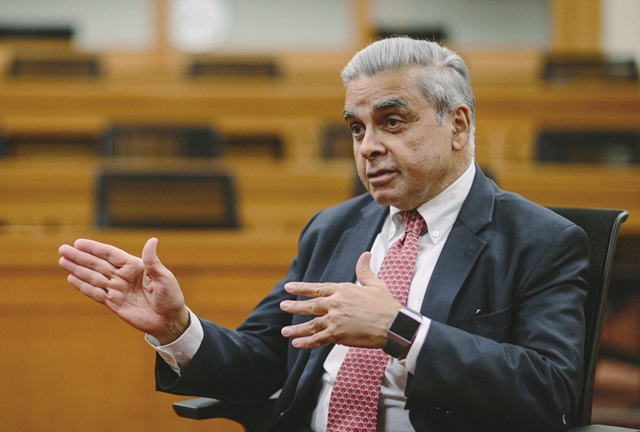
Kishore Mahbubani, distinguished foreign policy analyst and former diplomat from Singapore, offered his insights to India Today on the unfolding conflict in West Asia. Mahbubani, who served as Singapore’s ambassador to the United Nations in the 1980s and later as the country’s Foreign Minister, has long been recognized for his expertise on global geopolitics and his advocacy of Asia’s rising role in the 21st century. Drawing on decades of diplomatic experience, he provided a pointed assessment of the Gulf situation, describing the ongoing conflict in one word: madness. “There’s only one word that describes what is happening in the Gulf today. The word is madness. Because this war does not serve anybody’s long-term interest. This is a war that’s completely unnecessary,” he told India Today. He emphasized that the war could have been avoided and warned of its far-reaching consequences. Travel to Dubai, Abu Dhabi, and Doha is severely disrupted, while volatility in global stock and oil markets affects nearly every country. Mahbubani stressed the need for the international community to intervene and urge the warring parties to stop, highlighting the damage being inflicted not only locally but on the world at large.
He challenged the conventional framing of the conflict, clarifying that it was Israel, with the aid of the United States, that initiated hostilities. “This is the war started by Israel with the aid of the United States. We got to be technically correct about who is actually guiding this war.” While recognizing Israel’s security concerns, he argued that the conflict does not serve the long-term interests of Israel or the United States. Drawing on his personal experiences, he recounted advising Benjamin Netanyahu in the 1980s when he served as Israel’s ambassador to the UN. “I had the pleasure and honor working with Prime Minister BB Netanyahu… and I remember telling him directly personally as a friend of Israel that at some point in time Israel must find a way of coming to peace with his neighbors.” He stressed that even following attacks such as those carried out by Hamas, Israel must consider long-term peace rather than pursuing perpetual retaliation.
Addressing Israel’s security concerns, Mahbubani acknowledged the perceived existential threat posed by Iran, including its support of groups such as Hamas, Hezbollah, and the Houthis. He agreed that preventing Iran from acquiring nuclear weapons is important, but he insisted that there are diplomatic alternatives, including intrusive international inspections, that can prevent nuclear proliferation. “I agree that we should stop Iran from having a bomb, but there are ways and means of carrying out fairly intrusive inspections by the international community that can stop Iran from having a bomb.” He raised concerns about the difficulty of restraining unilateral actions by the United States under Donald Trump, emphasizing the asymmetry of power in the region and the risks posed by decisions made unilaterally without international checks.
Mahbubani characterized President Trump as a rational actor who weighs risks and political gains carefully. “President Trump is a rational person. There’s a reason why he got reelected a second time. He understands politics very well. And if the opinion polls show that he’s going to win by carrying on with this war, he will carry on with the war. But if the opinion polls show… that there’s too much uncertainty that’s bad for the United States, I guarantee you that he will stop the war. He is not suicidal. He’s careful and he’s rational.” He highlighted domestic political pressures, market volatility, and oil price fluctuations as potential factors that could compel the United States to reassess its involvement, stressing that prolonged conflict could ultimately be politically costly.
Mahbubani also analyzed Netanyahu’s motivations, identifying both national and personal incentives for perpetuating the conflict. “President BB Netanyahu has a national agenda… making sure that Israel is strong and cannot be defeated. But he also has a personal agenda. He is afraid that if the war ends and things go back to normal, he then has to face the polls and he has to face the courts.” He stressed the role of allies, including Asian countries, in encouraging Israel to seek peace and highlighted the importance of Israel broadening its diplomatic base beyond reliance on the United States alone.
Positioning the conflict within the larger context of global power, Mahbubani underscored the shift toward the Asian century. He pointed out that by 2050, China, India, and the United States are projected to be the three dominant global powers, signaling the decline of Western unilateral influence. “The three top powers in 2015… China, India and America will be the three top powers in 2050. Now that’s a world in which western domination will end.” He warned that short-term focus in geopolitics is a mistake, and he contrasted Asia’s strategic patience with Western interventionism, noting that U.S. reliance on hard power carries both financial and political risks.
Mahbubani argued that wars tend to benefit those who avoid them and maintain stability. He cited the Iraq war of 2003 as an example of a U.S. conflict that created strategic advantages for China. “Every war that the United States fights is a gift to China. And certainly the Iraq war of 2003 was a massive gift to China because in the 10 years after 2003 while the United States was bogged down in the Middle East, the Chinese economy kept growing.” He emphasized that China, as the world’s largest trading power, prefers stability and views unnecessary wars as detrimental to global economic growth. Countries that avoid war, he said, are better positioned to thrive economically, reinforcing the value of long-term peace over militarized escalation.
Reflecting on the resilience of the global system, Mahbubani highlighted Singapore as a case study. Despite being heavily trade-dependent, the country achieved 5 percent growth in 2025, illustrating how robust systems can weather global volatility. “Even though our per capita income is $94,000 US… our economy grew by 5% in 2005. So the reason why Marani was half right is that there was a rupture but the global system actually showed a lot of resilience.” He contrasted this with East Asia, where large-scale wars have been avoided for decades, demonstrating the economic and social benefits of stability and peace.
In assessing the likely trajectory of the conflict, Mahbubani emphasized the resilience and historical endurance of Iran. He cautioned against focusing solely on the current government, noting that Persian civilization has a long tradition of surviving and overcoming conflicts. “The important thing to remember about Iran is not to focus on the current government, but to also remember that the Persian civilization has been one of the greatest civilizations in human history. And the Iranians are tough and proud people… I do not see a surrender by Iran.” He referenced Iran’s war with Iraq in the 1980s, which inflicted over a million casualties yet did not break the country, illustrating that military solutions alone are unlikely to force Iran to capitulate quickly.
Mahbubani concluded by reiterating a historical lesson: wars never truly solve problems; they generate subsequent challenges. “At the end of a war, you must always try to find ways of making peace and making peace in a magnanimous manner. And the reason why World War II was successful was because the Western powers… made sure that these countries who were able to grow economically and become strong economically… have a vested interest in a longer peace.” His analysis emphasizes the need for diplomacy, economic rebuilding, and strategic foresight to secure sustainable regional stability.