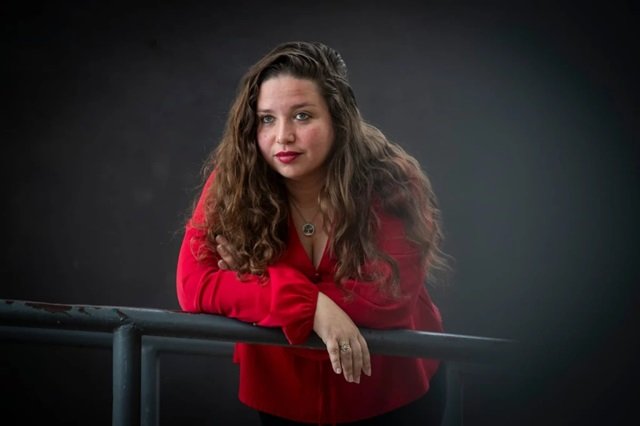
For Elaine Vilar Madruga, writing begins with a small group of obsessions: desire, violence, memory, land and motherhood. These “fundamental roots”, as the Cuban writer calls them, follow her from one page to the next. Her fiction has made her a literary star through its ability to bind intimate and political horrors to a form of magical realism that continues to evolve across the continent. She considers herself an heir to that tradition, but when she closes her eyes and confronts the act of creation, she says she is thinking about “the world that is out there”, whatever shape it eventually assumes within fiction.
That voracious world was at the centre of La piel hembra, published by Alfaguara, the latest novel with which Vilar Madruga closes a successful literary cycle that began five years ago with La tiranía de las moscas. As EL PAÍS has reported in its literary coverage, the book returns to many of the themes that have defined her work while pushing them into new territory.
The novel takes place in an ambiguous and sometimes suffocating physical space: a mountain village whose precise location is never established and which could be almost anywhere. It becomes both witness and protagonist to a story spanning several generations. It begins with the “golden night”, when the women disappear as though something has taken possession of their bodies. The following morning they return convinced that they are carrying the next Messiah within them.
The new beacon will eventually be a girl. But she will not be born from any of those women. Instead, she will emerge from the “calling” and love between two women.
For Vilar Madruga, this is above all a story about desire. “Desire is the oldest religion of all. It is the silent religion, the religion of calling, the one we do not dare to say aloud, the accursed religion, the bastard one, which we whisper in the corners of our houses,” she says.
Desire is present at both the beginning and the end of the story. It accompanies human beings in everything they do, she argues. When she began the ambitious novel, two questions were pressing on her: whether humanity deserves a second chance on Earth and whether people would recognise the person who came to save them if that saviour arrived in the skin of a woman.
The questions were not purely fictional. Vilar Madruga was herself experiencing a crisis of faith when she began the book. “I have believed in so many things in my life. When I make a map of my beliefs, I realise that it has changed enormously over the years,” she says. Her earlier certainties included faith in the invulnerability of parents, the goodness of families and the territory in which people grow up.
That instability became part of the novel’s intellectual engine. Vilar Madruga had another question lodged in her throat: “What can I believe in that is immutable?” She wrote 700 pages before reaching an answer that was less a doctrine than an observation about human existence. “I wrote 700 pages to realise that human fragility may perhaps be our greatest strength,” she jokes, “and that perhaps in this constant change of the human being lies the altar to which we should pray.”
For a writer navigating uncertainty, doubt is not necessarily a weakness. “Uncertainty, although it does not give you certainty, gives you the possibility of asking yourself every day what you are looking for in the world and in what way to be fair to that world,” she reflects.
The latest novel also introduces something that had been less prominent in her previous work: humour. Vilar Madruga sees humour not simply as relief from the darkness of her stories but as a means of confronting power. “I am interested in humour as a way of taking power. It allows you to debate the absurd world, not only of fiction but of the political reality we are living through,” she says. “When we have a laugh committed to reality, we are acquiring control and power over it.”
That political reality is reflected in the novel’s small-scale struggles for dominance. Vilar Madruga was thinking about Latin America as she constructed the internal conflicts of her fictional community and created what she calls the “machócratas”: “men who believe they hold all the reins of life, who do not believe they have flaws or guilt, who believe themselves to be in the image and likeness of the divine”.
The word itself forms part of an experiment that she considers among the most radical aspects of the novel. She wanted to give names to things that exist in real life but have not yet been named. She would like those words to escape the pages of the novel and enter everyday language.
Against these men stand characters such as Mangoloco and the San Huesero, who digs into the earth in a search resembling that undertaken by searching mothers around the world looking for their disappeared loved ones. More than 30 characters, men and women, populate the novel, creating a cast of male and female figures unlike anything she had previously explored.
Yet the questions remain familiar. Are these characters living in the best possible world or the worst? Vilar Madruga compares them to Dante. “All my characters are going towards the infernos and returning from them,” she says, laughing.
The scale of her literary career extends far beyond this single novel. Vilar Madruga has worked across genres, including poetry and theatre, and has published more than 50 works. It was the novel, however, that transformed her public profile and eventually began “vampirising” her other forms of writing.
Narrative is, for her, the “comfortable clay”, the “perfect monster” capable of holding everything together and the place where she has the most fun. “It took me 20 years to say it. I feel like a novelist,” she confesses.
Poetry comes only when other forms of expression have been exhausted, she says, when she needs “to reflect myself as human and fragile in a text”. Her reputation as a novelist has now brought recognition beyond Cuba. She has been selected by the Guadalajara International Book Fair, the largest forum for Spanish-language literature, as one of 26 voices renewing narrative in Spanish.
Yet the relationship between Vilar Madruga and Cuba remains as complicated as the relationship between her fictional characters and their territories. She continues to speak her language constantly, but misses the tropical cadence of the island in the Caribbean. “Sometimes in Cuba I have felt enclosed and sometimes I feel that it is my expansion into the world,” she says.
She has not visited home for a year, since her grandmother’s armchair became empty. The absence has left a profound grief, and she plans to return for the end of the year. She recalls the last time she saw Cuba from above, during a journey from Toronto to Argentina: “That feeling of seeing the land depart, without you entering it…”
Her grandmother’s death has become both a wound and a release. The loss, she says, has allowed her to search for other horizons. “The umbilical cord that held me there was cut.”
That grief is already shaping what comes next. Her next novel begins directly from the sadness and will seek a different language, turning inward rather than outward. “It is my attempt to fix the smells of my grandmother in memory,” she says.
The creative crisis that followed the completion of La piel hembra did not last long. The ideas have returned, and Vilar Madruga is already imagining another transformation. “If this one is a calling, the next novel will be the drop of water falling on the rock.”
For a writer whose work repeatedly returns to desire, violence, memory, motherhood, land and faith, the image is fitting. The Messiah in La piel hembra may arrive in the body of a woman, but Vilar Madruga’s own answer to uncertainty is less divine intervention than the persistent act of creation itself: questioning what can be believed, confronting what has been lost and continuing to search for what might come next.