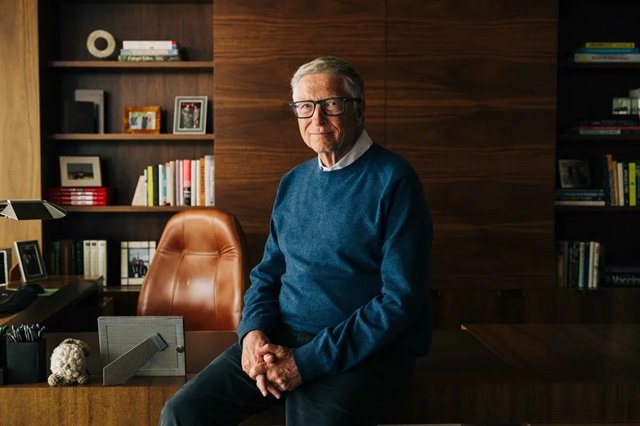
Bill Gates has spent much of his life at the centre of technological change. Since co-founding Microsoft with Paul Allen in 1975, he has witnessed — and helped shape — the rise of the personal computer, the internet and the smartphone. Yet artificial intelligence has altered his assessment of what technological disruption can mean.
In an interview with Die Zeit, Gates, now 70, offered an unusually stark warning: AI is developing faster than he expected, and society has not yet built the institutions capable of dealing with its consequences. The technology, he argued, is not simply another major innovation. Its capacity to alter cybersecurity, employment, biological threats and human relationships makes it fundamentally different from earlier technological shifts.
What changed his view was not a single breakthrough but the speed at which AI systems improved. Gates recalled being surprised when OpenAI chief executive Sam Altman demonstrated ChatGPT to him four years ago. He was similarly struck late last year when Anthropic’s Claude began programming at a very high level. For someone whose career had been devoted to thinking about how software is developed, the fact that AI could perform sophisticated programming was both impressive and alarming. The same capabilities that make the technology useful, he said, could also enable cyberattacks.
The risks extend further. Gates warned Die Zeit that AI could assist terrorists in developing biological weapons and that chatbots could create forms of psychosocial dependence. Unlike the personal computer or the internet, he argued, AI could produce consequences that are “far more dramatic” and unique in the way it changes the world.
The central concern for Gates is not simply technological capability but the absence of a sufficiently broad social response. He said discussions about AI risks have remained concentrated largely within the technology industry, even though the moment when safeguards were supposedly needed only after AI became powerful has already arrived. Economists, social scientists and politicians, he argued, need to become substantially more involved.
That leads to one of his most direct conclusions: the technology industry cannot be expected to regulate itself. Gates does not describe AI companies as uniquely reckless. Instead, he says the existing incentive structure pushes them to move ahead at full speed, while acknowledging that industry representatives themselves are increasingly open about the risks they see.
The missing actor, in his view, is government.
“The state must intervene,” Gates told Die Zeit. Governments, rather than companies themselves, have the authority to require developers to slow down and to monitor whether individuals are attempting to use AI to develop biological weapons. He compared the need for oversight with existing approaches to aviation safety and nuclear weapons. Yet, he said, too little expertise and time are currently being devoted to these questions.
His concerns also extend to the labour market. In a recently published essay, Gates warned that AI could eliminate many well-paid jobs while concentrating enormous wealth among a relatively small group. At the same time, the Die Zeit interview notes that economists have so far found no evidence that AI is already displacing jobs across the economy on a broad scale. There may, however, be early indications among people entering professions particularly exposed to AI.
Gates has therefore proposed taxing the use of AI and robots and reserving certain professions, including some areas of care work, for humans. The practical challenge is considerable, particularly in the United States, where the government is reluctant to regulate the industry heavily and sees AI development partly through the prism of competition with China.
Yet Gates argues that competition should not prevent governments from learning from one another. China, he noted, has adopted a more restrictive approach to AI and other digital technologies, including measures intended to protect young people from emotional dependence. The United States and China have common interests in areas such as health and education and, importantly, biosafety. According to Gates, the principal disagreement between the two countries concerns the extent to which AI should be used militarily.
That distinction matters because public attitudes towards AI in the United States and other Western countries have become increasingly negative. Die Zeit cites figures showing that more than two-thirds of Americans believe the technology poses substantial risks to society, with similarly high numbers opposing the construction of AI data centres.
Gates, however, argues that opposition to data centres addresses only a limited part of the problem. Issues such as water consumption and electricity can potentially be managed, he said, with companies producing their own power and paying higher taxes. The larger challenge lies in what AI will do to employment and society. Those consequences will not remain confined to individual communities hosting data centres.
For Gates, political leaders therefore face a more difficult task than simply responding to public anxiety. Democrats and Republicans in the United States, as well as political parties in Europe, need to understand AI in its full complexity. Better-informed policymakers, he argued, are less likely to resort to blunt responses such as attempting to prohibit AI altogether.
Yet Gates’ assessment is not overwhelmingly pessimistic. His strongest hopes concern countries in the Global South, where shortages of skilled professionals could make AI particularly valuable in healthcare, agriculture and education. His foundation plans to invest at least $1 billion in AI systems in low-income countries over the next two years.
The potential applications are practical. AI could advise small farmers on how to treat or fertilise crops, provide personalised educational material to students, and give learners feedback through smartphones rather than leaving them dependent on overcrowded classrooms. Gates cited pilot projects he had recently seen in Rwanda, where AI was being used to support medical professionals in making diagnoses more quickly and effectively.
But even here, Gates insists that enthusiasm must be measured against scarcity. His foundation evaluates programmes according to their cost and impact, and he acknowledges that the connection between AI investment and lives saved remains less established than in areas such as vaccination. In some hospitals, partners still work with paper records. AI capable of digitising handwriting could allow those records to be processed and transmitted weekly, but such systems cannot receive unlimited funding.
The calculation is uncomfortable but unavoidable. Gates said that, each October, the Gates Foundation examines its strategies and compares the cost of saving lives across different programmes. One project might save a life for $800, while another costs $3,000. He acknowledged that making such calculations can feel almost immoral, but argued that limited resources make them necessary.
That tension — between AI as a source of unprecedented risk and AI as a potentially powerful instrument for saving lives — defines Gates’ current position. He sees a technology capable of helping societies overcome shortages in healthcare, education and agriculture, while simultaneously creating dangers that governments and institutions are not yet adequately prepared to manage.
His own experience with Jeffrey Epstein provides a separate reminder of the risks involved in pursuing ambitious goals through powerful networks. Gates told Die Zeit that between 2011 and 2014 he had hoped Epstein might help him raise billions of dollars for global health. He said the relationship ultimately became a dead end and a reputational risk, and described his contact with Epstein in retrospect as a serious mistake.
The contrast is striking. Gates is now calling for greater caution precisely because technological power, financial incentives and institutional weakness can converge in unpredictable ways. His warning is not that AI should simply be stopped. It is that decisions about its development can no longer be left primarily to those developing it.
For Gates, the question facing governments is therefore not whether AI will transform society. That transformation is already under way. The more urgent question is whether political institutions, economists, scientists and the wider public can understand its consequences quickly enough to govern them.
And on that point, his assessment is unequivocal: society is not yet doing enough.