
Every civilisation peaks and then collapses. Mesopotamia and Babylonia, Mohendarajo and Harappa, the Soviet Union, and now the West! The UK is at the heart of the Western core! Today, the pro-Independence forces threaten the UK. Unless and until the far-reaching leaders of England, Scotland, Wales and Northern Ireland work together, the UK will break up. Such a breakup will have far-reaching consequences for the security of the West!
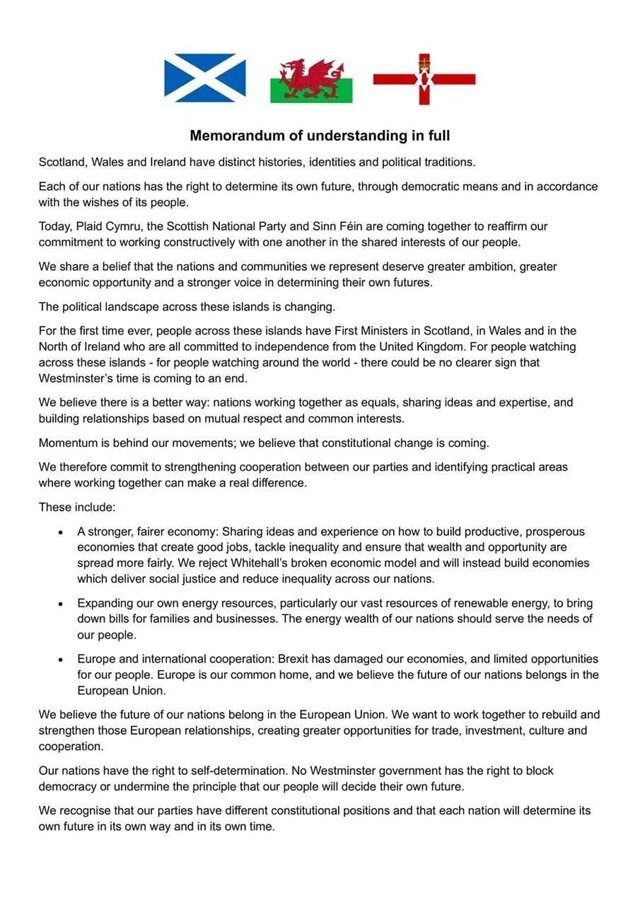
The first ministers of Scotland, Wales, and Northern Ireland signed a historic Memorandum of Understanding in Cardiff on September 14, 2026, declaring that “Westminster’s time is coming to an end”. At the Cardiff Summit, there was a United stand. For the first time since devolution began, the leaders of all three devolved UK nations represent pro-independence or nationalist parties.
The signatories were Scotland’s First Minister John Swinney (SNP), Wales’ First Minister Rhun ap Iorwerth (Plaid Cymru), and Northern Ireland’s First Minister Michelle O’Neill (Sinn Féin), along with Sinn Féin president Mary Lou McDonald, who attended the summit.
The joint declaration calls on the UK government under Prime Minister Andy Burnham to “prepare, plan and facilitate” constitutional change and self-determination. So, will Andy Burnham be the final prime minister of the UK?
Prime Minister Burnham has faced mounting pressure after acknowledging in Parliament that a Scottish independence referendum could be considered if backed by a clear public consensus.
Burnham argues that there was “no consensus for an independence referendum in Scotland and nor is there a clear basis to suggest that a majority of people in Northern Ireland presently wish to separate from the United Kingdom.” Nonetheless, the numbers tell a different story. There is sufficient momentum where the nationalist movements pose a severe threat to a United Kingdom (UK). In the face of the threats to the UK, it will be in the interest of England, Scotland, Wales and Northern Ireland to start to work together to mitigate the risks of a breakup. In modern geopolitics, economics, and military power, the United States and the UK are widely considered the undisputed anchor and superpower of the Western core. However, the UK plays a foundational, historic, and uniquely interconnected role that positions it as a vital artery, if not the singular heart of the West.
The political friction was further amplified after US President Donald Trump stated during a visit to Dublin that he would “love” to see a united Ireland.
While Scotland’s John Swinney aims for a new independence referendum by 2031, Wales’ Rhun ap Iorwerth has not yet set a specific timetable for a Welsh referendum, highlighting varied local strategies despite the unified joint stance.
A potential breakup of the United Kingdom would likely involve Scotland, Wales, and Northern Ireland separating from England, creating separate independent nations or a unified Ireland. First ministers from Scotland (John Swinney), Wales (Rhun ap Iorwerth), and Northern Ireland (Michelle O’Neill) have advanced joint political pushes and declarations demanding the right to hold self-determination and independence referendums.
In the case of Scotland, a successful vote would lead to an independent Scottish state, though timing remains cautious following the 2014 referendum and closely divided current polling. Under the Good Friday Agreement, a border poll could trigger reunification with the Republic of Ireland if majorities in both regions vote in favour.
In the case of Wales, nationalist leadership under Plaid Cymru pushes for constitutional change, overall polling for Welsh independence remains lower and tied closely to broader regional economic dissatisfaction.
In the case of Northern Ireland, it would only join the Republic of Ireland if a majority of voters in Northern Ireland chose to do so in a border poll. The Good Friday Agreement, the 1998 peace agreement, sets the official rules for constitutional change. The UK Secretary of State must call a border poll if it appears likely that a majority of voters would support leaving the UK and joining Ireland. A vote would also need to pass in the Republic of Ireland for unification to happen.
Recent polls show that only 36%, a minority of people in Northern Ireland currently support joining the Republic of Ireland. However, a larger share prefers to stay in the United Kingdom. Polls in the Republic of Ireland show broad general support for a united Ireland, though leaders and Reddit users express mixed opinions and concerns regarding the high economic costs and potential political friction.
Political momentum has picked up following discussions by regional leaders regarding self-determination. High-profile international remarks, such as comments from U.S. President Donald Trump supporting a merger, have reignited public debate on the topic, though local unionist leaders maintain that Northern Ireland’s future rests solely with its own residents.
However, what many do not understand is how a breakup of the United Kingdom will threaten national and regional security.
A breakup of the UK will disrupt defence infrastructure, fragment intelligence networks, and destabilise geopolitical alliances. A breakup will impact on defence and nuclear deterrence. It will prompt the relocation of the UK’s nuclear capabilities from Scotland, the home to HM Naval Base Clyde at Faslane and the Coulport armament depot. They host the UK’s Trident nuclear deterrent submarine fleet. Scottish independence would force a costly and logistically complex relocation of these strategic military assets to England or Wales.
The constituents of the UK will experience a loss of strategic positioning. A fragmented UK would weaken the Royal Navy’s operational reach and monitoring capabilities in the North Atlantic gap, a vital maritime corridor for European defence. With the decoupling of the security services, there will be intelligence and law-enforcement gaps. The division of the UK would fragment integrated domestic security frameworks, potentially disrupting coordination between intelligence services and regional law enforcement. There will be border and jurisdiction friction. Reopening a hard land border in Ireland through unification or creating new international borders between constituent nations would complicate counter-terrorism monitoring, cross-border policing, and immigration enforcement.
With the diminished global weight, there will be geopolitical implications. A smaller remnant UK would experience a reduced global diplomatic footprint and diminished defence spending power, altering the balance of power within NATO. Adversaries like Russia could exploit the constitutional and political turmoil of a dissolving state during a period of already heightened international tension and hybrid warfare threats.
Hundreds of years of shared political, monetary, defence, and trade integration mean any dissolution would be legally and economically complex.
In addition to the enormous military, economic, and intelligence costs, the international community must not lose sight of the cost of insurgency and terrorism. There are over 100 separatist movements worldwide. Their representatives in the UK are monitoring the call by the Scottish, Welsh and Irish separatists. A breakup or a split in the UK will embolden separatist movements, including those using violence.
Separatist leaders will campaign for their right to self-determination before secession. Based on ethnicity, if communities secede, there will be over 10,000 countries. Late devolution in countries where communities are already politicised, radicalised, and mobilised, will lead to separatism. The countries at risk of separatism in the 21st century are in China, India, Pakistan, Sri Lanka, Myanmar, Thailand, Philippines, Indonesia, Russia, Ukraine, Turkey, Iraq, Syria, Yemen, Cameroon, Mali, Ethiopia, Somalia, Nigeria and Senegal.
A divided UK will be weak. Is the rise and fall of empires inevitable? The British Empire was the largest empire in history, ruling a quarter of the world’s population at its height in 1913. The British Empire was described as the empire on which the sun never sets. It began with the English overseas trading posts and possessions in the late 16th and early 17th centuries. By 1920, the British Empire covered 35.5 million square kilometres, which was 24% of Earth’s total land area. Following economic strain from both World Wars, a global wave of decolonisation led to independence for most colonies, ending with the handover of Hong Kong in 1997.
A breakup of the United Kingdom would cause severe economic and political disruption. The growing political shifts across England, Scotland, Wales, and Northern Ireland have put the future of the Union under new strain. The economic impact, especially trade barriers, will be significant. Splitting the nations would create new borders and slow down trade. Independent regions would need to create new money systems or split national debt. Higher costs will be inevitable. Setting up separate tax and public systems would cost a lot of money. Political and global impact will be the loss of power.
A smaller UK would have less of a voice in the world and in groups like the United Nations. Moving military bases and splitting the armed forces would be complex and costly. In addition to defence challenges, there will be border tensions. Northern Ireland might join the Republic of Ireland, which could revive past conflicts.