More than four years after the Russian Federation launched its full-scale armed attack against Ukraine, a new United Nations report has documented sexual violence not as a series of isolated incidents, but as a recurring feature of the conflict — used against prisoners of war, civilian detainees and civilians living in occupied territory.
The Office of the United Nations High Commissioner for Human Rights (OHCHR) verified 1,004 cases of sexual violence between 24 February 2022 and 31 July 2026. The findings are based primarily on confidential interviews with survivors, alongside court documents, official records and other relevant material. OHCHR stresses that the figures are representative rather than comprehensive because sexual violence is significantly underreported and investigators have lacked access to areas controlled by the Russian Federation.
Of the verified cases, 89 per cent were attributed to Russian Federation authorities, including members of the Russian armed forces, the Federal Penitentiary Service (FSIN) and the Federal Security Service (FSB). The remaining 11 per cent were attributed to Ukrainian authorities, including members of the Ukrainian armed forces, the State Penitentiary Service and the Security Service of Ukraine (SBU).
The report describes sexual violence in the context of the conflict as a method of torture and other cruel, inhuman or degrading treatment or punishment. The documented forms range from rape and attempted rape to genital mutilation, sexual assault, forced nudity, beatings and electric shocks to the genitals, threats of sexual violence and other sexually degrading treatment.
The scale of the findings is particularly stark among Ukrainian prisoners of war and retained medical personnel. OHCHR interviewed 915 people released from captivity, including 879 men and 36 women. Of them, 572 — 63 per cent — gave consistent and detailed accounts of sexual violence. In 725 of the 892 cases attributed to Russian Federation authorities overall, the survivors were men; 151 were women, 14 were girls and two were boys.
Among Ukrainian POWs and retained medical personnel who reported sexual violence, 413, or 72 per cent, said they had experienced multiple incidents. In 274 cases, or 48 per cent, the violence occurred in more than one place of internment. OHCHR documented sexual violence in 83 official facilities and 81 unofficial or transit locations across six regions of Ukraine and 25 regions in the Russian Federation.
The forms of abuse were frequently combined. Electric shocks to the genitals using a “tapik” or taser were reported in 155 cases, representing 27 per cent of those interviewed who had experienced sexual violence. Genital beatings were reported in 246 cases, forced nudity in 372, and beatings or electric shocks to the body while nude in 348. In 428 cases, or 75 per cent, victims experienced multiple forms of sexual violence.
The report describes abuse occurring throughout captivity: during capture and transfer, admission to detention facilities, interrogation, routine cell inspections and showers, and immediately before exchange or release. OHCHR found that sexual violence was frequently used during interrogations to obtain information or compel confessions, while in other circumstances it was used to humiliate, punish or intimidate.
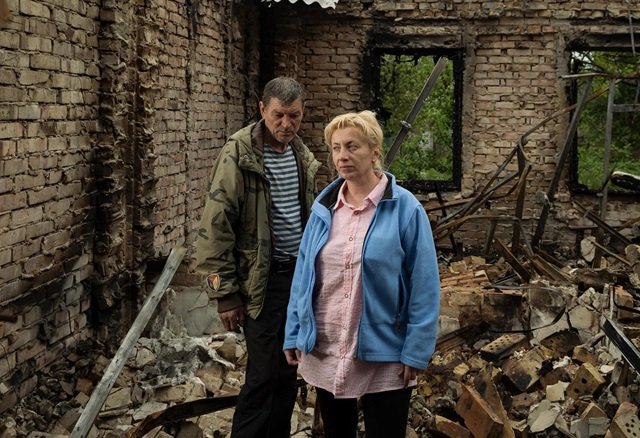
The violence extended beyond detention facilities. In occupied areas where Russian armed forces were stationed, OHCHR documented sexual violence against 95 civilians, including 72 women, eight men, 14 girls and one boy. Fifty-seven survivors gave detailed accounts of rape by Russian military personnel, including 15 who were gang raped. The oldest rape victim was 82 years old; the youngest survivor was four.
Women living in residential areas were particularly exposed. The report describes soldiers entering homes, occupying them for prolonged periods and subjecting residents to sexual violence. In one case, a Russian soldier stayed in a house in Kherson region for several months, raping a woman every night and repeatedly threatening her with gang rape. In another case, two Russian soldiers allegedly shot and killed a woman’s husband before gang raping her while threatening to shoot her in front of her four-year-old son if she resisted.
Sexual violence was also documented against Ukrainian civilians held in detention. OHCHR verified 205 cases during the reporting period, involving 156 men, 48 women and one boy. Forty-five per cent of these civilian detainees reported multiple incidents or sexual violence in more than one place of detention. The violations included rape, attempted rape, genital mutilation, electric shocks, beatings, forced nudity, sexual humiliation and threats.
Yet the report also documents sexual violence by Ukrainian authorities. OHCHR verified 112 cases involving 98 men and 14 women. No cases against children were documented. Among 881 Russian and third-country national POWs interviewed by OHCHR, 63 — all men — gave credible and reliable accounts of sexual violence. OHCHR found no cases of rape or attempted rape against these POWs, but documented electric shocks to the genitals, genital beatings, forced nudity, beatings or electric shocks while nude, degrading treatment and threats of rape or castration.
The report records similar violations against conflict-related detainees in Ukrainian-controlled territory. Of 656 detainees interviewed, 49 reported sexual violence. Threats were the most common form, with 34 cases comprising exclusively threats. OHCHR also documented forced nudity, beatings while nude, genital beatings, attempted rape and sexual assault.
The distinction in the report is not simply between two sets of allegations. It also concerns how each side has responded to them. OHCHR says it is not aware of action by the Russian Federation to investigate, prosecute or otherwise address sexual violence committed by Russian authorities, and notes Russia’s continued denial of access to occupied territory and detention facilities.
Ukraine, meanwhile, has provided OHCHR regular and unimpeded access to Russian and third-country national POWs and conflict-related detainees. The report records legal reforms, investigative procedures, monitoring arrangements and measures aimed at survivor assistance and reparations. It also notes that accountability remains limited: as of July 2026, OHCHR was not aware of notices of suspicion being issued in cases involving sexual violence against Russian or third-country national POWs.
The report therefore presents a conflict in which sexual violence has affected victims on both sides, while recording a substantially larger number of cases attributed to Russian Federation authorities. Its central demand is accountability regardless of affiliation. OHCHR calls on all parties to end sexual violence, investigate allegations promptly, thoroughly and impartially, protect prisoners and detainees, and provide survivors with access to justice, reparations and medical, psychological, social and legal support.
For the Russian Federation, the recommendations include ending unlawful detention practices, allowing OHCHR access to Ukrainian POWs and civilian detainees, and repealing provisions that exempt serving military personnel from criminal liability for serious human rights violations. For Ukraine, the UN calls for stronger protection of POWs and conflict-related detainees, particularly during the initial stages of captivity, and continued implementation of its reparations framework.
The report’s evidence also exposes the limits of any numerical account. OHCHR says the 1,004 documented cases significantly underrepresent the actual number of survivors. Many victims face trauma, stigma, fear of retaliation, mistrust of law enforcement and doubts about obtaining justice. In occupied territory, the absence of independent monitoring and fear that communications may be intercepted further restrict documentation.
The report’s conclusion is therefore both stark and carefully qualified: sexual violence has become a documented feature of the war, occurring in detention and outside it, against men, women and children, and involving multiple forms of torture, humiliation, coercion and intimidation. The evidence gathered by the UN does not purport to record every case. It establishes, within the “reasonable grounds to believe” standard used by OHCHR, patterns that demand investigation, accountability and protection of survivors regardless of who committed the abuse.