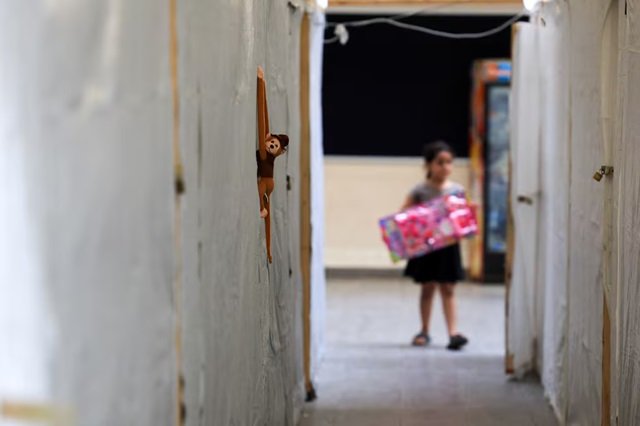
For Lebanon’s children, returning to school has become a struggle to recover routines repeatedly shattered by war, displacement and economic crisis. Jana, 12, sits in a classroom on the outskirts of Beirut, moving her legs beneath her desk as she explains that she does not want to miss another lesson. “I don’t intend to miss one more class,” she says.
For Wael, 10, online education during the conflict offered little alternative. He recalls staying with about 30 other people at his grandmother’s home after fleeing bombardment. “The bombings brought down the internet connection,” he says. “We couldn’t study.” Now, at a temporary education centre in Ghobeiry run by Save the Children, he concentrates on his teacher’s voice to block out the sound of drones overhead.
The disruption is part of a wider educational crisis. When open war resumed in March, Israeli military operations forcibly displaced 1.2 million people, including about 500,000 school-age children, according to the United Nations. Lebanon’s Education Ministry says 436 educational facilities have been bombed, representing 40% of those assessed. The government also converted almost half of the country’s remaining public schools into shelters, bringing education to a halt for many students.
Ceasefire agreements in June allowed some educational spaces to reopen, but Israel continues to occupy 67 villages in the south and has carried out further strikes. The Education Ministry plans to reopen more than 150 schools in the southern region, with some operating partly online depending on security conditions. About 100,000 children could remain without classes if damaged schools are not repaired, according to Unicef.
The consequences extend beyond lost classroom time. Yara, a 25-year-old teacher, says pupils ask whether the drones flying over Beirut will bomb them. She says some children joke about experiences that have frightened and traumatised them, while others do not know material they had studied before the war. “Don’t be surprised if they forget tomorrow what they learned today, or if they don’t respond because they are in shock,” says education expert Rania Hammoud.
Hammoud says years of interrupted schooling and remote learning have contributed to deficits in language and communication development, with some children unable to write at the age of 10. The disruption follows a financial crisis that began in 2019 and devalued Lebanon’s currency by 90%, the 2020 Beirut port explosion that temporarily left 300,000 people homeless, and subsequent pandemic and conflict-related interruptions.
The crisis is also deepening inequalities. Private schools maintained greater continuity in some parts of the country but remain unaffordable for many families, while public schools have been used to accommodate displaced people and have taken on humanitarian responsibilities. In the south, Israeli military restrictions have prevented residents from returning to areas under occupation, while other schools in accessible areas have been damaged.
In Marjayoun, school director Sister Hyam Habib says students from Nabatieh have been unable to attend because of closed roads. Fatma, a 39-year-old teacher from Nabatieh, says schools where she once worked have been destroyed. After Israel bombed the public school in Mansouri shortly before its planned reopening, she said: “I cried when I saw it.”
Lebanon’s Education Minister Rima Karami has made returning every child to school a priority. But the International Organization for Migration still records 330,000 forcibly displaced people without a clear prospect of return, while about 30 schools remain shelters. Save the Children director Nora Ingdal warns that prolonged absence from school increases the risk of child labour and recruitment by organised criminal networks or armed groups.
For 14-year-old Sarah, who was lightly wounded by a missile and developed a fear of any sound, mathematics has become a refuge. Proudly pointing to an equation she has solved on the classroom board, she says the subject helps her “abstract from the sounds of war”.