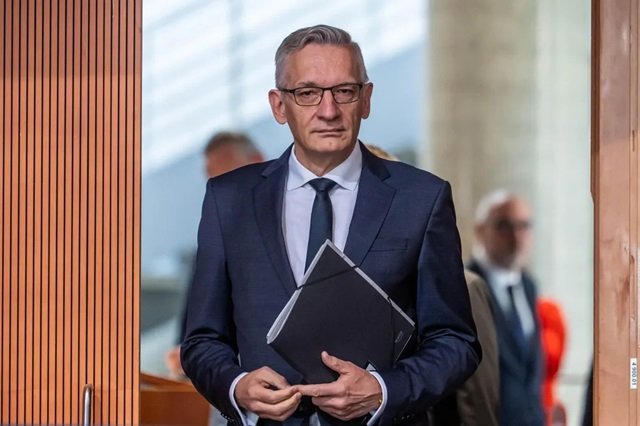
Germany’s foreign intelligence chief, Martin Jäger, has warned that Russia is waging a “shadow war” against Germany, describing a confrontation that he says has moved beyond conventional military and legal categories. His remarks, delivered in the Bundestag, marked a sharper description of the increasingly hostile relationship between Berlin and Moscow and came after a failed attack in Leipzig and a Russian drone strike near the German chancellor in Kyiv. The assessment was reported by Die Zeit, which described Jäger’s choice of language as both a clarification and a rhetorical escalation.
Jäger used the term “shadow war” during the annual public hearing of Germany’s three senior intelligence chiefs before the Bundestag’s Parliamentary Control Panel. Once a year, in October, the heads of the Federal Intelligence Service (BND) and the Federal Office for the Protection of the Constitution, together with the president of the Military Counterintelligence Service, outline the security situation before parliament. This year’s assessment focused heavily on what Jäger described as an increasingly dangerous confrontation with Russia.
Rather than using the increasingly familiar term “hybrid war”, Jäger deliberately characterised the activities as a “shadow war”. Sabotage, assassinations, hacking and disinformation, in his formulation, are not peripheral activities but components of an undeclared conflict. He said the confrontation with Russia had acquired “a new, more dangerous quality” and warned that Germany faced the possibility of being drawn into a violent conflict. A year earlier, Jäger had warned that an “icy peace” could at any time become a “hot confrontation”.
The warnings followed developments that German authorities regarded as evidence of increased Russian risk-taking. A failed attack in Leipzig had demonstrated what Jäger considered a disturbing willingness by Russian intelligence services to take greater risks, while a Russian military drone attack on Kyiv the day before the Bundestag hearing occurred while the German chancellor was in the Ukrainian capital. The source describes Germany as having narrowly avoided a catastrophe in Leipzig and presents the incidents as evidence that the physical proximity of the confrontation is increasing.
Jäger argues that Germany has become a particularly important target because of its role as a major supporter of Ukraine. “We did not seek this confrontation; Russia is imposing it on us,” he said, arguing that Germany rejects “Russia’s revisionist-expansionist policy” and its war against Ukraine while opposing Russian attempts to intimidate NATO partners in the Baltic states and elsewhere in Europe. In his assessment, Germany represents the “main obstacle to Russia’s projection of hegemonic power in Europe”.
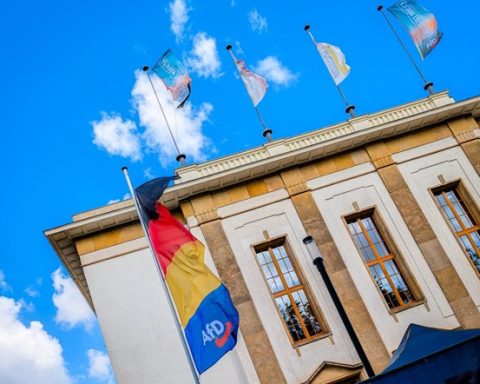
His assessment also carries a domestic political implication. Without naming individual parties, Jäger challenged the argument advanced by political forces that support for Ukraine should be reduced or ended in order to reach an accommodation with Moscow. The AfD, BSW and the Left have called for an end to weapons assistance to Ukraine as part of a move towards an agreement with Russia. Jäger argues that weakening support for Ukraine is precisely one of the objectives of Russia’s shadow war against Germany and that attacks aimed at demoralising Ukraine’s supporters are therefore likely to intensify.
The BND chief also portrayed Russia’s position on the battlefield as increasingly difficult. He said little progress was being made at the front and that Russia was consuming its own resources. “Russia is consuming its substance,” Jäger said. He added that President Vladimir Putin had gone beyond the point at which he could simply end the invasion without putting his domestic power base at risk.
According to Jäger, Russia is therefore pursuing a broader strategy aimed at weakening the countries supporting Ukraine. Moscow is acting on the assumption that European governments will eventually be unable to withstand Russian pressure and intimidation. Countries providing assistance to Ukraine could consequently become targets for violent operations designed to obstruct weapons deliveries, including through military means inside Germany.
Jäger also expects Russia to return to nuclear threats and warned that Western governments should not respond by wavering. “Every sign of hesitation, from the Kremlin leadership’s perspective, invites it to increase pressure on Germany further,” he said. At the same time, he stressed that there was currently no acute threat of major Russian attacks on NATO territory. He did, however, warn that Russia could undertake low-level military activities, particularly in the Baltic states, and said false-flag operations could not be ruled out.
The intelligence chief’s public intervention therefore serves two purposes: to describe the threat and to signal Germany’s intended response. The heightened risk-taking displayed by the failed Leipzig operation had reportedly alarmed the German government and intelligence services. Jäger’s appearance before parliament communicates to the German public that the authorities regard the situation seriously, while also sending a message to Moscow that its activities are being detected.
The central assertion is that Russia’s strategy is not confined to the battlefield in Ukraine. By targeting infrastructure, attempting to disrupt weapons supplies and seeking to undermine the resolve of countries supporting Kyiv, Moscow is also testing the political resilience of its opponents. Jäger’s warning is that Germany must expect further pressure while avoiding the conclusion that such pressure necessarily means a major attack on NATO territory is imminent.