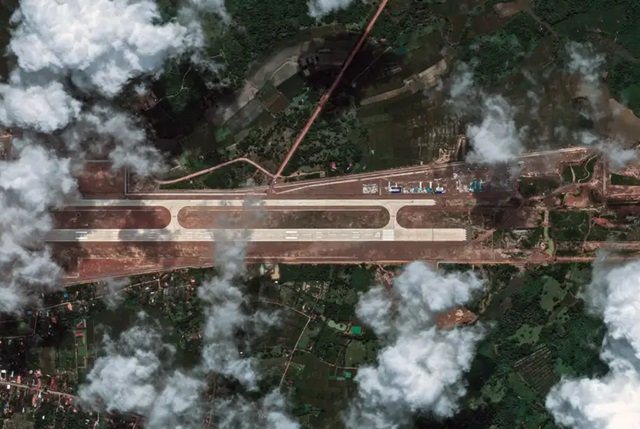
China has established a new military facility in Laos, expanding its overseas military footprint into a country where Beijing has historically competed for influence with Vietnam. The China-Laos Joint Support and Training Center and the China-Laos Friendship Aviation Academy are now operational at an airport in Ban Keun, about 50km (31 miles) north of the Lao capital, Vientiane, according to China’s Ministry of National Defence.
Commercial satellite imagery reviewed by Reuters indicates that construction began in late 2025 on what had previously been a patch of farmland. Until last year, imagery showed little more than a rough dirt strip. By early this month, the site contained a large paved runway, a parallel taxiway and apron, together with numerous new buildings, with construction still under way. Some records indicate that the area was once used by the United States during its war in Laos and neighbouring Vietnam and Cambodia in the 1960s and 1970s.
Beijing says the facility will be used to train Lao air force pilots and is “not directed against any third party”. It has not disclosed what personnel, equipment or other facilities will be permanently based at the airport. The Laos Ministry of Foreign Affairs did not respond to questions about the development.
The centre represents China’s third acknowledged overseas military facility and its second in Southeast Asia, following the logistics base in Djibouti and the joint training and support centre at Cambodia’s Ream naval base on the Gulf of Thailand. Cambodia has maintained that no Chinese personnel or warships are permanently stationed at Ream. China opened its Djibouti base in 2017 and has since expanded its berthing and surveillance capabilities there; the Pentagon has previously estimated that about 400 Chinese Marines were stationed at the facility.
The precise military significance of Ban Keun remains disputed. Rachel Vandenbrink, a senior analyst at the Australian Strategic Policy Institute, said the description of the site as a joint support and training centre suggested that the People’s Liberation Army could be seeking persistent access to a logistics hub capable of supporting forces rotating through Laos, potentially with “a small forward support element”. But she also cautioned that it was unclear what military power China could project from Laos that it could not already deploy from its southern province of Yunnan.
“At Ban Keun, the more immediate significance may be China’s ability to establish a persistent military presence and deepen its institutional relationship with the Lao armed forces,” Vandenbrink said.
Collin Koh, a security scholar at Singapore’s S. Rajaratnam School of International Studies, drew a more consequential comparison with China’s other overseas facilities. “Unlike Ream Naval Base, this military logistics base in Laos is more ostensibly similar to the one in Djibouti,” he wrote on X. “It may not be wrong to conclude this is the first full-fledged PLA overseas base in Southeast Asia.”
The new facility also gives Laos greater access to military training at home. The Lao air force is small and operates a handful of aircraft designed by China and Russia. Open-source information indicates that it operates five SAIC LE500 basic trainers and four Yakovlev Yak-130UTS advanced jet trainers. Lao troops have traditionally travelled to Vietnam, Russia and China for advanced training; a Southeast Asian diplomat said some training can now take place within Laos.
The development comes as military ties between Beijing and Vientiane deepen. Laos has participated in joint military exercises with China, including a humanitarian-response exercise this month. In June, Lao President Thongloun Sisoulith visited Beijing for talks with Chinese President Xi Jinping, who called for strategic dialogue on several issues, including national defence.
For Vietnam, the expansion has particular strategic significance. Laos and Vietnam are fellow communist states with a complicated history of cooperation and rivalry with China. Vietnam invaded Cambodia in 1978 to overthrow the pro-China Khmer Rouge government, and China invaded Vietnam the following year after Laos had vocally supported Hanoi. China now has, at minimum, a presence in both countries, alongside its expanding military facilities in the disputed South China Sea.
Nguyen Khac Giang, a visiting fellow at the ISEAS-Yusof Ishak Institute in Singapore, told Bloomberg that a meaningful Chinese presence in Laos could provide Beijing with serious leverage over Vietnam in a crisis. China’s existing South China Sea facilities include military-grade runways, surveillance and air-defence installations on Fiery Cross, Mischief and Subi reefs in the Spratly Islands. Reuters has also reported fresh construction at sites expected to become extensive new bases in the Paracel archipelago, which is also claimed by Vietnam.
Thailand, a US treaty ally that shares a long border with Laos, has so far been the only government to comment publicly on the new facility. Rear Admiral Surasant Kongsiri, a spokesperson for Thailand’s Ministry of Defence, said Bangkok regarded itself as a close partner of both Laos and China and recognised Vientiane’s sovereign right to decide whether to host a Chinese base.
“Nevertheless, Thailand will continue to closely monitor developments and how the matter proceeds, particularly with regard to building mutual trust,” he said.