
by Durga
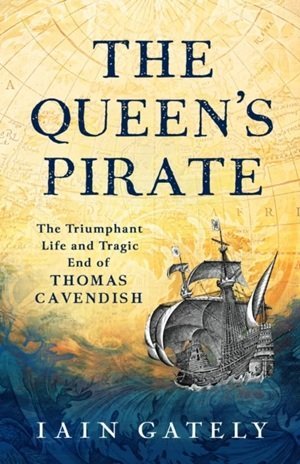
Iain Gately’s The Queen’s Pirate: The Triumphant Life and Tragic End of Thomas Cavendish begins with an image that seems almost designed to dismantle the mythology of Elizabethan maritime glory. On 11 June 1593, the Desire limped into Berehaven, Ireland, after a disastrous voyage. Of the seventy-four men who had departed from Plymouth, only sixteen remained alive, and just five could stand. The ship that had once dazzled Queen Elizabeth I with damask sails, Chinese silk and gold-plated extravagance was now a floating charnel house, its decks littered with corpses and its hold infested with worms. The contrast is more than a dramatic opening. It establishes the central question surrounding Thomas Cavendish: how does a society turn predation into patriotism, plunder into enterprise and a violent adventurer into a national hero? Gately’s biography is at its most compelling when it refuses to separate the glamour of Elizabethan expansion from the human wreckage that accompanied it.
The Desire provides Gately with an unusually effective narrative device. Its transformation from a magnificent vessel into a rotting survivor becomes a material record of Cavendish’s rise and collapse. In 1588, the ship arrived at Greenwich in a display of theatrical magnificence. Its crew wore blue silk, its standard was made from Chinese silk and cloth of gold, and its owner entertained the queen on solid gold plates. A Spanish observer reportedly thought the spectacle resembled Cleopatra’s resurrection. Five years later, the same vessel carried the remnants of a failed expedition. The juxtaposition is almost too perfect, but Gately understands the power of objects to disclose the ambitions and contradictions of their owners. The ship is not merely a setting for the story; it is the most eloquent witness to the cost of Cavendish’s ambition.
Yet the book’s real provocation lies elsewhere: in its treatment of privateering as piracy with official approval. Gately describes the practice without the usual romantic evasions: it was “a legal form of piracy”. The distinction between the English privateer and the Spanish corsair depended less on the nature of their conduct than on the authority under which they operated. Letters of reprisal provided a legal mechanism through which English merchants and adventurers could seize enemy shipping and property. The procedure gave violence an administrative vocabulary and made theft compatible with royal policy. Cavendish could therefore be celebrated at home for actions that made him an object of terror abroad.
This is the book’s most politically significant argument, because it exposes the moral selectivity embedded in national memory. The English celebrated the disruption of Spanish commerce as patriotic achievement; the Spanish regarded the same operations as criminal depredation. Neither description can be understood independently of imperial rivalry. Gately’s account invites readers to consider how easily a state can convert private greed into public service when the target is a rival power. The phrase “Privateers could also be patriots” captures the ambiguity, but it also raises a question that deserves more sustained examination: if patriotism can legitimise plunder, where does the distinction between national defence and organised robbery finally reside?
The author’s portrait of Cavendish makes the problem harder to resolve. He was not presented as a straightforward military commander driven by religious conviction or an elevated sense of public duty. Gately describes him as “aloof, calculating and motivated by opportunity and expediency rather than introspection, piety or prejudice”. This is an arresting characterisation, although the claim risks making Cavendish appear more psychologically transparent than the surviving evidence may allow. The description of him as “the most existential of Elizabethan heroes” is particularly suggestive but potentially anachronistic. It gives a sixteenth-century adventurer a distinctly modern cast, as though he were a self-conscious individual liberated from inherited loyalties and moral conventions. Yet the same account acknowledges that his principles rested on a medieval conception of honour that sanctioned violence, theft and revenge. The tension between these descriptions is revealing: Cavendish may have been personally pragmatic, but he operated within a culture whose assumptions about honour and legitimate violence were far from modern.
Gately’s reconstruction of Cavendish’s early life offers a possible explanation for his appetite for risk. Born into a wealthy and well-connected Suffolk family, he experienced the deaths of several siblings and lost his father when he was twelve. His guardian, Sir Thomas Wentworth, had once occupied an important position in public life but suffered lasting disgrace after the loss of Calais to the French in 1558. Cavendish, according to Gately, felt “contaminated by association”. After inheriting his estates, he rejected the Puritan restraint associated with his guardian and entered the extravagant world of Elizabeth’s court. The suggestion that his later ventures were attempts to escape the shadow of Wentworth’s humiliation is persuasive as a biographical interpretation. It is not, however, a conclusion that should be mistaken for established psychological fact. The desire to recover honour may explain something of Cavendish’s conduct, but it cannot fully account for the scale of his ambition or the violence through which he pursued it.
The court itself emerges as a remarkable theatre of vanity, competition and patronage. Gately’s descriptions of extravagant clothing, elaborate grooming, gambling and royal favour are among the liveliest passages in the material. Sir John Harrington’s observation that courtiers used padding and perfumes to appear better formed and more agreeable exposes the artificiality beneath the carefully constructed image of masculine perfection. The £1,000 wager Cavendish placed on whether George Gifford could walk to Constantinople is equally revealing. It suggests a young man for whom money was less a source of security than an instrument for manufacturing excitement. When gambling ceased to satisfy him, the sea offered a larger arena in which the stakes included not merely wealth but reputation, survival and power.
Walter Raleigh’s influence is central to this transition. Gately portrays him as a model of the successful Elizabethan courtier: physically impressive, articulate, extravagantly dressed and connected to established privateering interests. His shoes alone were reportedly worth £600, a sum that exposes the extraordinary inequalities concealed beneath the splendour of court culture. Cavendish admired Raleigh not simply because he enjoyed royal favour, but because he demonstrated how wealth, family connections, maritime violence and political access could reinforce one another. The relationship reveals that privateering was not an isolated adventure undertaken by reckless individuals. It was part of a wider system linking aristocratic ambition, commercial investment and the machinery of the state.
That system becomes even more disturbing in the language of colonial expansion. Elizabeth’s 1584 patent granted Raleigh permission to explore, occupy and possess territories described as “remote heathen and barbarous lands” not held by a Christian prince. The language is not incidental. It reveals the assumptions through which European powers claimed authority over territories and peoples beyond their control. The patent effectively treated the absence of Christian sovereignty as an invitation to appropriation. Gately’s presentation exposes the ideological foundations of expansion, although the material considered here does not fully develop the experiences of the people whose lands and political autonomy were threatened by these ambitions. Their relative absence matters. The story of maritime exploration cannot be adequately understood solely through the fortunes of the European men who financed, commanded and celebrated it.
Gately is also alert to the disjunction between Cavendish’s cultivated appearance and his reputation for brutality. The portrait of the young adventurer depicts an elaborately dressed gentleman, complete with velvet, jewels, embroidered clothing and a sword. Yet this is the same man associated with burning ships and towns and killing opponents. Gately’s description of the portrait, particularly its “pale blue eyes”, is atmospheric and memorable. He suggests that the dead man seems to scrutinise the viewer through the painting. It is an evocative piece of writing, but it also illustrates a difficulty in historical biography: portraits reveal how people wished to be seen, not necessarily what they were. The image can intensify the mystery of Cavendish; it cannot, by itself, disclose his conscience.
The Spanish response to his activities provides an essential counterweight to the English celebration of his achievements. His enemies called him a corsair, and the Inquisition executed captured members of his crew. News of his death was reportedly marked by Te Deums in three continents. These details demonstrate the scale of the hostility he provoked, but they also expose the brutal religious and political divisions of the age. Cavendish’s violence did not occur in a moral vacuum; it belonged to a conflict in which both sides could regard their own actions as legitimate and those of their opponents as intolerable. A balanced account must recognise the brutality of Spanish reprisals without allowing them to obscure the violence committed by English privateers.
The final voyage, with its failed ambitions and catastrophic human losses, gives the biography its tragic dimension. Cavendish died at an unmarked location in the South Atlantic, while the surviving ships returned without his body. The man once celebrated in ballads and commemorated by parents naming their sons after him disappeared into the ocean, leaving behind neither a grand monument nor a secure ending. Gately notes that the Dutch later used his charts and pilots in establishing their own presence in Asia, while Cavendish’s ambition for maritime commerce between England and China anticipated developments that would outlive him. But historical consequence should not be confused with moral vindication. The fact that later powers benefited from the routes and knowledge accumulated by such voyages does not transform the violence that helped produce them into an admirable achievement.
The significance of The Queen’s Pirate lies in its challenge to the comfortable categories through which national histories remember their adventurers. Cavendish was simultaneously a courtier and a corsair, a celebrated Englishman and a hated Spanish enemy, a man of extraordinary ambition and an architect of suffering. Gately’s narrative restores colour and personality to a figure largely absent from popular memory, while the opening image of the ruined Desire quietly undermines the triumphalism of the age. The book’s most important implication is that empire often begins not with noble declarations but with the conversion of private appetite into public virtue. Cavendish may have sailed in search of gold, glory and a place in history. What returned was a broken ship, a handful of exhausted survivors and a legacy that remains considerably less heroic than the legends suggest.