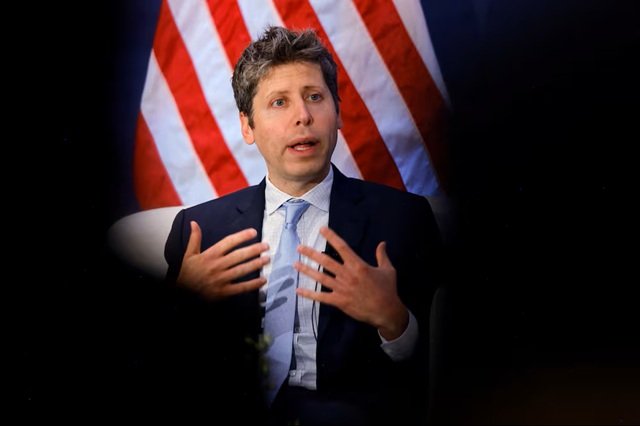
The people developing artificial intelligence understand why the public is anxious about its future. What they have yet to establish is whether those concerns genuinely influence the decisions they make. That contradiction was particularly evident when OpenAI chief executive Sam Altman acknowledged that people fear a future in which artificial intelligence assumes so much control over everyday life that humans become little more than dependent beneficiaries of systems designed to look after them. The concern, he suggested, is not simply whether machines will replace particular jobs, but what role people will retain in society, how power will be distributed between humans and machines, and whether those who control advanced AI will acquire an overwhelming advantage over everyone else.
Altman also recognised the unease surrounding what some in the technology industry describe as a potential ‘handover’ from human decision-making to artificial intelligence. Yet his acknowledgement of these fears has done little to reassure those questioning the industry’s priorities. The central problem is increasingly one of trust: whether the people developing technologies capable of transforming society are genuinely committed to protecting human interests or are primarily pursuing commercial and strategic advantage.
These questions emerged prominently at the Semafor conference, ‘Silicon Valley and the World’, held in Palo Alto, California. The gathering brought together some of the most influential figures in technology, finance and politics, including Amazon founder Jeff Bezos, OpenAI’s Altman, Amazon chief executive Andy Jassy and South African President Cyril Ramaphosa. Bezos discussed his new AI manufacturing venture, Prometheus, while Jassy examined the emerging agentic economy. Investment executive Divesh Makan, meanwhile, offered an indication of the extraordinary concentration of capital flowing into the sector, revealing that Iconiq Capital was directing 80 per cent of its investments towards AI, with 90 per cent of that allocation concentrated in and around San Francisco.
The conference offered a revealing illustration of how Silicon Valley increasingly understands the world through the language of technology, investment and corporate expansion. Even the terminology is changing. Artificial intelligence is increasingly being shortened to ‘intelligence’, suggesting that it has moved beyond the status of an experimental technology to become a commercial product in its own right. Bezos described the satisfaction of developing AI applications for physical manufacturing as ‘type-2 fun’, comparing it with the delayed gratification of completing a difficult mountain climb. Another emerging expression, ‘Model Autophagy Disorder’, describes the possibility of AI systems progressively deteriorating by consuming material generated by previous AI systems.
Behind this specialised vocabulary lies an economic system in which financial valuation has become a dominant measure of technological achievement. Investors finance innovators, whose products and corporate valuations subsequently reinforce the wealth and influence of those investors. The resulting concentration of economic power increasingly shapes the political arguments surrounding AI development.
That relationship was apparent in comments by Jacob Helberg, the Trump administration’s undersecretary of state for economic affairs, who argued that there were compelling national security reasons for Nvidia to succeed. Referring to the company’s ability to sustain an enterprise valued at trillions of dollars, he suggested that returning Jensen Huang to its leadership would be desirable. The argument reflects a wider tendency in Washington to regard the commercial success of major American technology companies as inseparable from the country’s economic and strategic position.
Within Silicon Valley, this perspective is reinforced by the belief that the United States and China are engaged in a decisive competition for AI supremacy. The contest is frequently presented as a zero-sum struggle in which technological leadership will determine the distribution of future economic and geopolitical power. This framing helps explain the industry’s resistance to extensive regulation, its willingness to release increasingly powerful systems and its defence of corporate structures that preserve exceptional authority for founders.
Altman himself acknowledges the possibility of a financial bubble surrounding artificial intelligence. He expects some speculative excess to disappear but argues that the industry’s underlying economic potential remains substantial. He points to the rapid development of AI agents and the technology’s growing contribution to scientific and mathematical research as evidence that current valuations may underestimate what future systems can deliver.
Bezos offers a similarly expansive assessment of AI’s industrial potential. He says manufacturing projects that previously required teams of 10 to 20 engineers and approximately six months to complete can now be undertaken in 12 hours. Describing these achievements as ‘miniature miracles’, he predicts that artificial intelligence will transform the manufacturing economy in the coming years. Such claims illustrate why investors and technology executives are prepared to commit enormous resources to the sector, even as questions about valuations and long-term profitability remain unresolved.
Not everyone accepts the assumption that the American-Chinese technological competition will determine the future of artificial intelligence. Microsoft co-founder Bill Gates has argued that the race may ultimately be unwinnable because AI will become so deeply embedded across societies and industries that neither country can claim exclusive dominance. That perspective challenges the zero-sum thinking prevalent in Silicon Valley, although it receives comparatively little attention within the industry’s dominant political and commercial discourse.
The concentration of influence around individual technology executives raises another concern. The prevailing culture increasingly treats exceptional commercial achievement as justification for exceptional personal authority. The comparison with Thomas Edison has become a recurring reference point, with figures such as Huang and Elon Musk presented as contemporary technological visionaries whose contributions supposedly outweigh their personal shortcomings. Altman captured this attitude when he described Huang as a personal hero, adding that ‘heroes have flaws’.
This philosophy, described as ‘cult capitalism’, extends beyond individual companies. It reflects a broader corporate culture in which founders are granted extraordinary control because their perceived genius is considered indispensable to financial success. The proposed Anthropic public offering, with its founders retaining more than 50 per cent of voting control, illustrates the institutional implications of this approach.
The controversy surrounding Nvidia adds a national security dimension to the debate. Questions have emerged over whether the company exported advanced AI chips to Chinese businesses in violation of American export restrictions. Reports involving Alice Huang, whose alleged connections to Chinese intelligence were subsequently disputed, also drew attention to wider concerns about the company’s exports. The distinction matters: allegations about an individual should not be confused with questions about corporate conduct, particularly when the latter could have implications for national security and American technology policy.
At the same time, the possibility of Jensen Huang returning to Nvidia’s leadership has become a subject of speculation amid concerns about the company’s valuation and investor confidence. The controversy raises uncomfortable questions about how much corporate misconduct shareholders and employees might tolerate if an executive continues to deliver extraordinary financial returns. It also exposes the tension between conventional standards of corporate accountability and the increasingly personalised authority of technology founders.
Beyond these immediate disputes lies a potentially more consequential development: recursive self-improvement, or RSI, through which artificial intelligence systems could progressively improve their own capabilities. Altman has warned that the technology could become extraordinarily powerful in a short period and that society has not fully understood its implications. He acknowledged that AI development could move towards this model without sufficient safeguards, adding that the industry’s current restraint in deploying it represents a deliberate tactic.
But that raises the question at the heart of the entire debate: who determines when development is safe, and who has the authority to decide how much risk society should accept?
Silicon Valley’s executives are increasingly candid about the scale of the transformation they anticipate. What remains unresolved is whether the institutions, corporate structures and individuals directing that transformation are accountable to the people who will live with its consequences. The concern is not simply that artificial intelligence may become more powerful than expected. It is that the power to determine humanity’s relationship with it may become concentrated in the hands of those whose primary measure of success is financial value.