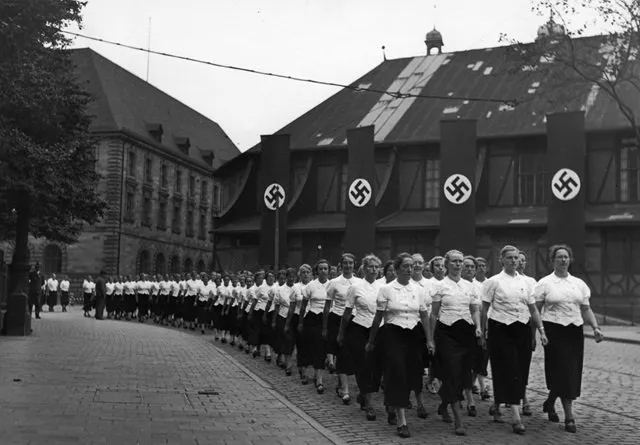
The history of Nazi Germany has often been told through the actions of its male leaders, military commanders, party officials and security organisations. Within families, the question of whether a grandfather belonged to the Nazi Party has become a familiar starting point for confronting the country’s past. But what about the grandmothers? A major archival investigation by German newspaper Die Zeit is challenging this gendered understanding of the Nazi era, revealing that millions of women were organised within institutions that helped spread National Socialist ideology, reinforce racial exclusion and sustain the regime throughout the Second World War.
An analysis of previously underexamined membership records suggests that the two largest Nazi women’s organisations, the National Socialist Women’s League (NS-Frauenschaft) and the German Women’s Enterprise (Deutsches Frauenwerk), collectively had approximately 9.6 million memberships. Although some women belonged to both organisations, the combined figure is substantially higher than earlier historical estimates. The findings suggest that approximately one in five of the 40 million women living in the German Reich was associated with these organisations.
To make the records accessible, Die Zeit has developed a searchable digital database containing approximately 3.5 million documents. The material consists predominantly of membership applications and registration records, many bearing the signatures of women seeking admission to the organisations. Using artificial intelligence-assisted software, the newspaper has made these historical documents searchable by personal details, including names, dates and places of birth, and residential locations. The project offers families an opportunity to investigate whether relatives participated in the Nazi women’s movement.
The scale of the newly identified membership is significant. Die Zeit estimates that the NS-Frauenschaft had approximately 2.6 million members, compared with previous scholarly estimates of around 2.3 million. The German Women’s Enterprise had approximately three million individual members, in addition to roughly four million women incorporated collectively from previously existing women’s associations that had been brought under Nazi control. The resulting total reaches approximately 9.6 million memberships, although overlapping participation means the actual number of individual women was lower.
Founded in 1931, the NS-Frauenschaft became an official subdivision of the Nazi Party in 1935. Membership was voluntary but restricted by the regime’s racial ideology. Applicants had to satisfy the Nazi definition of German racial ancestry, excluding women classified as Jewish or belonging to other racial categories rejected by the regime. From 1936, applicants were also required to demonstrate previous involvement in National Socialist activities.
The German Women’s Enterprise, established in 1933, served a broader organisational purpose. Rather than functioning as a direct party subdivision, it absorbed existing bourgeois and conservative women’s associations that had been brought into line with Nazi rule. Its leadership and organisational structure were closely connected to those of the NS-Frauenschaft. From 1934 until the end of the war, both organisations were directed by Gertrud Scholtz-Klink, the regime’s Reich Women’s Leader.
Their purpose extended far beyond domestic instruction. The Nazi leadership sought to penetrate German society through mass organisations, securing public loyalty and spreading its ideological objectives. Women were essential to this strategy. Members attended courses on household management, childcare, nursing and public leadership, while specialist training prepared them to deliver lectures and organise local communities. From 1936, the organisations increasingly prepared women for wartime responsibilities, including food preservation, household management during shortages and civilian emergency arrangements.
However, the language of community and social solidarity concealed a system founded on racial exclusion and persecution. Women associated with the organisations helped disseminate antisemitic propaganda, promote racial ideology and identify individuals considered enemies of the so-called national community. The activities were not confined to passive propaganda. In Mannheim, during the November 1938 pogrom, a deputy district women’s leader reportedly accompanied SA members through the streets, identifying the homes of Jewish residents.
In 1941, Nazi women in Berlin and Saxony campaigned against exemptions from the compulsory identification of Jewish people through the yellow star. Historian Anette Michel, cited by Die Zeit, argues that regional women’s leaders were involved in the different stages of Jewish persecution from the beginning. Members also helped legitimise the regime’s so-called euthanasia programme and the murder of people with disabilities, presenting these crimes as serving the interests of the national community.
The organisations became even more important after Germany invaded Poland in September 1939. Their activities expanded into an extensive system of wartime mobilisation. Women supported the armed forces, worked with the Red Cross, organised civilian air defence, repaired military uniforms and assisted people displaced by bombing. They also helped manage relations with foreign forced labourers and assumed lower-level positions in party and state institutions as men were conscripted into military service.
Some members worked as concentration camp guards, while thousands participated in the relocation and resettlement of ethnic Germans in occupied eastern territories. According to the investigation, these activities were overwhelmingly voluntary, particularly during the early years of the war.
The archival findings also challenge assumptions about the social composition of the Nazi women’s movement. Membership extended across agricultural, industrial, working-class and middle-class communities, as well as educated circles and sections of the former aristocracy. Leadership positions, however, were generally occupied by women from urban middle- and upper-class backgrounds. Membership was particularly strong in rural Protestant areas of northern and central Germany, while participation was considerably lower in major cities and industrial regions. In Berlin, for example, only around 2 per cent of women belonged to the NS-Frauenschaft, compared with rates reaching 10 per cent in some predominantly rural regions.
The reasons women joined were not necessarily identical. Membership records cannot establish individual motivations or determine the precise activities undertaken by each woman. Nevertheless, the investigation identifies ideological commitment, opportunities for organisational advancement and the possibility of participating in public life as relevant considerations. Although Nazi ideology excluded women from senior positions in the state and party, the organisations provided opportunities to exercise authority within their own structures and against those classified as enemies of the regime.
The database also reveals an important generational shift. Younger women increasingly joined from 1936 onwards, particularly during the war. Many had grown up under National Socialism and previously participated in the League of German Girls. The organisations therefore helped reproduce ideological loyalty across generations.
Die Zeit’s research draws on documents from the former Berlin Document Centre, established by the US Army after the Second World War to support investigations into Nazi perpetrators and the process of denazification. The digitised microfilm records are held by the US National Archives. The newspaper worked with the German Federal Archives and historians Nicole Kramer and Franka Maubach in analysing the material.
The database nevertheless has limitations. Its records cover approximately 80 per cent of known NS-Frauenschaft members, while documentation for the German Women’s Enterprise is less complete. Of its estimated three million individual members, approximately 1.2 million are represented. The four million women incorporated through collective membership of earlier associations are not individually documented. Artificial intelligence-assisted transcription can also produce errors, and the absence of a search result does not establish that a woman was never a member.
Crucially, membership alone does not establish the precise nature or extent of an individual’s involvement in Nazi crimes. Further investigation may require denazification records, military personnel files, correspondence, photographs and other family documents. Die Zeit therefore presents its database as a starting point for historical investigation rather than a definitive account of individual responsibility.
Yet the broader historical significance is difficult to dismiss. The Nazi regime did not depend exclusively on its male political and military leadership. Its capacity to maintain ideological loyalty, organise society and sustain persecution also relied on millions of women participating in institutions that reached into homes, workplaces and local communities.
As historian Franka Maubach of the University of Jena argues in the investigation, the radical progression of repression, persecution, violence and mass murder cannot be understood without recognising this structural support. By making millions of previously inaccessible records searchable, Die Zeit has brought a neglected dimension of Nazi Germany into sharper focus. It has also placed a difficult question before families and historians alike: understanding the history of the regime requires investigating not only the men who commanded it, but also the millions of women who helped make its machinery function.