A national security nightmare!
Who was importing 405 tonnes of sodium perchlorate into Bangladesh—and why were millions of blank SIM cards travelling aboard the same suspicious vessel?
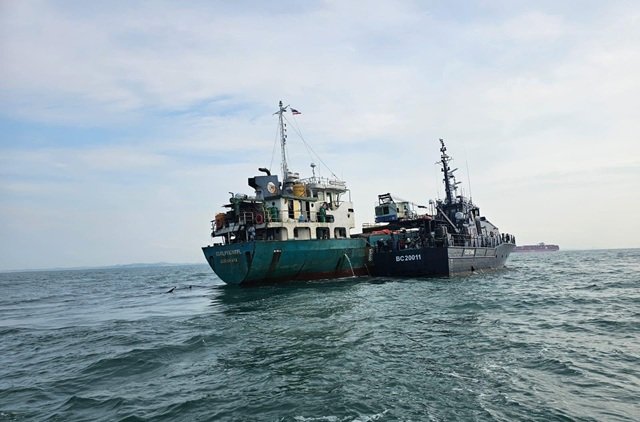
A disturbing maritime incident in Southeast Asia has suddenly placed Bangladesh under an uncomfortable international spotlight. On 7 November 2026, the Indonesian Navy intercepted the Comoros-flagged cargo vessel MV Star Line in the waters off Belawan, North Sumatra.
Its declared voyage was from China’s Lianyungang Port to Bangladesh’s Mongla Port. What Indonesian naval personnel subsequently discovered was extraordinary: 405 tonnes of sodium perchlorate, distributed across 15 containers, alongside millions of blank 4G LTE SIM cards carried on 54 pallets.
The Indonesian Navy publicly disclosed the seizure on 20 November 2026. The vessel had reportedly attracted attention through suspicious movements detected by the Seavision maritime surveillance system. Its registration status was suspended, while irregularities in its documentation raised further concerns. The ship was subsequently detained for investigation.
This is no ordinary shipping irregularity. It is a national security question demanding immediate answers.
Sodium perchlorate is a powerful oxidising chemical with legitimate industrial and laboratory applications. It also has specialised uses in rocket-propellant production and certain explosive formulations. Crucially, it is not itself a missile or an explosive. Its potential military applications, however, make the transportation of such an enormous quantity a matter of legitimate security concern.
According to Indonesian naval assessments, the seized consignment could potentially support the manufacture of materials for as many as 100 missiles. That estimate should be treated as a preliminary military assessment, not an independently established production calculation. Nevertheless, the scale of the shipment demands scrutiny.
The central question is unavoidable: why was such a strategically sensitive chemical being transported to Bangladesh in this quantity?
Bangladesh has legitimate industrial requirements for specialised chemicals. Sodium perchlorate may have lawful industrial applications, and its presence aboard a commercial vessel does not automatically establish military intent. Yet the government must explain whether the consignment corresponded to any verified industrial demand, who authorised its importation, who financed the transaction and who was named as its ultimate recipient.
The accompanying discovery of millions of blank 4G LTE SIM cards makes the mystery even more compelling. Telecommunications equipment is not inherently suspicious. Blank SIM cards have legitimate commercial uses. But their simultaneous transportation alongside a massive consignment of strategically sensitive chemicals raises questions about ownership, customs declarations, regulatory compliance and the relationship, if any, between the two shipments.
Were these unrelated commercial consignments? Was Bangladesh merely the declared destination? Could the country have been considered a transit point for onward transportation elsewhere in the region? These are legitimate investigative questions—not conclusions that can responsibly be drawn before the evidence is established.
Equally troubling is the nearly two-week interval between the interception on 7 November and the public disclosure on 20 November. Indonesian authorities have not established publicly why this interval occurred.
An investigation involving hazardous chemicals, questionable registration and potentially sensitive cargo understandably require operational discretion. Nevertheless, transparency about the timeline and the subsequent investigation is essential.
The historical record offers sobering lessons. In May 1988, the PEPCON disaster in Henderson, Nevada, involving approximately 4,500 tonnes of ammonium perchlorate, killed two people and injured more than 300.
In April 2025, a catastrophic explosion at Iran’s Bandar Abbas port killed and injured hundreds. Investigations and expert assessments raised questions about improperly documented and stored hazardous chemicals, including possible perchlorate involvement. These incidents are not chemically or operationally identical to the present shipment, but they demonstrate the potentially devastating consequences of inadequate oversight.
For Bangladesh, the implications extend beyond customs and commercial regulation. The Bay of Bengal occupies an increasingly consequential position in Indo-Pacific geopolitics. Mongla is an important maritime gateway. Any attempt to exploit Bangladeshi ports, shipping networks or commercial channels for undisclosed strategic purposes could expose the country to diplomatic complications, international suspicion and serious security vulnerabilities.
Bangladesh must never become an unwitting instrument in somebody else’s geopolitical calculations.
The government must immediately establish an independent, transparent investigation involving the National Board of Revenue, Bangladesh Customs, the Department of Explosives, the Ministry of Shipping, intelligence agencies and relevant maritime authorities. The Import General Manifest, bills of lading, certificates of origin, hazardous-cargo declarations, insurance records, financial transactions and ultimate beneficial ownership must be examined.
Investigators must establish the identity of the importer, consignee, shipping agents and intended end-users. They must also determine whether the SIM cards and chemical consignments shared any commercial ownership or operational connection.
China, too, should be requested through appropriate diplomatic channels to clarify the identity of the exporter, the declared purpose of the shipment and the commercial parties involved.
Above all, the Indonesian investigation must be respected and its findings obtained through formal cooperation. The Seavision detection, the vessel’s suspicious movements and the reported irregularities in its registration deserve serious attention.
But national security concerns must not be buried beneath bureaucratic silence.
The most important question is not simply what was aboard the MV Star Line. It is who was expecting it in Bangladesh, who stood behind the transaction and what purpose this extraordinary consignment was intended to serve.
A sovereign nation cannot afford to remain ignorant of what enters its ports in its name.
Bangladesh must demand the truth. Its sovereignty, maritime security and international credibility are not commodities to be negotiated in the shadows.