


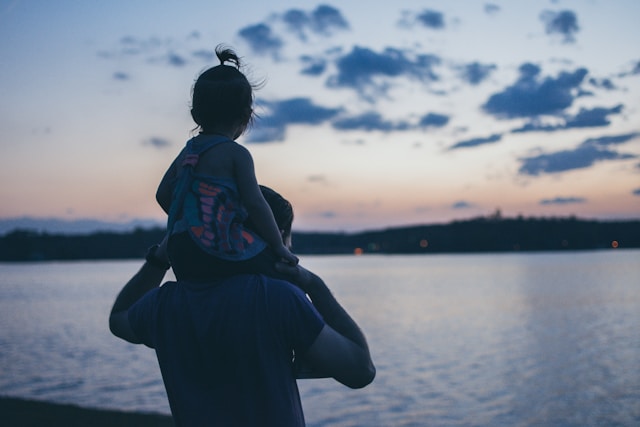
In the hush of memory, when the world pauses to remember, may every father find peace in knowing: he was, and is, deeply loved.
Father’s Day falls on 15th June each year.
There are moments in life when time does not flow—it stands, gazing at us in silent testimony to what was once said, or left unsaid. Father’s Day is one such moment. Not a celebration alone, but a reckoning. A quiet summoning of memory that, like incense in a still room, fills the soul with both fragrance and ache.
A father does not speak of love in declarations. He speaks through silence, through the soft gesture of placing his hand on your shoulder when your world is falling apart; through the long, wordless stare he casts as you walk away into adulthood; through the restraint in his voice when he wants to say “I’m proud” but knows not how. His language is coded in the quiet agony of self-sacrifice. It is in the empty chair at dinner when he works late, the shoes he does not buy so you can wear yours, the dreams he shelves so you can chase yours.
As I write this, I think of the many fathers whose hearts have carried the weight of guilt, not for what they did, but for what they could not do. For the afternoons missed at school plays, for the harsh word uttered in a moment of exhaustion, for the tear they never dried, not because they didn’t care, but because they thought they were showing strength.
The greatest tragedy of fatherhood is that it often reveals itself only in hindsight. The son grows into a man, and only then does he see. He sees the deep furrows on his father’s brow not as signs of aging but of sacrifice; he hears the worn leather belt unbuckling after a long day, no longer as a sound of authority, but of exhaustion; he remembers the unopened letters in the drawer—letters of rejection, debt, unanswered appeals—testaments to quiet battles waged alone.
And what of the father? His is a journey filled not just with protection, but with pain. Beneath the surface of his stoicism is a landscape of wounds—disappointments in himself, moments where he faltered in his duty, words he regrets, love he struggled to express. He watches his children rise, succeed, and soar—but carries a private sadness that they never truly saw him. That in their freedom was his disappearance.
The French philosopher Simone Weil once wrote, “To love purely is to consent to distance, it is to adore the distance between ourselves and that which we love.” This is perhaps the truest reflection of a father’s heart. He stands apart, not because he wishes to, but because he must. In that distance lies protection, provision, and pride. But in that same space dwells loneliness too.
There is a haunting beauty in the assertion: “Mother is the moon.” It is the mother’s love that often graces poetry and song, captured in metaphor, deified in lore. But what of the father? In the soft glow of maternal tenderness, the father is often cast as a shadow—present, yet seldom illumined. And yet, if we are to look deeper, we will see that he, too, is a celestial force — perhaps not the moon, but the steadfast sun, silver in heat and tempered in light.
In this deeply poignant reflection, the father could say, “If my wife were the moon, then I, in my silence, became the silver sun that warmed your world.” It was through the moonlight of the mother that the child’s world was made radiant, but it was through the invisible burden of the father’s sorrow—unvoiced, unwritten—that the child was protected. The pain he bore was not cried out but absorbed into the sinews of his being, and through that pain, poems of paternal love were born, though rarely sung aloud.
He confesses, almost with sacred hesitation: “The blood that runs in your veins is not mine, my son. You were not carried in my womb.” And yet, that admission does not diminish the magnitude of his love. Indeed, it heightens it. For the love he bears is not tethered to biology. It was not inherited — it was chosen. The burden of life you carry, he would tell the son, was never yours alone; it pressed upon him, invisibly, inexorably. Love for a child, he would proclaim, rises higher than the Himalayas when it is rooted not in the body, but in the soul.
Fathers, unlike mothers, are rarely sanctified as givers of life in the spiritual sense. And so he would ask, not in bitterness but in yearning: “Is a father’s love not known, not seen? Are only mothers destined to become Buddhas reborn?”
This question, gentle yet piercing, invites us to reflect on the invisibility of paternal affection. It is rarely articulated in the language of nurturance, and even more rarely recognized as divine. But in its quiet power — in the sacrifices made without witness, in the patience endured without reward — it is no less sacred. A father’s love is often uncelebrated, yet it is enduring. It does not seek recognition. It seeks only to endure in the lives of his sons, to give them the freedom to forget the cost of their liberation.
And perhaps that is the most generous act of love — to carry the burden so that the son may run free, to remain unremembered so that the son may live unburdened.
In the end, he would not plead for gratitude. He would merely speak, gently and with the quiet authority of truth: “You did not come from me, but you came to me. And that is enough.”
Thus, in the tapestry of human affection, the father’s thread is not always golden, but it is strong, often the very weave that keeps the fabric from fraying.
Father’s Day is not only a day of gratitude. It is a day of redemption. For sons and daughters to recognize that the man who stood behind them in every photograph was often the one most out of focus, yet most integral to the frame. And for fathers, it is a day not just to be thanked, but to forgive themselves for the harsh words, the absences, the misjudged silences, and the impossible expectations they held over their heads.
Let the children remember, then, this Father’s Day—not just the stoic protector or the provider—but the tender, flawed human being who loved them through the bruises of his becoming. The man who wept in secret when we left home; the man who sat up in fear when our phone call came late; the man who still, in the twilight of his years, watches the road hoping to see them return.
In the final analysis, the poetry of fatherhood lies not in its grand gestures but in its quiet failures and steadfast presence. It is not the heroic, but the human, that we must now honor. It is the father, not of perfection, but of persistence.
May this Father’s Day be not just a card or a phone call, but a whispered benediction over all the broken and beautiful parts of fatherhood. May it be a moment when the son sees the father not as a shadow in the past, but as the light that made all paths possible.
And to the fathers who live with regret in their hearts: your love was always enough. Your sins were never greater than your sacrifices.











