by Eric
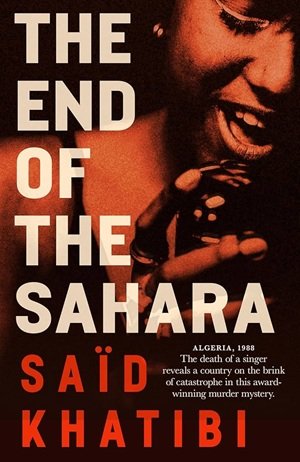
Saïd Khatibi’s The End of the Sahara confronts readers with a world of moral ambiguity, social collapse, and personal despair, set against the backdrop of Algeria at the precipice of historical and political upheaval. From the outset, Khatibi signals a narrative preoccupied with both individual and collective memory, framing the Sahara Hotel as a microcosm of a nation “on the verge of collapse” (p. 10), a locus where “people from all over the country, rich and poor, come together” (p. 10). The novel’s narrative strategy is immediately destabilizing: the protagonist’s consciousness is a torrent of observation, reflection, and moral reckoning, wherein the quotidian—shortages of coffee, the peddler’s shouts (p. 12)—intersects with larger questions of justice, memory, and social decay. This oscillation between the intimate and the political underscores a central tension: the individual is embedded in a system whose collapse seems both inevitable and cyclical, as Khatibi remarks, “It was as if this country’s history just repeats itself rather than moving forward in a linear fashion” (p. 225).
Khatibi’s prose is deliberately colloquial yet morally incisive, capturing the protagonist’s internalized contradictions. He is both intimate and acerbic, aware of the hypocrisy and brutality surrounding him. Early reflections on his upbringing illustrate the pervasive control of patriarchal norms: “I was still shy around women, something drummed into me by my mother when I was young” (p. 16), or his mother’s injunction that “crying… isn’t something proper people do” (p. 22). These early experiences are compounded by societal violence and surveillance, forming a landscape where private desire, public morality, and coercive power intersect. The protagonist’s sardonic observation that “Names aren’t important in this place” (p. 12) gestures toward a depersonalised social environment, where individuals exist as both actors and witnesses to an ongoing, unrecorded cycle of suffering and oppression.
Central to the novel is the theme of gendered power and social control, which Khatibi interrogates with both narrative empathy and structural critique. Women are depicted as simultaneously constrained and weaponized within patriarchal hierarchies: “All a woman has is her husband or her grave” (p. 163), “A woman with too much freedom has never been happy” (p. 44), and “Even if forced to do something against her will, every girl bears the sin alone” (p. 212). These statements are neither incidental nor rhetorical: they are embedded in the social fabric Khatibi seeks to illuminate, in which systemic misogyny is reinforced through religious, familial, and legal structures. Yet the novel also gestures toward resistance and survival, suggesting that constrained agency may be transformed into cultural resilience: “They have lost their freedom, but they have freed up their language” (p. 91). Here, Khatibi seems to suggest that linguistic and narrative expression functions as a form of emancipation in a society otherwise suffused with coercion.
The novel’s exploration of violence—both structural and personal—is unflinching and morally complex. Crimes are seldom singular or exceptional: “Experience has taught me that no crime is an isolated event. One is always followed by another one like it” (p. 23). Revenge, betrayal, and complicity thread the narrative, culminating in passages such as the protagonist’s admission that “I was not alone in silencing Zakia’s voice… her brothers, who disowned her, took part with us… Ibrahim… planted a desire in my heart to take revenge against her” (p. 249). This conflation of personal and societal violence illustrates Khatibi’s insistence on the inextricability of the moral from the political: the failures and complicities of individuals are inseparable from the structures that shape them, a point reinforced when the protagonist observes, “There is no justice or law there, only blood revenge and retaliation” (p. 241). The moral universe of the novel is thus relentlessly mediated by historical and political context, as the collapse of socialism, the rise of Islamism, and the onset of civil war form a continuous backdrop (p. 10).
Memory and historical consciousness are intricately intertwined in Khatibi’s critique of Algeria’s political and cultural amnesia. The novel positions forgetting as both a survival strategy and a collective moral failing: “This is a novel… about the silences of a country we rarely see and recounts the crime of forgetting that we all are prone to commit” (p. 10). Individuals, like the protagonist, navigate layers of remembrance and erasure, attempting to reconcile personal loss with the broader sweep of political failure: “People who write in diaries imagine themselves important, but my life is of interest to no one but myself. My life is a garden of losses” (p. 251). In this sense, Khatibi’s work is both historiographic and philosophical, exploring how societies reconcile—or fail to reconcile—trauma and the erasure of collective memory, emphasizing the ethical imperative to bear witness.
Khatibi’s treatment of morality and culpability is provocatively ambiguous, avoiding simplistic binaries of good and evil. The protagonist is self-aware in his failures and complicit in harm, acknowledging “I am accused of killing her, and angry at myself for having known and loved her” (p. 252). Similarly, he recognises cowardice and moral compromise as enduring features of his existence: “I’ve lived as a coward,” he confesses (p. 237). This confessional mode is coupled with an acute understanding of structural and interpersonal power: “Whoever lacks dignity isn’t a man” (p. 245), linking ethical integrity to social recognition. Khatibi’s narrative thus refuses catharsis in favour of a sustained interrogation of responsibility, demonstrating that personal and collective morality are inseparably entwined in the dynamics of historical violence.
The novel’s stylistic choices reinforce its thematic complexity. Khatibi frequently employs a fragmented, episodic structure, reflecting both the instability of his protagonist’s world and the layered histories of Algeria itself. Episodes of domestic tension, sexual exploration, bureaucratic observation, and violent confrontation co-exist in a rhythm that mirrors the unpredictability of political and social collapse. Humour and irony are deployed alongside horror, creating a tonal interplay that reinforces the novel’s moral complexity. The protagonist’s sardonic reactions—“We’re out of coffee?! ‘Go drink some poison!’” (p. 12)—juxtapose the absurdity of domestic life with the larger absurdities of social and political disintegration, creating a narrative that is simultaneously intimate and panoramic.
Khatibi’s philosophical engagement with fate, desire, and the human condition further distinguishes the work. Love is consistently depicted as partial, contingent, and fraught with loss: “I have always believed that the most beautiful love is incomplete. The most beautiful part of love is our desire, and if we end up finding our beloved, desire dies” (p. 251). Similarly, the novel interrogates human agency within constraints imposed by social, political, and historical forces, suggesting that survival and moral integrity often require negotiation with injustice: “Friend, be patient and forbearing about what has happened to you. Lie down naked on thorns ’til your day dawns anew” (p. 195). Khatibi’s work is thus as much a meditation on the ethics of living under conditions of structural and moral precarity as it is a historical or political narrative.
The End of the Sahara offers a rigorous, ethically charged, and stylistically ambitious exploration of Algeria at a moment of radical transformation. Khatibi interrogates the entanglement of patriarchy, political collapse, and personal morality with an unflinching eye, crafting a narrative that is as morally ambiguous as it is socially and politically insightful. Through the protagonist’s intimate observations and confessional voice, the novel illuminates the ethical and emotional stakes of living under conditions of historical erasure and systemic violence. Khatibi’s narrative is neither nostalgic nor didactic; it is a sustained meditation on memory, justice, and human desire, demanding that readers grapple with both the intimate and structural dimensions of moral and political life. The novel’s insistence on ambiguity, complexity, and witness challenges the reader to confront uncomfortable truths about both individual responsibility and collective failure, marking it as a singular contribution to contemporary Algerian literature.