According to the latest official data available, as on April 1, 2025, the Armed Forces (Special Powers) Act (AFSPA) was in force in 194 Police Stations in 37 districts across four states – Assam, Arunachal Pradesh, Manipur and Nagaland – in India’s northeast region, which comprises of eight states. The eight states include Arunachal Pradesh, Assam, Manipur, Meghalaya, Mizoram, Nagaland, Sikkim and Tripura.
AFSPA for the North-Eastern states was passed in 1958 and was initially implemented in Assam and Manipur and, after amendment in 1972, extended to Meghalaya, Nagaland, Tripura and Arunachal Pradesh. As insurgencies peaked in the region, it was implemented across almost the entire territories of these six states.
Later, due to the continuous improvement in the security situation in these six states, the Government started withdrawing AFSPA from several areas. AFSPA was completely withdrawn from Tripura in May 2015, and from Meghalaya in March 2018.
Over the years, AFSPA’s removal/imposition/extension has been related to patterns of violent and insurgency-related incidents in the region. According to partial data compiled by the South Asia Terrorism Portal (SATP), at the peak of insurgency in the year 2000, India’s northeast recorded 1,696 fatalities [946 civilians, 151 Security Force (SF) personnel, and 599 terrorists]. Fatalities fell to their lowest at 21 (12 civilians, two SF personnel and seven terrorists) in 2022, but recorded an abrupt spurt in 2023, at 174 (71 civilians, 18 SF personnel, 84 terrorists and one Not Specified) primarily because of the ethnic violence in Manipur. The number of fatalities came down to 95 (53 civilians, six SF personnel, and 36 terrorists) in 2024, as the security situation improved in Manipur. Total fatalities in the region stand at 26 (one civilian and 25 terrorists) in the current year, so far (data till April 6, 2025).
Meanwhile, as per the latest notification dated March 30, 2025, three districts – Tinsukia, Charaideo and Sivasagar – of Assam remained under AFSPA. AFSPA had been in force in four districts of Assam under the previous notification of October 8, 2024. Earlier, on March 31, 2022, the ‘disturbed area’ notification had been completely removed from 23 districts out of the total of 33 districts in the State.
In Assam, four insurgency-related fatalities were recorded in 2024, as compared to eight in 2023. No fatality has been recorded in the state in the current year thus far (April 6, 2025). At its peak, Assam had recorded 783 fatalities in 1998. However, the state continues to face a multiplicity of security challenges, including the stubborn refusal of the Independent faction of the United Liberation Front of Asom (ULFA-I) to participate in any peace negotiations with the Government and its increasing activities to expand its networks. Adding to the potential threat are the exertions of Islamist radical groups operating out of both Pakistani and Bangladeshi soil, including Jaish-e-Mohammed (JeM) and Ansar-al-Islam (AaI)/Ansarullah Bangla Team (ABT), as well as global Islamist groups such as the Islamic State (IS) and Al-Qaeda, which are trying to establish a foothold in the state. The marginal spillover of the insurgencies in the neighbouring north-eastern states, particularly problems connected with the activities of National Socialist Council of Nagaland (NSCN) and its factions compound the security challenges. The terrorist groups active in the State and across its borders include ULFA-I, Kamatapur Liberation Organisation (KLO), KLO-Koch Nationalism (KLO-KN) and various factions of NSCN.
In Arunachal Pradesh, as per the notification dated March 30, 2025, Tirap, Changlang and Longding districts and the areas falling within the jurisdiction of Namsai, Mahadevpur and Chowkham Police Stations in Namsai District, bordering the State of Assam, have been declared ‘disturbed areas’ and remained under AFSPA. This represents no change from the earlier notifications.
A single fatality was recorded in Arunachal Pradesh in 2024, when a cadre of the Yung Aung faction of the NSCN-Khaplang (NSCN-K-YA), identified as ‘major’ Gangjun Gangsa, was killed in a clash with the Assam Rifles in Longding District, on October 25. Arunachal recorded five fatalities (one civilian, one SF trooper and three terrorists) in 2023. A high of 41 fatalities (all terrorists) was recorded in 2011.
The ‘overflow’ of insurgency in three districts, Tirap, Changlang, and Longding (TCL), located along the Indo-Myanmar border, primarily from Assam, Nagaland and Manipur, remains a concern in Arunachal Pradesh. TCL continues to be used as a transit route by various militant groups, whose camps are situated in the Sagaing Region of Myanmar. NSCN-K-YA remains violently active in the state through its abduction and extortion campaigns. The operation of various NSCN factions is the result of Naga Nationalism in the Naga-inhabited areas of the state. Significantly, on January 27, 2024, the Eastern Naga National Government merged with NSCN-IM, aligning to support and motivate the people in the TCL region to engage in the ongoing Naga national movement. In addition, the state witnessed the emergence of a new insurgent outfit, the United Tani Army, at the end of 2024.
On March 30, 2025, the Central Government declared eight districts and 21 Police Stations in five districts of the State of Nagaland as ‘disturbed areas’ for a period of six months, with effect from April 1, 2025. This represented no change from the earlier notifications. However, on April 1, 2025, Nagaland’s Meluri District (which was carved out from Nagaland’s Phek District in November 2024) was also declared a ‘disturbed area’ and was brought under the purview of AFSPA.
The overall situation in Nagaland has improved considerably, with just three (one civilian and two militants) insurgent-linked fatalities recorded in three incidents in 2024. Similarly, three insurgency-linked fatalities were recorded in 2023 (all terrorists). However, the Isak-Muivah faction of NSCN (NSCN-IM) remains active in the state. The outfit has been in negotiation or peace talks with the Government of India for 27, years since 1997. Although the 2015 Framework Agreement between the two parties was a historic step in the ongoing peace talks, lack of its implementation led to increasing resentment and a change in the stand of NSCN-IM. On November 8, 2024, NSCN-IM sought third-party intervention to address the deadlock over the Naga political issue and delivered an ultimatum to the Union Government, threatening to “resume the violent armed resistance against India” if the Centre did not “honour” the 2015 Framework Agreement. Recently, on March 21, 2025, NSCN-IM ‘chairman’ Q Tuccu, stated that the NSCN was not responsible for the delay in the Naga political solution, asserting that the Government of India was to be blamed.
Meanwhile, in Manipur AFSPA was imposed in additional six Police Stations (Sekmai, Lamsang, Lamlai, Jiribam Leimakhong, and Moirang) in five districts (Imphal West, Imphal East, Jiribam, Kangpokpi and Bishnupur), according to a notice dated November 14, 2024. UMHA observed,
The Situation continues to remain volatile amidst ongoing ethnic violence in Manipur and intermittent firing in violence-prone areas continues in the fringe areas of Bishnupur-Churachandpur, Imphal East Kangpokpi-Imphal West and Jiribam districts with several instances of active participation of insurgent groups in heinous acts of violence.
Indeed, on March 30, 2025, the Government declared the entire area of the state excluding the areas falling under the jurisdiction of 13 Police Stations of five districts, as ‘disturbed areas’, for a period of six months with effect from April 1. According to the March 31, 2022, notification, AFSPA was removed from 15 police station areas in six districts. After removal from these areas, the ‘disturbed areas’ notification will remain in force in 82 police stations in 16 districts out of 97 police stations in 16 districts in the state.
The wave of violence between the two ethnic communities (Meitei and Kuki-Zo) in Manipur in 2023, triggered the resurgence of insurgent activities in the state. In its Annual Report 2023-2024, UMHA emphasised that Manipur accounted for about 77 per cent of the total violent incidents in the entire northeastern region in 2023, and had emerged as the epicentre of violence in the region. After nearly two years since the violence broke out on May 3, 2023, the state was placed under President’s Rule under Article 356 of the Indian Constitution by the Proclamation of the President of India on February 13, 2025. This was announced after former Chief Minister N. Biren Singh resigned on February 9, 2025, after failing to initiate a political dialogue between the warring communities.
Since then, 226 militants/ associates have been arrested, and 97 incidents of arms recoveries have been recorded between February 13 and April 6, 2025. In the corresponding period of 2024, 41 militants/ associates were arrested, and 39 incidents of arms recoveries were recorded. Altogether, out of 353 militants arrested in the entire Northeast region in the current year, 307 were from Manipur.
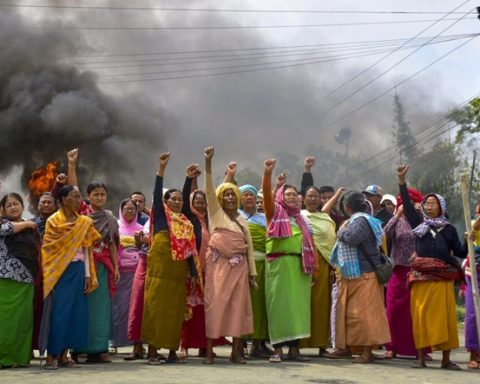
The violence has divided the warring communities, with buffer zones between the Valley and the Hill districts of Manipur. To break the chain of violence, in a high-level meeting on the security situation in Manipur, Union Home Minister (UHM) Amit Shah, on March 1, 2025, directed the SFs to ensure the free movement of all citizens on all roads from March 8. The Kuki-Zo groups, who have long demanded a ‘Separate Administration’ as a fallout of the crisis, protested against this directive. As a result, on March 8, one protester succumbed to injuries, and another 43 persons, including 27 SF personnel, were injured due to heavy stone pelting, catapult attacks, and gunfire, in the mob violence at Gamgiphai in Kangpokpi District. The incidents occurred when a Manipur State Transport (MST) bus, travelling along the Imphal-Kangpokpi-Senapati route as part of UHM Amit Shah’s ‘free movement’ directive, came under attack. Two SF vehicles were also set ablaze by the irate mob.
In 2024, the state saw drastic changes in the activities of militants with significant implications for the ethnic strife, as SAIR noted earlier. One such change was the increasing use of drones for targeted killings, with four such drone incidents reported. Rivalry among different insurgent outfits, significantly between NSCN-IM and the Zeliangrong United Front (ZUF), also came to the fore. At least four incidents of violence involving the two outfits were recorded, as well as one between NSCN-IM and KNA-B.
The situation in Meghalaya remained peaceful, as the state has not recorded any insurgency-linked fatalities since September 14, 2021, when Robison R. Marak, an over ground worker (OGW) of two outfits – the United Achik Liberation Army (UALA) and the A’chik Songna An’pachakgipa Kotok (ASAK) – was killed in an encounter near Sherwood School on the outskirts of Tura in the West Garo Hills District of Meghalaya.
The Hynniewtrep National Liberation Council (HNLC) is the only active insurgent group in the State and has been responsible for six of the 21 Improvised Explosive Device (IED) blasts that occurred in Meghalaya between 2017 and 2024. The last explosion that HNLC claimed responsibility for took place,on March 9, 2024, at the Shillong City Bus Syndicate near the Harijan Colony in Them Lew Mawlong in East Khasi Hills District. Following the blast, on April 4, 2024, Meghalaya Deputy Chief Minister Prestone Tynsong asserted that the door was still open for HNLC to engage in peace talks with the state government. Further, on November 14, 2024, the Union Ministry of Home Affairs (UMHA) declared HNLC a banned organisation for five years due to its involvement in violent activities and actions that threatened India’s sovereignty and integrity. More recently, it was reported in February 2025, that the outfit is making renewed efforts to recruit vulnerable youth through online radicalisation tactics.
Tripura has gained an “insurgent-free or zero insurgency” status with the signing of a peace agreement, the Memorandum of Settlement (MoS), on September 4, 2024, between the Government of India (GoI), the Government of Tripura, the National Liberation Front of Tripura (NLFT) and the All Tripura Tiger Force (ATTF), in the presence of the Union Home Minister (UHM) Amit Shah, at North Block, in New Delhi. According to official figures, between September 24, 2024, and December 11, 2024, a total of 902 cadres of NLFT, ATTF and other groups abjured violence and joined the mainstream of society. Despite this, Tripura is facing a crisis along its border with Bangladesh. According to an official release by the Border Security Force (BSF) on December 1, 2024, a total of 675 illegal immigrants, including 55 Rohingyas, 620 Bangladeshi nationals and 260 Indian nationals, were apprehended by BSF between January 1 and November 30, 2024.
Mizoram has not recorded any insurgency-related violence since 2016. However, the state is troubled by rising weapons and explosives smuggling. Earlier, SAIR noted that Mizoram remains a significant hub for arms, ammunition, and explosives trafficking, largely due to its porous border with Myanmar. According to the SATP database, the state has already recorded seven incidents of arms and ammunition recoveries in 2025 (data till April 6, 2025), while there were 16 such incidents in 2024, 11 in 2023, and 13 in 2022. As reported on March 5, 2025, there were 13 explosives seizures in the state in 2024, aggregating over 2,000 kilograms of explosives, at least 60,000 detonators, and 13,000 gelatine sticks. The long-running boundary dispute between Assam and Mizoram is another concern. However, on August 9, 2024, Mizoram and Assam agreed to continue to promote and maintain peace along the inter-state border as part of the efforts to resolve their decades-long boundary dispute.
Apart from the unique problems of each of the states affected by insurgency, the Northeast region is influenced by the unstable geopolitical milieu of the neighbouring countries, especially Bangladesh and Myanmar. As reported on April 1, 2025, Bangladesh Interim Government Chief Adviser Muhammad Yunus stated that Northeast India is “landlocked”, and Dhaka is the “only guardian of the ocean for all this region” and outlined the objective of economic expansion in partnership with China during his visit to Beijing. However, Assam Chief Minister (CM) Himanta Biswa Sarma condemned the Chief Adviser’s statement as offensive and criticized on the “persistent vulnerability narrative” regarding the Chicken’s Neck corridor, which connects the Northeast with other parts of India.
After the February 1, 2021, coup d’état by Tatmadaw (the Myanmar military) in Myanmar, more than 30,000 refugees (mostly from the Chin ethnic group) have taken shelter in Mizoram, raising concerns. Chief Minister (CM) Lalduhoma, observed, on March 10, 2025, “The people of the State should be wary of the law and order that could arise (sic) from the humanitarian obligations of addressing the needs of our Chin brothers.”
There are divergent responses from the various sections of society in Mizoram, including its civil society organisations, on the Government’s handling of the border crisis. Activist V.L. Thlamuanpuia maintained that the unchecked entry of refugees disturbed the state’s demography, and increased cross-border crimes such as human trafficking, drug smuggling and illegal trade of explosives.
The Northeast region represents one of the country’s most volatile zones, characterised by a protracted history of insurgency. This instability is linked to the aspirations of diverse ethnic groups in the regions, issues of ethnic conflicts/violence, cross-border infiltration, etc., which have exacerbated the region’s security challenges. Over the decades, many insurgencies have been substantially contained, and multiple peace agreements are in place. Nevertheless, secessionist movements and demands for ethnic homelands have not subsided. As a result, several insurgencies linger on, even as the spectre of revival of others is never entirely purged. These unresolved issues continue to complicate the central government’s policy framework and strategic approach to the Northeast, even as the region faces emergent threats, including renewed cross-border challenges and aggravation in a multitude of internal issues, creating significant obstacles to sustainable peace and governance.