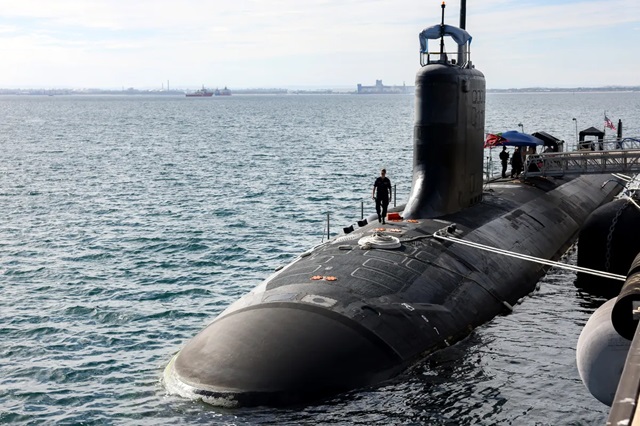
China’s Victory Day parade in September offered a striking message to Washington: a sleek, uncrewed submarine roughly the size of a semi-truck rolled through Tiananmen Square, symbolizing Beijing’s ambitions to dominate the world’s oceans. Designed to monitor U.S. vessels and undersea cables, the new platform underscored how aggressively China is investing in the undersea domain — at a time when America’s own submarine industry is mired in crisis.
According to a Bloomberg investigation, the U.S. Navy’s submarine program — long considered the backbone of America’s deterrence and stealth operations — is facing years of costly delays, shrinking industrial capacity, and an acute shortage of skilled workers. Factories that once fueled Cold War production lines are now struggling to keep pace as the Pentagon scrambles to revive a faltering defense manufacturing base.
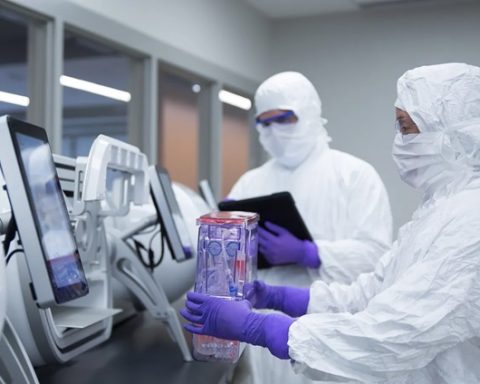
At the heart of the effort are people like William Kaisen, a 39-year-old Marine Corps veteran who spent months this year at a Navy training center in southern Virginia mastering computer-directed machining. He is one of hundreds enrolled in the Accelerated Training in Defense Manufacturing (ATDM) program, an initiative designed to replenish an industry short on welders, machinists, and technicians. Their mission is visible on a mural looming over the 100,000-square-foot facility — a U.S. attack submarine, the very fleet the Navy is desperate to rebuild.
“We made a conscious decision to downsize because of the, quote, peace dividend from the Cold War,” said retired Admiral James Foggo, who commanded the USS Oklahoma City. “Well, guess what? It didn’t work out well.”
Since 2000, the U.S. submarine fleet has stagnated at low numbers. Nearly a third of all attack submarines now require maintenance, according to Navy data cited by Bloomberg. Of 49 attack submarines, only 33 are fully functional, while 16 are under repair — often for years. The USS Boise, for instance, has sat idle since 2015 awaiting a maintenance slot and will not return to service before 2029, after repairs costing more than $1.2 billion.
Secretary of the Navy John Phelan warned lawmakers in May that the delays have left the fleet “in a precarious position.” His office declined multiple requests for comment.
The scale of the crisis is sobering. One Los Angeles-class attack submarine has been in maintenance for a decade. The first of the new Columbia-class ballistic missile submarines — the USS District of Columbia — is two years behind schedule and projected to cost over $16 billion, while next-generation Virginia-class submarines face delays of up to three years. Both programs form the centerpiece of America’s undersea nuclear deterrent and conventional warfighting capability.
The Columbia-class boats are designed to replace the aging Ohio-class fleet and form the most survivable leg of the U.S. nuclear triad, carrying Trident ballistic missiles with ranges exceeding 7,000 miles. But as Bloomberg reported, the first vessel’s delivery has slipped from October 2027 to as late as March 2029, with costs up 12% since 2021 due to inflation, material shortages, and shipyard inefficiencies. The Government Accountability Office (GAO) says the total program cost has now ballooned past $126 billion, with some estimates nearing $140 billion.
Meanwhile, delays in producing Virginia-class submarines threaten U.S. commitments under the AUKUS pact, which involves supplying Australia with nuclear-powered submarines. The U.S. is supposed to sell three Virginia-class boats to Canberra and help develop its own fleet, but the production rate — currently stuck at about 1.2 submarines a year — falls far short of the Navy’s goal of two per year. Admiral Daryl Caudle, the newly confirmed Chief of Naval Operations, told Congress the Navy needs a “transformational improvement” to double output. “We need an all-hands-on-deck approach to get to 2.3 submarines per year,” he said.
The reasons behind the slowdown are deep-rooted. A GAO report in February 2025 described “particularly acute” workforce shortages, with shipyards losing up to 30% of their skilled labor force. The Navy’s own data show that the submarine industrial base must recruit 140,000 new workers over the next decade to meet demand. In response, hiring has surged by 200% since 2021, with the Navy and contractors such as General Dynamics Electric Boat and Huntington Ingalls Industries offering aggressive training and incentive programs.
Still, the shortage of experienced labor is taking a toll. “Manufacturing submarines is not easy,” said Kelly Grieco, a senior fellow at the Stimson Center in Washington. “There are supply chain bottlenecks everywhere, but the skilled workforce is one of the biggest limiting factors.” General Dynamics CEO Phebe Novakovic admitted on a recent earnings call that “materials and parts are late and sometimes exhibit quality escapes,” referring to defective components that slip through inspections.
Legacy shipyards and suppliers are also fading. The United States once had more than 70 shipyards capable of producing or maintaining submarines; today it relies on just two private construction yards and four government repair facilities. Many smaller suppliers are struggling to attract younger workers after the pandemic, with some going out of business altogether. “These legacy businesses can’t get new generations to sign on,” said Admiral Foggo. “They’ll struggle and go out of business.”
Congress and the White House have taken notice. The Trump administration earmarked $29 billion for shipyard upgrades, supplier support, and workforce development. The House-approved 2026 Defense Appropriations Act adds another $1.5 billion for wages and infrastructure improvements, while the Senate version allocates $8.7 billion, including $2.7 billion specifically for submarine production. The Navy has also partnered with BlueForge Alliance, a nonprofit that has spent $300 million on recruitment and training, including the website buildsubmarines.com, which connects job seekers to thousands of defense suppliers.
Despite this investment, Bloomberg Intelligence senior defense analyst Wayne Sanders cautioned that results will not appear overnight. “It’s probably going to take three to five years to actually see a movement of that needle,” he said.
For now, the U.S. still holds a technological edge. Its submarines remain quieter, stealthier, and more capable than their Chinese counterparts, maintaining what analysts call a five- to ten-year advantage. But the gap is narrowing. A 2024 Observer Research Foundation study estimated that the People’s Liberation Army Navy (PLAN) can produce between 4.5 and 6 nuclear-powered submarines annually. The U.S. Department of Defense expects China’s submarine fleet to grow to 80 vessels by 2035.
“The risk is clear,” said Collin Koh, senior fellow at the Institute of Defence and Strategic Studies in Singapore. “Production delays could erode America’s deterrent posture in the Indo-Pacific and embolden adversaries.”
As the geopolitical rivalry intensifies, the pressure to rebuild America’s undersea strength is mounting. Inside the Danville training facility in Virginia, Kaisen and his fellow graduates represent the human front line of that effort. After 16 grueling weeks of instruction, he’s preparing to begin work at a Navy contractor in North Carolina.
Addressing his class at graduation, Kaisen struck a note of determination that might resonate across the entire submarine fleet. “Let’s get to work,” he said. “I hear we’ve got some catching up to do.”